eSIM vs Pocket WiFi vs Local SIM: Which Should You Choose?

This article contains affiliate links. We may earn a commission if you make a purchase through our links, at no extra cost to you.
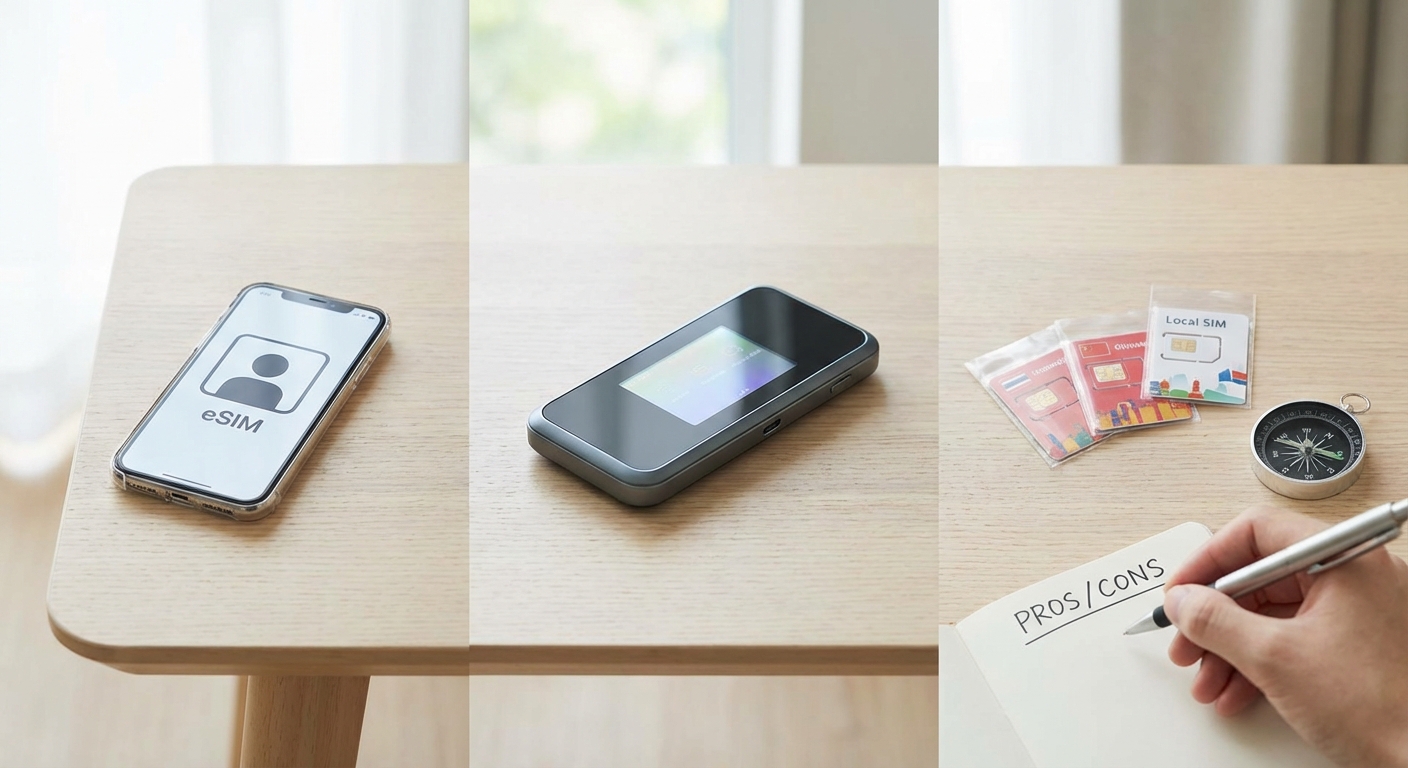
You're planning your next trip—or maybe your nomadic life—and you've hit the connectivity question. eSIM? Pocket WiFi? Local SIM cards? The advice online is contradictory, often outdated, and rarely accounts for how you actually travel.
I've spent three years testing all three approaches across 40+ countries. Here's what I've learned: there is no universally "best" option. The right choice depends on how you travel, how you work, and what trade-offs you're willing to accept.
This guide will help you make that decision. By the end, you'll know exactly which approach fits your situation—and you might discover that the answer involves more than one.
This article is part of our complete digital nomad connectivity guide, which covers everything from basic setup to bulletproof backup systems.
Quick Decision Framework
Before diving deep, answer these three questions:
Question 1: How often do you change countries?
- Multiple countries per month → eSIM wins
- One country for 1-3 months → Local SIM or eSIM
- Single country for 3+ months → Local SIM wins
Question 2: Do you need to connect multiple devices?
- Just your phone → eSIM or Local SIM
- Phone + laptop regularly → Pocket WiFi or eSIM with tethering
- 3+ devices or group travel → Pocket WiFi wins
Question 3: How critical is your connectivity?
- Nice to have → Cheapest option works
- Important for work → Reliable option with backup
- Mission-critical → Multiple redundant options
| Scenario | Best Primary Option | Runner-Up |
|---|---|---|
| Country hopper | eSIM | Pocket WiFi |
| Long-stay nomad | Local SIM | eSIM |
| Multi-device user | Pocket WiFi | eSIM with tethering |
| Budget priority | Local SIM | eSIM |
| Maximum convenience | eSIM | Pocket WiFi |
Still not sure? Read on for the full breakdown.
Deep Dive: eSIM
What It Is
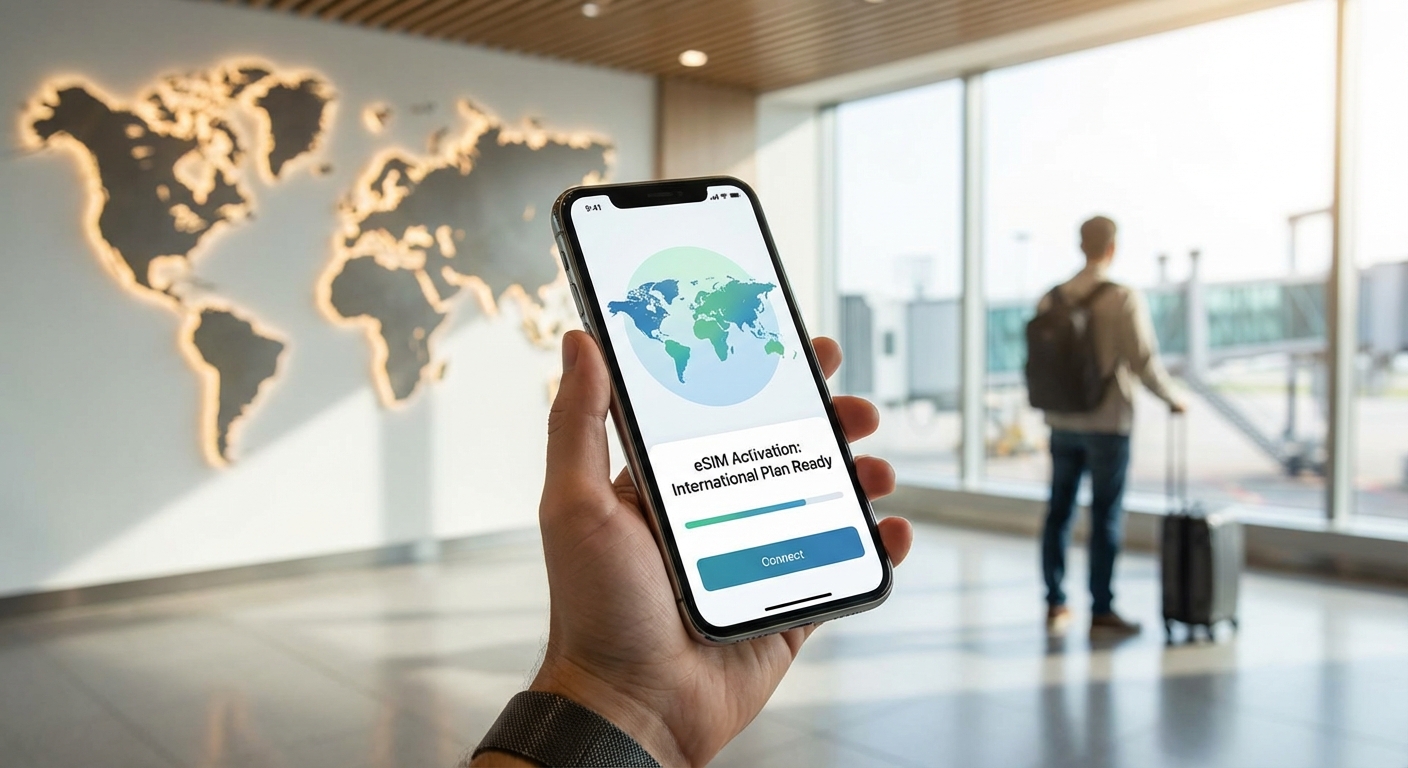
An eSIM is a digital SIM card embedded in your phone. Instead of swapping physical cards, you download a data plan through an app and activate it instantly—often before you even board your flight. Most smartphones from 2019 onward support eSIM alongside a physical SIM slot, giving you dual connectivity.
When eSIM Wins
Country hopping. Crossing borders every few weeks? eSIM eliminates the hassle of finding SIM shops, dealing with language barriers, and managing a collection of physical cards. Buy a new plan in two minutes from your phone.
Keeping your home number. Your physical SIM keeps working for calls and texts while eSIM handles data. No missed messages from back home.
Instant activation. Land in a new country, enable your pre-purchased eSIM, and you're connected before you leave the airport. No hunting for shops that might be closed.
Dual-SIM flexibility. Switch between plans instantly. Keep a backup eSIM ready for emergencies. Use different providers for different regions.
For specific provider recommendations, see my guide to the best eSIMs for digital nomads.
When eSIM Falls Short
Hotspot restrictions. Many eSIM providers limit or block tethering. If you need to connect your laptop through your phone, verify hotspot support before buying. For workarounds, check the eSIM hotspot tethering guide.
"Unlimited" isn't unlimited. Most unlimited eSIM plans throttle after 3-5GB daily usage. Heavy data users may find themselves slowed down at inconvenient moments.
Coverage varies. eSIM providers partner with local carriers, but quality differs dramatically. A plan that works perfectly in Portugal might be painfully slow in rural Vietnam.
Premium pricing. eSIM typically costs more per gigabyte than local SIMs, especially for smaller data packages.
Cost Range
- Budget plans: $1-3 per GB
- Regional packages: $30-60 for 30 days, 5-20GB
- Unlimited plans: $50-80 for 30 days with throttling
For a detailed cost analysis, see the eSIM vs roaming cost comparison.
Deep Dive: Pocket WiFi and Portable Hotspots
What It Is
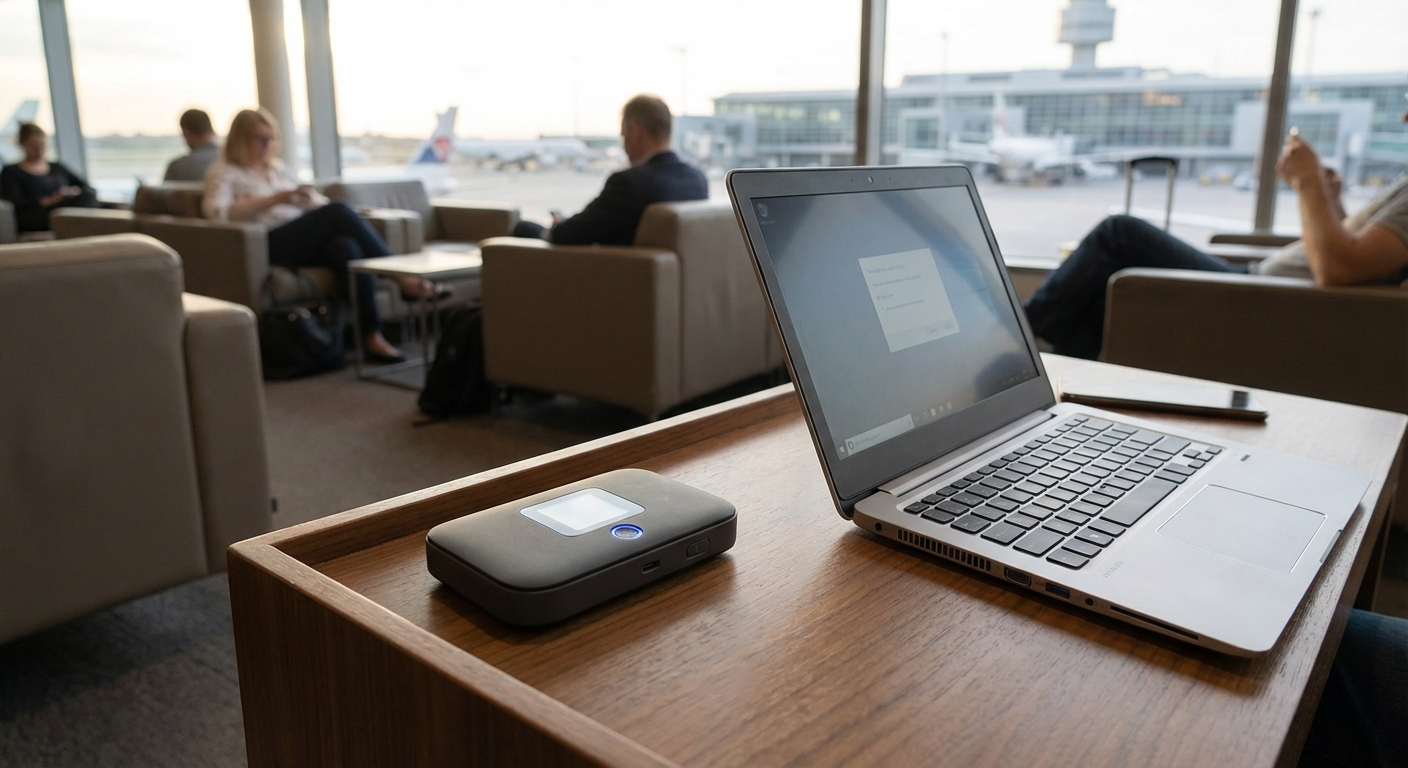
A portable WiFi hotspot is a battery-powered device that connects to cellular networks and broadcasts its own WiFi signal. You connect your phone, laptop, tablet—whatever needs internet—to this personal network.
When Pocket WiFi Wins
Multiple devices. Connecting 5-10 devices without draining your phone battery or worrying about tethering restrictions. Laptops, tablets, e-readers, smartwatches—all connected through one data plan.
Group travel. Traveling with a partner or small team? One hotspot covers everyone without buying separate plans.
Better signal. Dedicated hotspot devices often have stronger antennas than smartphones. In areas with weak coverage, they can maintain connection when phones struggle.
Phone independence. Your phone battery stays full. You can use your regular phone plan for calls without affecting data. If your phone dies, your laptop still has internet.
Work-critical reliability. Premium hotspots like the Netgear Nighthawk offer features smartphones can't match: external antenna ports, band locking, and carrier aggregation for maximum speed.
For device recommendations, see the best portable WiFi hotspots guide.
When Pocket WiFi Falls Short
Another device to manage. Charging, carrying, not losing it—pocket WiFi adds complexity to your daily routine. That's one more thing to pack, one more battery to monitor.
Upfront investment. Quality hotspots cost $150-700. You're committing money before you know if the device suits your travel style.
Data plans add up. The device is just the beginning. You'll need SIM cards or cloud SIM data plans, which can match or exceed eSIM costs.
Overkill for solo travelers. If you only need phone connectivity and occasional laptop tethering, a dedicated hotspot might be unnecessary weight and expense.
Cost Range
Equipment:
- Budget hotspots: $50-100
- Mid-range: $150-250
- Premium 5G devices: $400-700
Monthly data:
- Local SIM in device: $10-40 per month
- Cloud SIM services: $30-80 per month
- Global data plans: $50-150 per month
Deep Dive: Local SIM Cards
What It Is
The traditional approach: walk into a mobile shop, buy a physical SIM card from a local carrier, and insert it into your phone. You get a local phone number and access to the carrier's network directly.
When Local SIM Wins
Maximum data for minimum cost. Local SIMs almost always offer more data per dollar than eSIM or hotspot plans. In some countries, you can get "unlimited" data for under $20 monthly.
Extended stays. Spending 1-3 months in one country? A local SIM makes financial sense. The hassle of acquisition pays off over weeks of use.
Best network access. Local SIMs often get priority network access and full speed, while roaming agreements including some eSIMs may be deprioritized during congestion.
Local phone number. Some services require local numbers for verification. Booking local services, delivery apps, and ride-shares work better with local numbers.
When Local SIM Falls Short
Acquisition hassle. Finding shops, navigating language barriers, providing passport copies, waiting for activation—it's rarely as simple as "walk in and buy."
Lose your home number. Unless you have a dual-SIM phone, inserting a local SIM means your home number goes dark. Missed calls, expired 2FA codes, disconnected from home.
Country-specific. Each SIM works only in its home country with occasional regional exceptions. Cross a border and you need a new SIM.
Documentation requirements. Some countries require registration with passport, proof of address, or other bureaucracy. India and Brazil, for example, can be particularly complicated.
Cost Range
- Tourist SIMs: $5-20 for 1-2 weeks
- Monthly plans: $10-40 for substantial data
- Prepaid top-ups: $5-20 increments
Head-to-Head Comparison
| Criteria | eSIM | Pocket WiFi | Local SIM |
|---|---|---|---|
| Setup ease | Excellent - instant digital | Moderate - device + plan | Poor - shop visit required |
| Cost per GB | Medium | Medium-High | Low |
| Upfront cost | None | $50-700 | None |
| Multi-device | Limited - tethering varies | Excellent - 5-10+ devices | Limited - tethering |
| Cross-border | Excellent | Good - depends on plan | Poor - country-specific |
| Keep home number | Yes - dual SIM | Yes - separate device | No - unless dual SIM |
| Network priority | Varies by provider | Varies by SIM used | Usually highest |
| Best for | Country hoppers | Multi-device, groups | Long stays, budget |
Real-World Scenarios
Scenario 1: The Country Hopper
Profile: Moving every 2-4 weeks, visiting 8+ countries per year, working remotely.
Recommendation: eSIM as primary.
Country hopping makes local SIMs impractical—you'd spend half your trip hunting for mobile shops. eSIM's instant activation across borders is worth the price premium. Choose a provider with good regional coverage like Airalo for flexibility or Holafly for unlimited data.
Backup: Keep a second eSIM provider installed for redundancy.
Scenario 2: The Long-Stay Nomad
Profile: Spending 1-3 months per location, choosing bases strategically.
Recommendation: Local SIM as primary, eSIM as backup.
With weeks in one place, the upfront hassle of getting a local SIM pays off in lower costs and better service. Use eSIM for the first few days while you get oriented, then switch to local.
Pro tip: Buy a local SIM that allows tethering—many do with the right plan.
Scenario 3: The Remote Worker with Critical Calls
Profile: Client calls, video meetings, deadlines that can't slip.
Recommendation: eSIM plus pocket WiFi or travel router.
Redundancy is non-negotiable. Your primary connection should be whatever's most reliable in your current location, usually eSIM with good coverage, but you need an instant backup. A portable hotspot with a different carrier ensures you're never one network outage away from a missed deadline.
Investment: Worth spending more on premium services and backup equipment.
Scenario 4: The Budget Traveler
Profile: Stretching every dollar, can tolerate inconvenience for savings.
Recommendation: Local SIM as primary.
Local SIMs offer dramatically better value in most countries. Yes, you'll spend time finding shops and dealing with activation. But if budget matters more than convenience, the savings are substantial—often 50-70% less than eSIM for equivalent data.
Strategy: Research SIM options before arrival. Airport SIMs are typically overpriced; city shops offer better deals.
The Hybrid Approach
Most experienced nomads don't choose just one—they combine options based on situation.
My setup:
- Primary: eSIM with Airalo for instant coverage everywhere
- Backup: Second eSIM with Nomad ready for hotspot when needed
- Long stays: Local SIM when I'm somewhere for a month or more
- Critical work: Travel router to secure and extend hotel WiFi
Common pairings:
eSIM + Local SIM: Use eSIM for arrival and transitions, local SIM for extended stays. Dual-SIM phones make this seamless.
eSIM + Pocket WiFi: eSIM on phone for mobility, pocket WiFi for laptop work sessions. Best of both worlds.
Local SIM + Travel Router: Lowest cost approach for stationary work. Get the cheapest local data, then broadcast it to all your devices through the router.
Frequently Asked Questions
Can I use eSIM for hotspot and tethering?
Depends on the provider and plan. Nomad eSIM and Saily allow it on all plans. Airalo varies—some regional plans support it, others don't. Holafly generally restricts tethering. Always verify before purchasing.
What if my phone doesn't support eSIM?
You'll need either local SIMs or a portable hotspot. Older phones, carrier-locked devices, and some budget models lack eSIM capability. Check your phone's settings under "Cellular" to verify support.
Is pocket WiFi worth the extra weight?
For solo travelers just browsing and occasional calls—probably not. For remote workers connecting laptops regularly, traveling in groups, or needing maximum reliability—yes. The weight is minimal at 150-250g, but the value depends on your use case.
How do I handle two-factor authentication when switching SIMs?
Set up authenticator apps like Google Authenticator or Authy before leaving home. Switch SMS-based 2FA to app-based wherever possible. Keep your home SIM active through eSIM dual-SIM functionality, or use Google Voice or Skype number for important services.
Which is most reliable for video calls?
All can work well—reliability depends more on the local network than the technology. That said, portable hotspots with external antenna capability can improve weak signals. For critical calls, having a backup option ready to switch is more important than which primary you choose.
Conclusion
The "best" connectivity option doesn't exist—only the best option for your specific situation.
Choose eSIM if: You value convenience, change countries frequently, and want to keep your home number active.
Choose pocket WiFi if: You connect multiple devices, travel with others, or need maximum reliability for work.
Choose local SIM if: You stay put for extended periods and prioritize cost over convenience.
Choose a combination if: You're serious about staying connected and want redundancy.
For complete setup guides on each approach, explore the full connectivity guide. Ready to build your connectivity kit? Check out the complete connectivity packing list for everything you need.
About the Author