International Roaming vs eSIM: Cost Comparison for 30 Countries

This article contains affiliate links. We may earn a commission if you make a purchase through our links, at no extra cost to you.
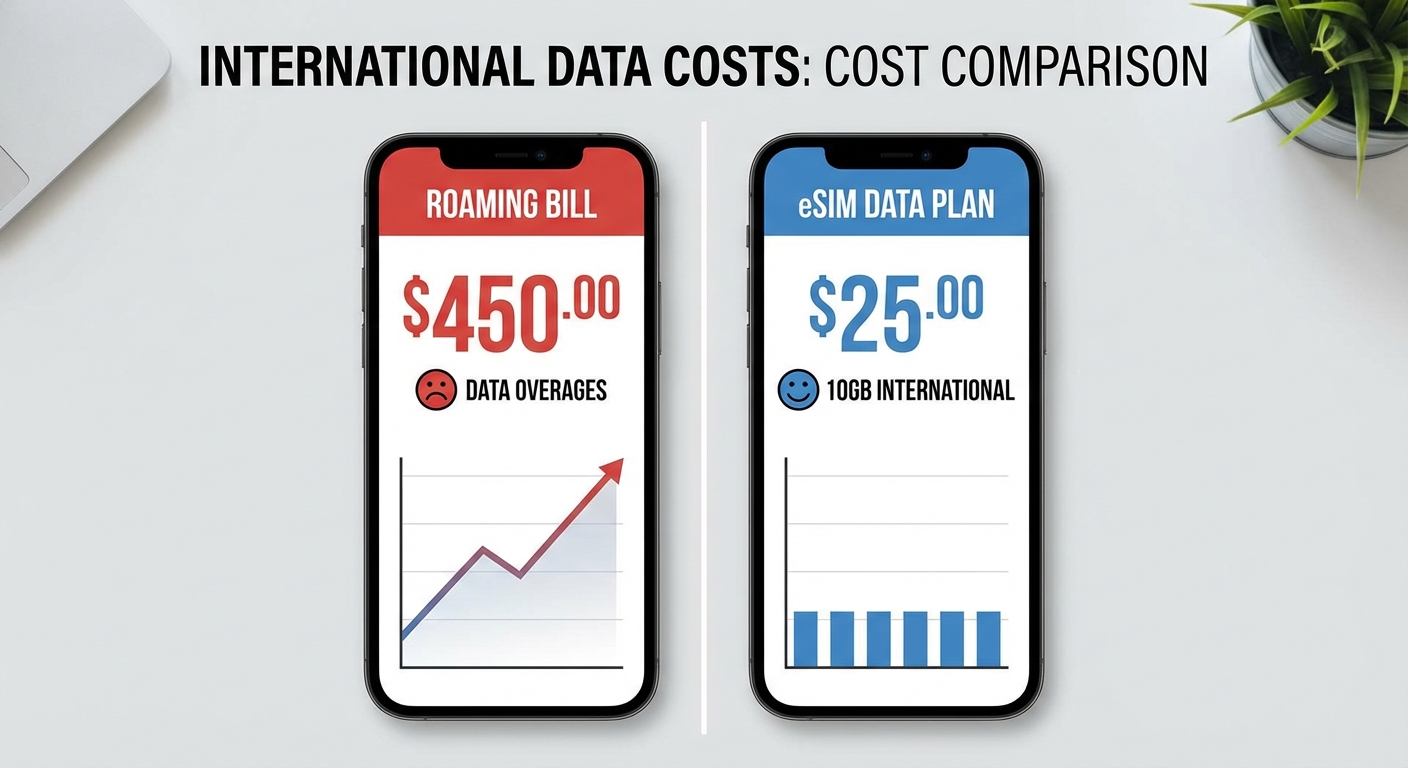
International roaming remains shockingly expensive. Major US carriers charge $10-15 per day for international access—costs that add up to hundreds of dollars on even short trips. Meanwhile, eSIM providers offer the same connectivity for a fraction of the price.
This comparison breaks down real costs across 30 popular destinations, showing exactly how much eSIM saves compared to carrier roaming.
This article is part of our complete digital nomad connectivity guide, covering everything you need for reliable connectivity anywhere.
The Cost Gap Overview
US Carrier International Day Passes
| Carrier | International Plan | Daily Cost | Included |
|---|---|---|---|
| AT&T | International Day Pass | $12/day | Unlimited data, texts, calls |
| Verizon | TravelPass | $14/day | Unlimited data, texts, calls |
| T-Mobile | Magenta/Go5G | Free slow data | Unlimited 2G, $5/day for high-speed |
eSIM Alternative Costs
| Provider | 7-Day Europe | 7-Day Asia | Per-Day Average |
|---|---|---|---|
| Airalo | $15-25 | $12-20 | $2-3 |
| Holafly | $27 | $27 | ~$4 |
| Nomad eSIM | $15-25 | $15-25 | $2-4 |
The Math
One week in Europe:
- AT&T International Day Pass: $84
- Airalo Europe 5GB: $15
- Savings: $69
Two weeks in Asia:
- Verizon TravelPass: $196
- Airalo Asia 10GB: $27
- Savings: $169
Country-by-Country Breakdown
Europe
| Country | Carrier Roaming 7-Day | Airalo 5GB | Savings |
|---|---|---|---|
| France | $84-98 | $15 | $69-83 |
| Germany | $84-98 | $15 | $69-83 |
| Italy | $84-98 | $15 | $69-83 |
| Spain | $84-98 | $15 | $69-83 |
| UK | $84-98 | $15 | $69-83 |
| Portugal | $84-98 | $15 | $69-83 |
| Netherlands | $84-98 | $15 | $69-83 |
| Greece | $84-98 | $15 | $69-83 |
| Czech Republic | $84-98 | $15 | $69-83 |
| Poland | $84-98 | $15 | $69-83 |
Note: European eSIM plans typically cover multiple countries at the same price, adding value for multi-country trips.
For detailed European eSIM recommendations, see our best eSIMs for Europe guide.
Asia
| Country | Carrier Roaming 7-Day | Airalo 3-5GB | Savings |
|---|---|---|---|
| Japan | $84-98 | $12-18 | $66-86 |
| South Korea | $84-98 | $12-16 | $68-86 |
| Thailand | $84-98 | $10-15 | $69-88 |
| Vietnam | $84-98 | $10-14 | $70-88 |
| Indonesia | $84-98 | $12-18 | $66-86 |
| Singapore | $84-98 | $12-16 | $68-86 |
| Malaysia | $84-98 | $10-15 | $69-88 |
| Philippines | $84-98 | $10-14 | $70-88 |
| Taiwan | $84-98 | $12-16 | $68-86 |
| Hong Kong | $84-98 | $10-14 | $70-88 |
For detailed Asian eSIM recommendations, see our best eSIMs for Asia guide.
Americas
| Country | Carrier Roaming 7-Day | Airalo 3-5GB | Savings |
|---|---|---|---|
| Mexico | $84-98 | $12-18 | $66-86 |
| Canada | $84-98 | $15-22 | $62-83 |
| Brazil | $84-98 | $14-20 | $64-84 |
| Argentina | $84-98 | $16-22 | $62-82 |
| Colombia | $84-98 | $12-18 | $66-86 |
| Costa Rica | $84-98 | $14-20 | $64-84 |
Other Regions
| Country | Carrier Roaming 7-Day | Airalo 3-5GB | Savings |
|---|---|---|---|
| Australia | $84-98 | $14-20 | $64-84 |
| New Zealand | $84-98 | $14-20 | $64-84 |
| UAE | $84-98 | $14-20 | $64-84 |
| South Africa | $84-98 | $16-24 | $60-82 |
Why Carrier Roaming Costs So Much
Legacy Agreements
International roaming rates date from an era when carriers negotiated bilateral agreements for network access. These wholesale costs, plus substantial margins, created the rates we see today.
Lack of Competition
Most travelers don't know alternatives exist. Carriers have little incentive to lower rates when customers continue paying.
Convenience Premium
Roaming "just works"—your phone connects automatically. Carriers charge for this convenience, knowing many travelers prefer simplicity over savings.
Hidden Costs
Beyond daily rates, carriers often charge additional fees:
- Per-minute call charges beyond included amounts
- Per-text charges in some plans
- Data overage fees
- Connection or activation fees
When Roaming Makes Sense
Despite the cost difference, carrier roaming occasionally makes sense:
Very Short Trips
A single day overseas where you barely need data might not justify eSIM setup time. But even then, eSIM is usually cheaper.
Phone Number Requirement
Roaming keeps your regular phone number working for calls and texts. eSIMs are data-only—voice requires VoIP apps.
Corporate Accounts
Some corporate phone plans include international roaming. If your employer pays, the cost calculation changes.
Backup Connectivity
Having roaming as a backup when your eSIM fails provides peace of mind worth some cost.
eSIM Cost Optimization
Regional Plans
For multi-country trips, regional eSIM plans provide the best value:
| Region | Provider | Coverage | Price | Per-Country |
|---|---|---|---|---|
| Europe | Airalo | 42 countries | $49/50GB | ~$1.17 |
| Asia | Airalo | 15 countries | $27/10GB | ~$1.80 |
| Global | Airalo | 130+ countries | $59/10GB | ~$0.45 |
Bulk Data Discounts
Larger data packages have lower per-GB costs:
| Package | Price | Per GB |
|---|---|---|
| 1GB | $4 | $4.00 |
| 5GB | $15 | $3.00 |
| 20GB | $42 | $2.10 |
| 50GB | $49 | $0.98 |
Provider Comparison
Different eSIM providers offer different value propositions. For detailed comparisons, see:
The Real-World Savings
Scenario 1: Two-Week European Vacation
Using carrier roaming:
- 14 days × $12/day = $168
- Occasional overage = $20
- Total: ~$188
Using eSIM:
- Airalo Europe 20GB = $42
- Total: $42
- Savings: $146
Scenario 2: Month-Long Digital Nomad Trip - Southeast Asia
Using carrier roaming:
- 30 days × $12/day = $360
- Additional data usage = $50
- Total: ~$410
Using eSIM:
- Airalo Asia 20GB = $65
- Total: $65
- Savings: $345
Scenario 3: Frequent Business Traveler - 12 International Trips per Year
Using carrier roaming:
- 12 trips × 5 days × $14/day = $840/year
- Total: ~$840
Using eSIM:
- 12 trips × $20 average = $240/year
- Total: ~$240
- Savings: $600 per year
Making the Switch
Setting Up eSIM
- Verify phone compatibility - Most phones from 2020 onward support eSIM
- Choose a provider - See our eSIM comparison guide
- Download the app before traveling
- Purchase your plan while on WiFi
- Install the eSIM following app instructions
- Activate upon arrival at your destination
Keeping Your Phone Number
eSIMs are data-only. To maintain your phone number:
Option 1: Keep home SIM active with roaming disabled, use VoIP for calls
Option 2: Port number to Google Voice or similar for calling over data
Option 3: Use dual-SIM phone—home SIM for texts/calls at home, eSIM for travel data
Transition Strategy
For your first eSIM experience:
- Keep roaming available as backup
- Test eSIM before critical needs
- Verify coverage at your destination
- Have WiFi backup plan
After successful trips, you'll confidently rely on eSIM as primary connectivity.
Frequently Asked Questions
Can I still receive texts on my regular number with eSIM?
If you have a dual-SIM phone, yes. Your physical SIM continues receiving texts while eSIM handles data. On single-SIM phones, you'd need to switch between SIMs.
What happens if I use roaming accidentally?
Most phones let you disable roaming for your home carrier. With roaming off and eSIM active, your phone uses eSIM data exclusively.
Is eSIM coverage as good as roaming?
eSIM providers partner with local carriers, often the same ones your home carrier uses for roaming. Coverage is typically identical.
What about international calls?
eSIMs are data-only. Use WhatsApp, FaceTime, or other VoIP apps over your eSIM data connection. Quality is typically better than traditional cellular calls.
Can my employer reimburse for eSIM?
Yes. eSIM purchases generate receipts just like any other expense. Many employers appreciate the cost savings compared to carrier roaming.
Conclusion
The math is clear: eSIM saves 70-90% compared to carrier roaming in most scenarios. A typical week abroad costs $84-98 on carrier roaming versus $15-25 on eSIM—savings of $60-80 per trip.
The switch is straightforward:
- Get an eSIM-compatible phone
- Download Airalo, Holafly, or another provider app
- Purchase data before your trip
- Activate when you land
For most travelers, there's no reason to continue paying carrier roaming rates. The setup takes minutes, the savings are substantial, and the coverage is equivalent.
For the complete picture of connectivity options while traveling, explore our complete digital nomad connectivity guide.
About the Author