Flying With Spare Batteries: Cameras, Drones and Laptop Cells

The short answer
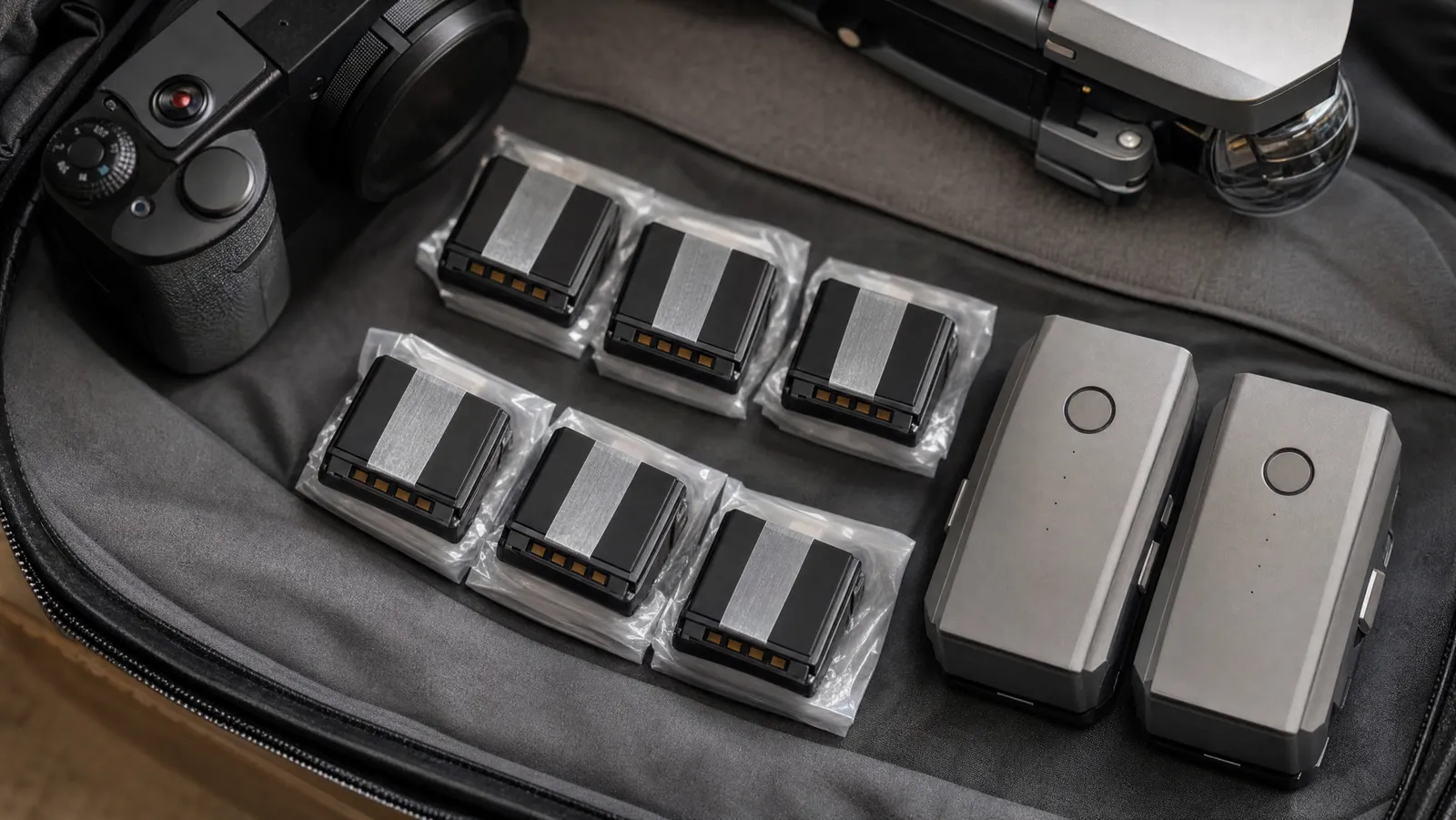
The flying with spare batteries rules are narrower than they look. Spare camera cells and drone packs travel in carry-on baggage only, never in the hold. Almost every one of them sits under the 100 watt-hour line that needs no approval. The rule that actually gets people stopped is terminal protection: each loose cell individually insulated against short circuit.
IATA's Guidance Document for Passengers Travelling with Lithium Batteries, dated 31 March 2026, states that it is based on the 2025-2026 Edition of the ICAO Technical Instructions for the Safe Transport of Dangerous Goods by Air and the 67th Edition of the IATA Dangerous Goods Regulations. Your airline enforces those rules, and IATA's traveller page says carriers differ because they "must also comply with local aviation authorities and national laws". For the rest of what changed in the cabin, start with the 2027 airline carry-on rules.
A spare is a spare, whatever device it came from
Regulators do not write a camera-battery rule and a drone-battery rule; they write a spare-battery rule. IATA's 2026 guidance defines spare batteries as "either single cell batteries (AAA, CR123, etc.) or multi-celled batteries but designed to be inserted into or directly affixed to a specific device" — mirrorless packs, intelligent flight batteries and replacement laptop cells all qualify. The same document notes that batteries removed from a device "are then treated in the same way as spare batteries". Pulling the pack out of your drone does not escape the spare rules; it opts you into them. Power banks are the one category now split out, which is why they get power bank rules on planes of their own.
Watt-hours, and the arithmetic that places your gear
Every limit is written in watt-hours, not milliamp-hours. The FAA's PackSafe entry for lithium batteries, last updated 11 August 2026, gives the conversion in one line: "To calculate Wh, multiply the battery voltage by the Amp hours (Ah)." So divide the mAh figure by 1,000, then multiply by nominal voltage. Work a camera cell. Sony's own specification page for the NP-FZ100 lists an "electrical capacity of 16.4Wh (7.2V/2280mAh)": 2,280 ÷ 1,000 = 2.28Ah, times 7.2V, equals 16.4Wh.
Now a drone pack. DJI's published specifications for the Air 3S Intelligent Flight Battery give 4,276mAh at a nominal 14.6V and a rating of 62.5Wh — and 4.276 × 14.6 comes to 62.4Wh, so the maths holds. Four camera cells' worth of energy in one brick, still inside the no-approval band.
The threshold is per battery, not per bag. The FAA states its limit as a rating "of 100 watt hours (Wh) per battery", so ten NP-FZ100s — 164Wh of stored energy between them — are each compliant with no paperwork, while one 110Wh cell is not — under the FAA's own wording that single cell needs airline approval.
The three watt-hour bands and what each means
| Watt-hour rating | Spare in carry-on | Spare in checked | Operator approval |
|---|---|---|---|
| Up to 100Wh (or 2g lithium metal) | Permitted | Not permitted | Not required |
| Over 100Wh up to 160Wh | Permitted, maximum of two | Not permitted | Required |
| Over 160Wh | Not permitted in baggage | Not permitted | Cargo only |
From Table 1 of IATA's passenger lithium battery guidance dated 31 March 2026 and Tables 2.3.A and 2.3.B of the IATA Dangerous Goods Regulations, Edition 68, effective 1 January 2027. Checked November 2026. Carriers may be stricter — read your airline's own dangerous goods page before you fly.
Above 160Wh, IATA's Table 1 says a battery "must be prepared and carried as cargo". The middle band is where approval lives. The FAA says the 101-160Wh allowance "covers the larger after-market extended-life laptop computer batteries and some larger batteries used in professional audio/visual equipment". To get it, IATA says you must give the airline the Wh rating, the number of batteries and whether each is removable, and warns that "the operator has the right to not give an approval if the information is not adequate".
Where real camera and drone batteries land
Manufacturer figures from each maker's own specification page, November 2026.
| Battery | Rated energy | Band |
|---|---|---|
| Sony NP-FZ100 mirrorless pack | 16.4Wh (7.2V, 2,280mAh) | Under 100Wh, no approval |
| DJI Mini 4 Pro Intelligent Flight Battery | 18.96Wh (2,590mAh) | Under 100Wh, no approval |
| DJI Air 3S Intelligent Flight Battery | 62.5Wh (14.6V, 4,276mAh) | Under 100Wh, no approval |
| DJI Inspire 3 TB51 Intelligent Battery | 98.8Wh (23.1V, 4,280mAh) | Under 100Wh by 1.2Wh |
| Apple MacBook Pro 16-inch internal cell | 100Wh quoted (99.6Wh actual, per Apple's own footnote) | At the line, and installed in a device |
| DJI Matrice 350 RTK TB65 | 263.2Wh (44.76V, 5,880mAh) | Over 160Wh, cargo only |
Consumer gear is not what these rules were written for; professional kit is. Apple's quoted 100 watt-hours for the 16-inch MacBook Pro is an installed cell, not a spare — our laptop buying guide for nomads covers the machines, this page the loose cells.
Carry-on only, with no small-cell exemption
A cell of a few watt-hours is as prohibited from the hold as a 98.8Wh drone pack. The FAA's wording is flat: "Spare (uninstalled) lithium ion and lithium metal batteries, including power banks and cell phone battery charging cases, must be carried in carry-on baggage only." IATA's Table 1 marks spares as not permitted in checked baggage at every rating.
The reason is crew reach. IATA's traveller page puts it plainly: "If a lithium battery overheats or ignites in the cargo hold, the crew cannot take immediate action to identify and extinguish it." All lithium-ion batteries, the FAA says, "are capable of overheating and undergoing a process called thermal runaway", which "can occur without warning".
A battery installed in a device is a different rule. IATA's Table 1 permits a camera, drone or laptop with its battery fitted in either carry-on or checked baggage, capped at 15 portable electronic devices per person, and requires anything checked to be "completely switched off (not in sleep or hibernation mode)". A spare has no such option.
Gate-checking is the trap: the FAA requires that when a bag is checked at the gate or planeside, "all spare lithium batteries and power banks must be removed from the bag and kept with the passenger in the aircraft cabin".
How many spares you may carry
- US federal rules set no count at or under 100Wh. The FAA's quantity entry reads "None for most batteries — but batteries must be for use by the passenger", adding that "batteries carried for further sale or distribution (vendor samples, etc.) are prohibited".
- IATA's current ceiling is 20. Footnote 2 to Table 1 of its 31 March 2026 guidance states "each person is limited to a maximum of 20 spare batteries of any type", with the operator free to approve more.
- That drops to 18 from 1 January 2027, when Table 2.3.B of the IATA Dangerous Goods Regulations, Edition 68, reads "each person is limited to a maximum of 18 spare batteries" — again with operator discretion. Read it alongside the split: the same table counts power banks separately, at "no more than two (2) per passenger".
- In the 100-160Wh band it is two, and the sources disagree on how to count them. Edition 68's Table 2.3.A says "maximum of two spare batteries in carry-on baggage only" and the FAA says "there is a limit of two spare batteries per person", while IATA's 2026 footnote says "limited to a maximum of 2 spare batteries per device". Plan on two in total and you cannot be wrong.
The commercial line is the FAA's: carried for your own use, fine; carried as stock, prohibited.
Terminal protection: the rule people actually get stopped for
This applies to every cell you carry, and a camera bag fails it by default. IATA's wording is the full legal test: spare batteries "must be individually protected to prevent short circuits by placement in the original retail packaging or by otherwise insulating terminals, e.g. by taping over exposed terminals or placing each battery in a separate plastic bag or protective pouch and carried in carry-on baggage only".
The FAA lists what counts: "leaving the batteries in their retail packaging, covering battery terminals with tape, using a battery case, using a battery sleeve in a camera bag, or putting them snugly in a plastic bag or protective pouch." A sleeve in a camera bag is explicitly accepted: the cheapest fix a photographer has.
The failure mode is mechanical. DJI's own Intelligent Flight Battery Safety Guidelines spell it out: "DO NOT put the loose cells in a pocket, bag or drawer where they may short-circuit against other items or where the battery terminals could be pressed against each other." Two contacts bridged by a tripod plate complete a circuit the cell cannot limit, and the FAA lists improper packing among the triggers for thermal runaway.
- One cell, one enclosure. Retail cases, terminal caps or individual zip bags all qualify. Loose cells in a lens pocket do not.
- Tape is legal and free, and on the FAA's accepted list.
- Keep them apart. IATA advises you "keep some space between spare batteries", which a compartmented tech pouch or cable organiser does for you.
- One fixed home for the batteries — easier to show a screener, easier to strip out if the bag gets gate-checked, and the logic behind our approach to organising a nomad backpack.
Drone packs: state of charge, pouches and the destination problem
On charge level, the regulation is softer than the folklore. IATA's passenger guidance says only that airlines "prefer spare batteries and power banks to be at less than 25%", and that where approval is needed for multiple spares the operator "may require additional separation between the batteries or that they are at a low state of charge (<25% indicated when inserted into the device)". A preference and a possible condition of approval, not a limit.
Manufacturers go further, model by model. DJI's Intelligent Flight Battery Safety Guidelines for the Mavic Air tell owners to "never transport a damaged battery or a battery with power level higher than 30%", and for flights: "before carrying the Intelligent Flight Battery on an airline flight, it must first be fully discharged", done "in a fireproof location". That covers an older airframe and DJI's current Mini 4 Pro guidelines do not repeat the air-travel wording, so check your own model. Arriving under 25 per cent satisfies IATA's stated preference; DJI's Mavic Air travel notice goes further still and asks for a full discharge before the flight.
Fireproof lithium battery safety bags are a reasonable belt-and-braces choice for a case of drone packs, but neither the FAA's list of accepted protection methods nor IATA's 2026 passenger guidance mentions them, and buying one raises no watt-hour or quantity limit.
Keep the two problems separate. Getting your batteries into the cabin is a dangerous-goods question, answered by the tables above. Getting your drone into the country is answered by the destination's aviation and customs authorities — IATA's own explanation of why airline policies diverge lists "local regulations (e.g., bans on vapes or drones)" first.
At the checkpoint
- Keep the batteries reachable. IATA warns travellers to "be prepared for extended security checks when traveling with an unusual amount of electronic equipment". One liftable pouch shortens that.
- Know your numbers. IATA tells you to "always check your battery's watt-hour rating (printed on the device or battery label)". For an unlabelled third-party cell, photograph the spec page.
- Expect the laptop and drone out of the bag, depending on the scanner in your lane; taking laptops out at security is its own question.
- None of this is a liquids rule, but sensor fluid and lens cleaner are — see our guide to airport liquid rules.
If a cell is challenged or confiscated
An officer objects to loose cells. Protect the terminals on the spot rather than arguing the rating; at consumer wattages the rating is almost never the issue.
A battery is swollen, damaged or recalled. Not negotiable. The FAA states that damaged or recalled batteries "must not be carried aboard an aircraft (e.g., carry-on or checked baggage) unless the damaged or recalled battery has been removed, or otherwise made safe". IATA is blunter: "do not travel with swollen, punctured, or damaged batteries."
It gets taken off you. Checking it instead is not an option — the FAA entry and IATA's Table 1 both close that door — and no compensation route appears in either document. For a case of professional packs, read how tech gear cover works inside a travel insurance policy.
The bottom line
As of November 2026: every spare camera, drone and laptop cell goes in carry-on only, each individually protected against short circuit, with no count under US federal rules and a ceiling of 20 per person under IATA's current guidance — dropping to 18 from 1 January 2027 under Edition 68 of the Dangerous Goods Regulations. Under 100Wh per battery, the approval machinery never touches you; at 100-160Wh plan on two spares and ask in advance; above 160Wh it is cargo.
Do one thing tonight: put every loose cell in its own sleeve or bag. If your kit includes a charging brick, our roundup of airline-approved power banks sizes the field against the same line. For the sizers, liquids and the rest of the cabin, see Nomad Outfit's carry-on rules guide.
Frequently Asked Questions
Can I put spare camera batteries in checked luggage?
No, at any size. The FAA's PackSafe entry of 11 August 2026 states that spare uninstalled lithium-ion and lithium-metal batteries "must be carried in carry-on baggage only", and IATA's Table 1 marks spares as not permitted in checked baggage at every rating. A battery left inside the camera body is a different case.
How many camera batteries can I take on a plane?
The FAA sets no count at or under 100Wh beyond requiring they be "for use by the passenger", with resale stock prohibited. IATA's 31 March 2026 guidance caps each person at 20 spare batteries of any type, and Edition 68 of the Dangerous Goods Regulations lowers that to 18 from 1 January 2027. Operators may approve more.
Do I actually have to tape my battery terminals?
One of several accepted things, yes. IATA requires each spare to be "individually protected to prevent short circuits" by retail packaging or by insulating the terminals. The FAA's accepted methods: retail packaging, tape over the terminals, a battery case, "a battery sleeve in a camera bag", or the cell snugly in a plastic bag or pouch.
Are DJI drone batteries allowed in carry-on baggage?
Consumer packs, yes, without approval. DJI's own specifications rate the Mini 4 Pro battery at 18.96Wh, the Air 3S at 62.5Wh and the Mavic 3 Pro at 77Wh, all under the 100Wh threshold; the Inspire 3's TB51 at 98.8Wh is still under. The Matrice 350 RTK's TB65 at 263.2Wh exceeds 160Wh and must travel as cargo.
What about non-rechargeable lithium cells for flashes and light meters?
They fall under a lithium-content limit, not a watt-hour one. IATA's Table 1 and the FAA both cap spare lithium-metal batteries at 2 grams of lithium content, which covers the AAA and CR123-type cells IATA names in its own definition of a spare. Between 2 and 8 grams, IATA's Table 1 and Table 2.3.A of Edition 68 restrict spares to portable medical devices, while the FAA's PackSafe entry allows up to two such spares with airline approval and names no medical restriction.
About the Author