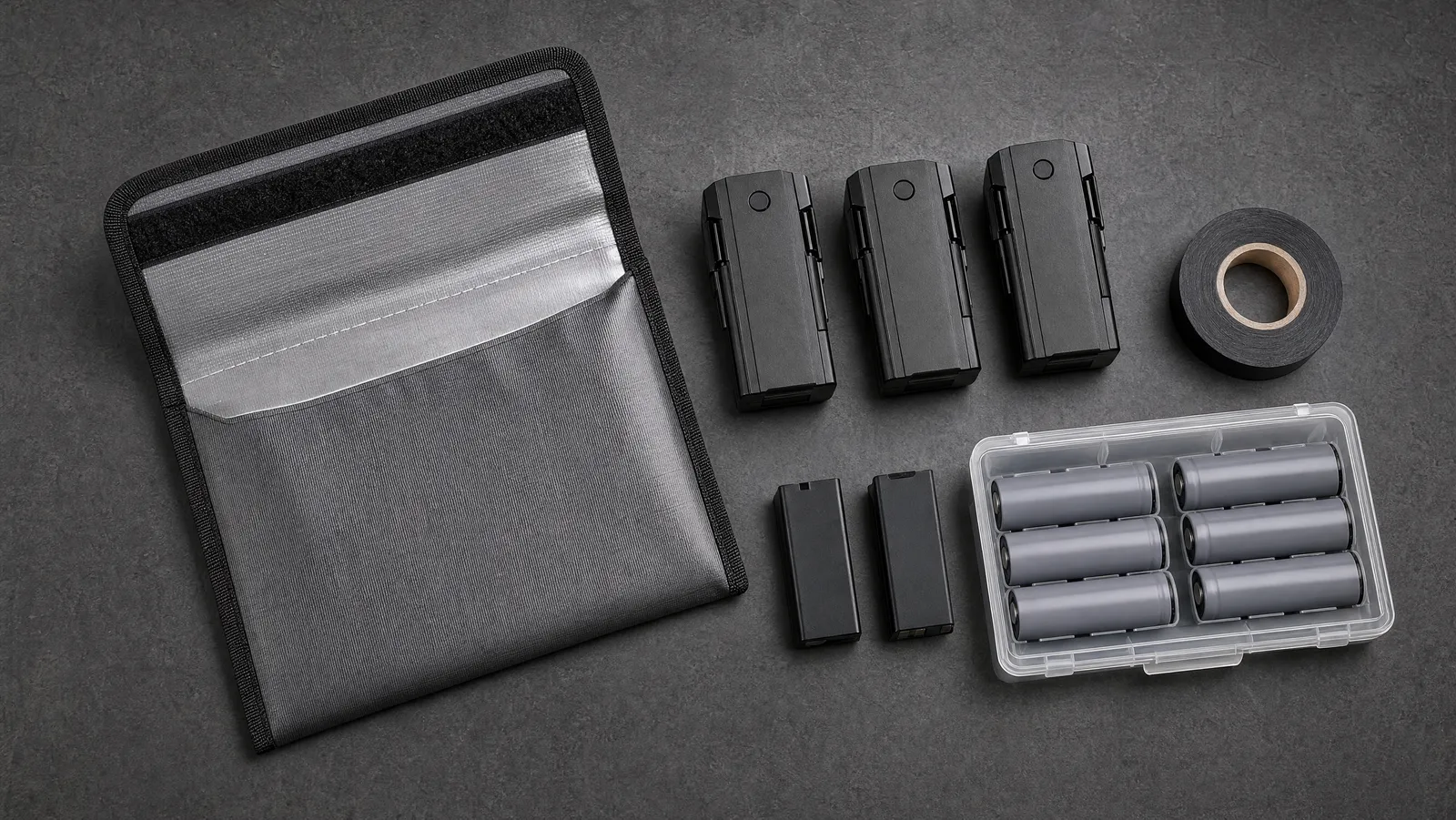
The short answer
The best lithium battery safety bag for travel is the one you will actually pack, and for most people living out of a cabin bag that means a flat LiPo pouch or a per-cell case rather than a rigid box. Our overall pick is the Tenergy 2-pack of 7 x 9 inch pouches, which Tenergy states are triple-layered flame retardant. No regulator requires one, and we found no airline that does.
Some links on this page are affiliate links: if you buy through them we earn a commission at no extra cost to you.
What the rules require is narrower and cheaper: each spare cell's terminals individually protected, and the cells in the cabin. Tape does that. A containment bag answers a different question - what happens if a cell fails - and raises no limit whatsoever. For the full picture of the 2027 airline battery rules, start with our pillar; this page is only about the kit. The buying order is separation first, containment second.
What the rule actually says
IATA's guidance for passengers travelling with lithium batteries, revised for the 2026 regulations and dated 31 March 2026, puts the whole obligation in one sentence. Spare batteries "must be individually protected to prevent short circuits by placement in the original retail packaging or by otherwise insulating terminals, e.g. by taping over exposed terminals or placing each battery in a separate plastic bag or protective pouch and carried in carry-on baggage only."
The FAA's PackSafe entry says the same in plainer language: terminals "must not come in contact with other metal", and methods include "leaving the batteries in their retail packaging, covering battery terminals with tape, using a battery case, using a battery sleeve in a camera bag, or putting them snugly in a plastic bag or protective pouch" - citing 49 CFR 175.10(a)(18).
The UK Civil Aviation Authority's page on the changes effective 27 March 2026 repeats the same three options for spares and power banks.
Three authorities, three identical lists, and not one of them mentions fire. The requirement is electrical, not thermal.
No authority requires a fireproof bag
We looked, and could not find one. ICAO's announcement of the power bank restrictions that "become effective on 27 March 2026" - under which the devices "will now be limited to two per passenger" - says nothing about containment bags. Neither does IATA's 2026 guidance, the UK CAA page or the FAA's PackSafe entry.
The containment bags aviation relies on are crew equipment, stowed on the aircraft - and the FAA is lukewarm even about those. FAA Information for Operators InFO 17021, dated 26 December 2017, states that "there are no FAA test standards for these containment products, nor is there a mechanism in place for the approval of these products", and that "the highest risk may lie in the transfer of a burning or overheated battery to the containment kit/bag." That notice addresses operators rather than passengers and predates the 2026 changes, but it is the only FAA position on these products we found - and it ends any claim about an FAA-certified bag.
The second thing no bag does is buy capacity. IATA's Table 1 lists power banks above 100Wh and up to 160Wh as forbidden outright and caps you at two at or below 100Wh. A pouch does not move that line by a watt-hour, so the shortlist that matters is still airline-approved power banks under 100Wh, and our power bank buying guide starts with watt-hour arithmetic, not a bag.
Terminal tape is the cheapest compliance step there is
A roll of electrical tape weighs nothing and satisfies the requirement outright. IATA tells passengers to "keep spare batteries and power banks in their original packaging or cover the terminals with tape to prevent short-circuits."
- Bare 18650 and 21700 cells. A strip across the flat negative end and the button positive end. These are the cells that short against a pocketful of coins.
- Camera packs such as LP-E6 or NP-FZ100. Tape the exposed contact strip, or refit the plastic cap it shipped with.
- Drone packs with XT60 or XT30 plugs. The plug is the risk, not the casing. Cap it, and never let two packs sit plug to plug.
A power bank has no exposed terminals to tape, but it is not exempt: the UK CAA states that spare lithium batteries and power banks alike must be individually protected to prevent short circuits when not in use, which for a power bank means a pouch or a sleeve rather than tape. Tape can also peel in a hot bag, which is the honest case for a pouch: a per-cell pocket does the same job and survives repacking.
The five picks, and the job each one does
Two of these separate cells, the step the rules describe. Three contain them, the optional extra.
| Pick | Size | The job it does | Price as of November 2026 |
|---|---|---|---|
| Tenergy 2-Pack LiPo Bags - Best Overall | 7 x 9 in flat pouch, two per pack | Containment for a mixed kit, at near-zero packed volume | 10.99 USD |
| Zeee Fireproof LiPo Bag - Best for Drone Batteries | 8.46 x 6.5 x 5.71 in (21.5 x 14.5 x 16.5 cm) | Keeps a stack of drone packs apart and holds its shape | 12.74 USD |
| Hodyludy Small LiPo Bag - Smallest Useful Size | 5.5 x 3.5 x 2.1 in | One power bank or a few cells; folds flat | 6.99 USD |
| JJC 6-Pocket Battery Pouch - Best for Camera Cells | Four battery pockets plus two card pockets | Per-cell separation: one cell, one pocket | 12.99 USD |
| JJC 18650 Hard Case - Best Hard Case | Six moulded 18650 slots | Terminals physically cannot touch metal | 9.99 USD |
Prices checked November 2026; they move, so treat each card as the live figure.
What a fireproof claim is and is not
Zeee states heat insulation to 1000 F for its bag and, in the same listing, says plainly that it is not 100 per cent fireproof above that temperature. That honesty tells you what you are buying: minutes and smoke control, not immunity.
Tenergy states its pouches are triple-layered flame retardant and meet the UL 94 international flammability standard. UL 94 is titled Tests for Flammability of Plastic Materials for Parts in Devices and Appliances, and UL describes it as a preliminary indication of a plastic's acceptability for use in a device or appliance. It is a bench test on materials, not an aviation approval.
Drone and camera kits: where containment earns its place
Travel with a drone and you are carrying three or four loose packs with exposed plugs - the one case where we think a containment bag earns its volume. The regulations bite first: IATA limits each passenger to 20 spare batteries of any type at or below 100Wh unless the operator approves more, and cells above 100Wh and up to 160Wh need operator approval, capped at two per device.
IATA also publishes habits rather than rules. These are advice from the same document, not law:
- "Airlines prefer spare batteries and power banks to be at less than 25%" state of charge.
- "Do not recharge it prior to boarding and then store it in the overhead locker", and let a device cool before packing.
- "Keep some space between spare batteries", and tell crew at once if a device is hot, smoking or damaged.
For approval, IATA notes that "the operator may require additional separation between the batteries or that they are at a low state of charge" - the one place a slotted case shortens an awkward conversation. A kit worth four figures is also where tech gear cover inside a travel insurance policy stops being optional.
Checked bags, gate-checks and the checkpoint
Spare cells and power banks are cabin-only, and no bag changes that. The FAA states that spare lithium batteries, including power banks, "must be carried in carry-on baggage only", and that if a carry-on is checked at the gate or planeside they "must be removed from the bag and kept with the passenger in the aircraft cabin."
So where the pouch lives matters as much as which one you buy. One grab-able pouch at the top of the bag turns a jet-bridge repack into a ten-second job - the same logic behind getting your tech through security and behind giving the kit a fixed home when organising a nomad backpack.
Two cases a bag cannot fix: IATA lists smart luggage with a non-removable battery above 2.7Wh as forbidden, and e-cigarettes must be carry-on only and never recharged on board. For in-flight use see the power bank rules airlines now enforce; for quantity caps and the paperwork above 100Wh, flying with spare batteries has the full treatment.
What not to buy
Search for a fireproof battery bag and much of what comes back is built for a garage: zip-up sacks sized for e-bike packs, 200Ah LiFePO4 house batteries and RC charging stations, made to sit on a concrete floor while something charges unattended. In a carry-on they are dead weight, and the batteries they serve sit far above the 160Wh threshold at which IATA requires carriage as cargo - as do most portable power stations for remote work.
Nor is a bag a workaround for a bad cell. The FAA states that damaged or recalled batteries "which are likely to create sparks or generate a dangerous evolution of heat must not be carried aboard an aircraft" unless made safe. Recycle the swollen pack before the airport, not after.
The bottom line
Buy separation first: a per-cell pouch, a slotted hard case, or a roll of tape if you travel with two cells and a sense of proportion. Add containment where the kit justifies it - a camera bag with four loose drone packs does, a single power bank does not. Then ignore any claim that a bag changes a limit.
And check the carrier rather than the bag. IATA is explicit that "airlines may impose more stringent conditions on the carriage and use of power banks by passengers", and some carriers reportedly go further than ICAO requires. Nomad Outfit's carry-on rules guide tracks where those policies now sit.
Frequently Asked Questions
Do I need a fireproof bag to fly with lithium batteries?
No. We found no such requirement in ICAO's provisions effective 27 March 2026, IATA's 2026 passenger guidance, the UK CAA's page or the FAA's PackSafe entry. All four ask only that spare cells travel in the cabin with terminals individually protected - retail packaging, tape, or a separate pouch per battery.
Does a battery safety bag let me carry a battery over 100Wh?
No, and this is the misunderstanding worth killing. IATA's Table 1 lists power banks above 100Wh and up to 160Wh as forbidden, and spare cells in that range as needing operator approval, capped at two per device. The container is irrelevant: only the watt-hours marked on the battery count.
Is taping battery terminals really enough?
Yes, by the regulators' own wording. The FAA lists "covering battery terminals with tape" among its accepted methods of preventing a short circuit, and IATA allows "taping over exposed terminals". Use electrical or gaffer tape across the contacts, and keep taped cells where they cannot be crushed.
Can I put a LiPo bag in my checked luggage?
The bag can go in the hold; the batteries cannot. The FAA states that spare lithium batteries and power banks must be carried in carry-on baggage only, and that if a carry-on is checked at the gate or planeside they must come out and stay with you in the cabin.
How many spare batteries can I take on a plane?
IATA's 2026 table limits each passenger to 20 spare batteries of any type at or below 100Wh unless the operator approves more, plus a maximum of two power banks and 15 portable electronic devices. Above 100Wh and up to 160Wh you need the airline's approval, limited to two spares per device.