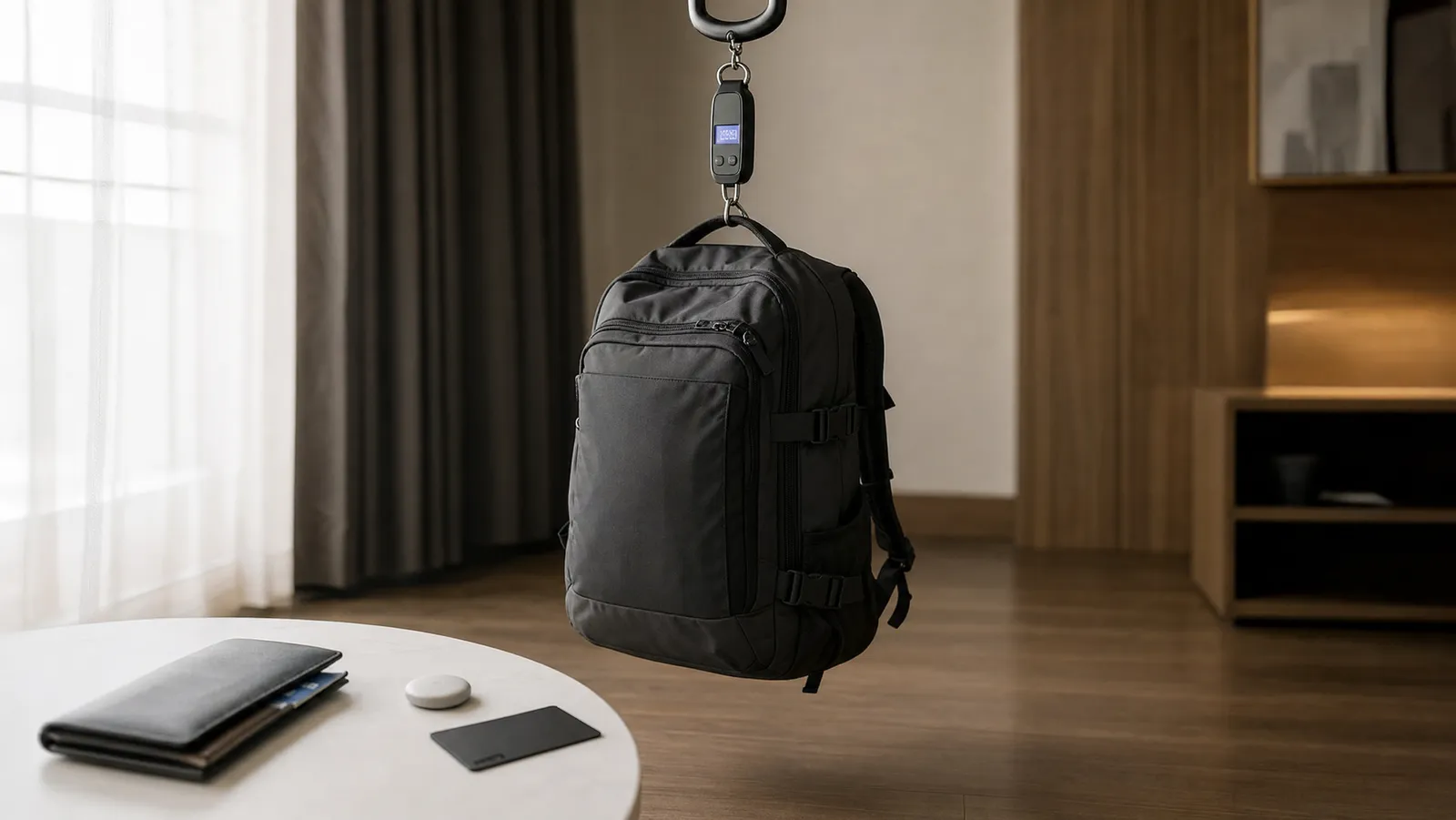
The short answer
The best luggage scale for travel is the cheapest one you will actually keep in the bag, and our overall pick is the Etekcity Digital Luggage Scale, which Etekcity rates to 110 lb / 50 kg, at $9.86 as of November 2026. The tracker half of this kit answers a different question: a scale stops a charge, a tracker finds a bag.
Some links on this page are affiliate links: if you buy through them we earn a commission at no extra cost to you.
Between them these two cheap devices remove most of the uncertainty left in a flight under current airline carry-on rules: an overweight cabin bag you could have fixed at home for nothing, and a gate-checked bag that vanishes into a transfer system you cannot see. Below: five picks, the platform split that decides your tracker, and what the regulators publish.
Why you weigh at home, not at the desk
The carrier's scale is the one with authority. Yours has none, which is why you need it: the only useful number is the one you knew before you left, while repacking is free.
The risk is cabin weight, not checked weight. The big US carriers mostly publish no cabin weight limit at all — JetBlue's own help page states that "JetBlue does not currently have a weight restriction for carry-on bags", asking only that you can lift it — while Emirates, Qatar Airways and Singapore Airlines each publish a 7 kg Economy cabin allowance, about 15 lb, which can be put on a scale at the desk. That asymmetry catches one-baggers, and it is why we keep the figures in carry-on size limits by airline.
One instruction matters more than the rest of this article: weigh the bag you will actually present, with the laptop and both power banks inside it. Cabin limits count contents, not the empty shell, and the two banks you may carry under the power bank rules airlines enforce are dense.
Allowances are moving too. Regulation (EU) 2026/2202, dated 16 September 2026 and published in the EU's Official Journal on 2 October 2026 after the European Parliament confirmed the text on 7 July 2026, guarantees one free personal item, which the regulation's definitions article sets at "maximum dimensions of 40 x 30 x 15 cm" or a bag that fits under the seat in front. Its final article states that "It shall apply from 23 October 2027", so Europe's new hand luggage rules change nothing at a gate before then.
How to read a hook scale without fooling yourself
Lift the bag completely clear of the floor and wait for the display to settle. Both halves matter: a reading taken while the bag touches the ground is wrong, because part of the load is on the floor, and a swinging bag reads wrong too. A tare function only matters if you weigh contents rather than the packed bag.
On accuracy we will be dull rather than reassuring. Neither scale here publishes a certified accuracy tolerance in the listing we read, and we have not measured either, so treat the number as indicative and keep a kilogram or two of margin. A reading of 9.9 kg against a 10 kg allowance is not a pass.
If you own neither, there is a free method: weigh yourself, then yourself holding the bag, and subtract. It beats guessing, but you are taking the difference between two readings, so each error lands in the answer, and a cabin bag sits at the imprecise end of an instrument built for body weight.
The picks, side by side
Platform is the column that decides the tracker choice — two of these three tags do not work on an Android phone at all.
| Product | Type | Platform | Price as of November 2026 |
|---|---|---|---|
| Etekcity Digital Luggage Scale | Hook scale, 110 lb / 50 kg, coin cell | No phone needed | $9.86 |
| travel inspira Rechargeable Scale | Hook scale, 110 lb / 50 kg, USB-C rechargeable | No phone needed | $22.99 |
| Apple AirTag (single) | Bluetooth tracker, Find My network | iOS only | $29.00 list price |
| QCOQ Air Tracker Tags, 4 Pack | Bluetooth trackers, Find My network | iOS only | $19.99 |
| Life360 Tile (1-Pack) | Bluetooth tracker, Tile network | iOS and Android | $24.22 |
Prices checked November 2026; check the seller's page before buying. The AirTag figure is Apple's list price, not a confirmed in-stock price — on 10 November 2026 Amazon returned a future availability date.
What the rules actually say about bag trackers
This is the cleanest answer in the carry-on rulebook. The IATA Guidance Document for Passengers Travelling with Lithium Batteries - 2026, dated 31 March 2026, states in full: "Bag tags and GPS tracking devices are not restricted."
Its definition is broad, covering trackers attached to baggage "with or without GSM capability, Bluetooth, RFID, or Wi-Fi technologies." A Bluetooth tag is not a dangerous-goods question in ICAO or IATA terms. The caveat sits in the same document: "Always confirm your airline's policies, as requirements may differ in compliance with local regulations."
The Lufthansa AirTag ban that was not a ban
In October 2022 Lufthansa said over social media that trackers had to be deactivated in checked bags, citing ICAO guidance for portable electronic devices. The story ran worldwide as an AirTag ban. It lasted days.
Lufthansa reversed itself in a statement quoted by The Points Guy, saying the German aviation authority, the Luftfahrtbundesamt, "share our risk assessment, that tracking devices with very low battery and transmission power in checked luggage do not pose a safety risk. With that, these devices are allowed on Lufthansa flights." MacRumors reported that on 12 October 2022.
The FAA supplied the number that settled it, in a statement quoted by AFAR: "Luggage tracking devices powered by lithium metal cells that have 0.3 grams or less of lithium can be used on checked baggage. Apple AirTags meet this threshold; other luggage tracking devices may not."
Air New Zealand briefly listed trackers as prohibited too; its own checked baggage page now allows them "while still in 'on' mode" subject to the limits below. As of November 2026 we found no carrier restricting Bluetooth trackers, and MacRumors reported on 12 January 2026 that Apple's Share Item Location feature now covers 36 airlines.
Coin cells in a checked bag: the two numbers that matter
The rule turns on two thresholds, not on the device. IATA's Table 1 footnote requires a device in checked baggage to be "completely switched off (not in sleep or hibernation mode)" unless, per device, its lithium content "does not exceed 0.3 g for lithium metal batteries" and its "Wh rating does not exceed 2.7 Wh for lithium-ion batteries". Under those figures it may stay on in the hold — the whole point of a tracker.
A CR2032 sits well under the line: Energizer's own datasheet lists a typical lithium content of 0.109 grams. The FAA's PackSafe chart allows baggage location tracking devices in checked bags at or below 0.3 grams of lithium metal or 2.7 watt-hours, and Air New Zealand publishes those same two figures.
A power bank is a different animal: IATA's Table 1 lists those at or below 100 Wh as carry-on only, never checked.
iOS or Android decides your tracker, not the price
Get this wrong and the tag is a paperweight. Apple's AirTag and the Find My-compatible third-party tags are iOS only. The AirTag needs an iPhone or iPad and has no Android app, and QCOQ states explicitly that its tags support iOS and not Android. The Life360 Tile works on both.
The finding networks are the real buying criterion. Apple describes Find My as hundreds of millions of Apple devices, which is why an AirTag in a busy terminal usually has something nearby to report it; Tile's network is its own smaller installed base. We will not invent coverage figures, but that trade-off is not in dispute.
One caveat applies to all three: none of these is GPS. QCOQ says so in its own listing — position comes from nearby Apple devices and updates are not real-time. A tag tells you where it was last seen by somebody else's phone: enough to know your bag is still in Doha, not enough to watch it cross a ramp. Apple's support page says to replace an AirTag's cell with a CR2032 marked "Compatible with Apple AirTag".
Gate-checks, and where to hide the tag
A tracker is not really for lost checked bags. It is for the gate-check you did not plan: your cabin bag goes into the hold at the aircraft door and reappears, or does not, at the other end.
IATA's passenger advice is explicit: "If your hand baggage is taken at the gate to go in the aircraft baggage hold, remove all lithium batteries and devices first." Laptop, power banks and spare cells come out in the jet bridge, in front of a queue, which goes faster if the battery kit lives in one grab-able pouch — the argument for lithium battery safety bags and cases and for organising a nomad backpack deliberately. The same habit makes getting your tech through security a one-tray operation.
Placement matters too. Put the tag deep inside the bag, in an internal pocket or a packing cube, not clipped to an external handle where it is the first thing anyone removes. There is a separate case for a thin card-format tracker lying flat in a passport wallet - none of the five picks here is one, so that is a second purchase. Our travel security accessories guide covers the rest.
The bottom line
Buy the scale first. It prevents a cost rather than reporting one, and the Etekcity pick at $9.86 as of November 2026 pays for itself the first time a European carrier weighs your cabin bag. Weigh it fully packed, keep a kilogram or two of margin, and ignore any accuracy figure nobody has published.
Then buy the tracker that matches your phone. On an iPhone the AirTag's network advantage is real and the QCOQ four-pack is the cheap way to cover several bags; on Android the Life360 Tile is the only pick here that works. The rules are in your favour: IATA states plainly that bag tags and GPS tracking devices are not restricted.
For everything else that moved in the cabin this year, start with the 2027 carry-on rules guide — and read your carrier's own baggage page in the week before you fly.
Frequently Asked Questions
Are luggage trackers allowed in checked baggage?
Yes, as a regulatory matter. The IATA Guidance Document for Passengers Travelling with Lithium Batteries - 2026, dated 31 March 2026, states that "bag tags and GPS tracking devices are not restricted", and the FAA has said trackers powered by lithium metal cells of 0.3 grams or less "can be used on checked baggage". Carriers may still be stricter.
Do I have to turn an AirTag off in a checked bag?
Under IATA's Table 1 footnote a device in checked baggage must be switched off unless its lithium metal content is no more than 0.3 g and its lithium-ion rating no more than 2.7 Wh. Energizer lists a CR2032 at a typical 0.109 grams, under that line, and Air New Zealand's page allows trackers in "on" mode on those terms.
Does an AirTag work with Android?
No. Apple's AirTag requires an iPhone or iPad and there is no Android app, and the Find My-compatible third-party tags are the same: QCOQ states that its tags support iOS only. On Android, the Life360 Tile is the pick here.
How accurate are digital luggage scales?
Neither scale here publishes a certified accuracy tolerance in the listing we read, and we have not measured them, so we will not quote a figure in grams or ounces. Treat the reading as indicative, take it with the bag hanging clear of the floor, and keep a kilogram or two of margin.
Is a Bluetooth luggage tracker the same as GPS?
No, and QCOQ says as much in its own listing: position comes from nearby phones and updates are not real-time. A tag reports where it was last detected by somebody else's device, which is why airports work well and empty cargo sheds do not. Apple's Precision Finding on select iPhone models is the only close-range direction-finder here.