Solis 5G vs GlocalMe G4 Pro: Global Hotspot Showdown

This article contains affiliate links. We may earn a commission if you make a purchase through our links, at no extra cost to you.
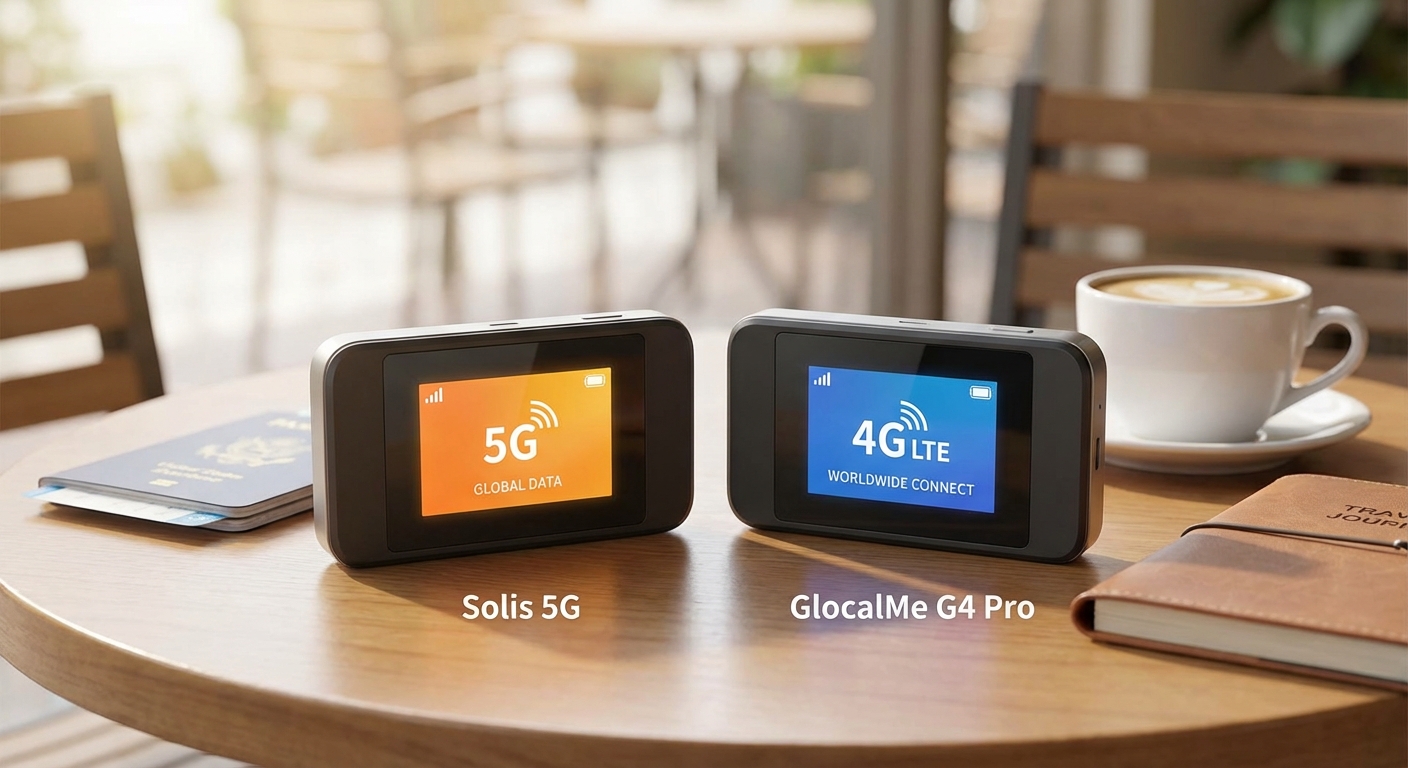
Global hotspots eliminate the need to hunt for local SIMs in every country. The Solis and GlocalMe represent two philosophies: Solis emphasizes simplicity with cloud-only connectivity, while GlocalMe offers flexibility with both cloud SIM and physical SIM slots.
After testing both across multiple continents, here's how they compare for real travel use.
This article is part of our complete digital nomad connectivity guide, covering everything from eSIMs to portable hotspots.
Quick Verdict
| Factor | Winner | Why |
|---|---|---|
| Global Coverage | Tie | Both cover 135-140+ countries |
| Flexibility | GlocalMe G4 Pro | Physical SIM slots add options |
| Simplicity | Solis X | No SIM management needed |
| Data Value | GlocalMe G4 Pro | Local SIM option reduces costs |
| Battery Life | GlocalMe G4 Pro | Larger battery capacity |
| Speed Potential | Solis X | 5G capability where available |
| Price | Tie | Both around $179 |
Bottom line: Choose GlocalMe G4 Pro if you want flexibility to use local SIMs for better rates. Choose Solis X if you prioritize simplicity and 5G speeds in supported areas.
Head-to-Head Specifications
| Spec | Solis X | GlocalMe G4 Pro |
|---|---|---|
| Network | 5G/4G LTE | 4G LTE |
| Cloud SIM Countries | 135+ | 140+ |
| Physical SIM Slots | None | 2 nano-SIM |
| Max Speed | 5G: 300Mbps / LTE: 150Mbps | 150 Mbps |
| WiFi Standard | WiFi 5 | WiFi 5 |
| Connected Devices | Up to 10 | Up to 10 |
| Battery | 4700mAh | 3900mAh |
| Power Bank Mode | Yes | Yes |
| Display | 2.4" touchscreen | 4" touchscreen |
| Dimensions | 127 x 65 x 15mm | 136 x 72 x 15mm |
| Weight | 180g | 240g |
| Price | ~$179 | ~$179 |
Solis X - The Simple Choice
What Works Well
True global simplicity - Turn on the Solis anywhere in 135+ countries and it connects. No SIM hunting, no configuration, no language barriers at phone shops. Land, power on, connect.
5G where available - The Solis X supports 5G in regions with coverage. In cities like Seoul, Tokyo, and parts of the US, you'll see notably faster speeds than 4G alternatives.
Built-in VPN - Solis includes Skyroam's VPN service, useful for securing connections on public networks and accessing restricted content.
Power bank functionality - The 4700mAh battery can charge your phone in a pinch, though this drains hotspot battery quickly.
Clean interface - The 2.4" touchscreen shows connection status, data usage, and plan management clearly.
Limitations
No physical SIM option - You're locked into Solis data pricing. In countries where local SIMs are cheap and abundant, this costs more than necessary.
Data pricing - Cloud SIM data is inherently more expensive than local rates. Long stays in one country make this cost disadvantage significant.
Limited battery - The 4700mAh battery provides decent life, but heavy use drains it in 6-8 hours.
WiFi 5 only - Modern devices could benefit from WiFi 6, though this rarely matters for typical travel use.
GlocalMe G4 Pro - The Flexible Choice
What Works Well
Dual SIM slots - This is GlocalMe's killer feature. Use cloud SIM for immediate connectivity on arrival, then switch to a local SIM for better rates during longer stays. Best of both worlds.
Local SIM value - In countries where local SIMs cost a fraction of cloud data, the G4 Pro's SIM slots provide significant savings. A week in Thailand on cloud SIM versus local SIM can differ by $20-30.
Large display - The 4" touchscreen makes plan management, connection status, and troubleshooting easier than smaller screens.
Solid battery - The 3900mAh battery provides 8-12 hours of moderate use. Power bank mode available for phone charging.
Reliable performance - The G4 Pro has been on the market long enough to iron out bugs. It consistently connects and maintains stable speeds.
Limitations
4G only - No 5G support. In areas with excellent 5G coverage, you're leaving speed on the table compared to 5G devices.
Heavier and bulkier - At 240g with that 4" screen, the G4 Pro is noticeably larger than competitors. Fits in a jacket pocket but not comfortably in pants.
SIM management complexity - The flexibility of physical SIMs comes with the task of managing them—buying, installing, tracking balances, dealing with expiration.
Cloud SIM pricing - Like Solis, GlocalMe's cloud SIM data is expensive compared to local rates. The difference is you can avoid it with physical SIMs.
Check GlocalMe G4 Pro price on Amazon
Data Pricing Comparison
Both devices use cloud SIM technology with similar pricing structures:
Solis Data Plans
| Plan | Coverage | Price | Notes |
|---|---|---|---|
| Day Pass | Global | $9/day | Unlimited in most countries |
| Monthly | Global | $99/month | Unlimited data |
| Pay-as-you-go | Regional | Varies | Buy GB as needed |
GlocalMe Data Plans
| Plan | Coverage | Price | Notes |
|---|---|---|---|
| Day Pass | Global | $9/day | Unlimited |
| Data Packages | Regional | Varies | Buy GB bundles |
| Local SIM | Country-specific | Local rates | Physical SIM option |
The Real Cost Difference
For a week in Thailand:
Solis (cloud SIM only): ~$50-70 depending on plan
GlocalMe with local SIM: ~$15-20 for local tourist SIM + any arrival cloud data
The GlocalMe's physical SIM option creates substantial savings in countries with affordable local SIMs. In Western Europe where local SIMs are also expensive, the difference narrows.
Real-World Testing
Airport Arrival Test - Bangkok
Solis: Powered on immediately after landing. Connected within 2 minutes to Thai carrier. Worked perfectly for navigation to hotel. Cloud data used: 200MB.
GlocalMe: Same immediate connection via cloud SIM. Later that day, purchased local TRUE SIM for $12 (15GB/30 days). Switched to local SIM for remaining stay.
Verdict: Both worked perfectly for arrival. GlocalMe saved money over the full week.
Rural Coverage Test - Portugal
Solis: Connected to Portuguese carrier in small villages. Speeds adequate for messaging and maps, struggled with video calls in remote areas.
GlocalMe: Identical cloud SIM performance. With a local NOS SIM, coverage was slightly better in some spots—local SIMs sometimes have better carrier agreements.
Verdict: Similar performance, slight edge to GlocalMe with local SIM.
Speed Test - Urban Seoul
Solis: 5G connected in central Seoul. Achieved 150-220 Mbps in tests—notably faster than 4G alternatives.
GlocalMe: 4G LTE reached 40-60 Mbps in same locations. Perfectly usable but noticeably slower than Solis 5G.
Verdict: Solis wins in 5G-enabled areas.
Battery Endurance Test
Solis: 6.5 hours of active use (video calls, constant connection) depleted battery completely.
GlocalMe: 8 hours of similar use with battery remaining. The larger display doesn't seem to impact battery negatively.
Verdict: GlocalMe lasts longer despite larger screen.
Use Case Recommendations
Choose Solis X If:
You prioritize simplicity - One device, one data source, no SIM management. Turn on and connect anywhere.
You travel to 5G areas - Seoul, Tokyo, major US cities—Solis delivers noticeably faster speeds.
Short trips to many countries - Hopping between countries weekly makes local SIM management impractical. Cloud SIM convenience wins.
You value built-in VPN - Solis's integrated VPN adds security without additional configuration.
Choose GlocalMe G4 Pro If:
You want cost control - Using local SIMs in countries with cheap data significantly reduces connectivity costs.
You stay in countries longer - A week or more in one place makes local SIM purchases worthwhile.
You already collect SIMs - If you have local SIMs from previous trips, the G4 Pro gives them new life.
Battery life matters - The G4 Pro lasts 20-30% longer under similar use.
You prefer larger displays - The 4" screen makes management easier, especially for troubleshooting.
Alternative Considerations
Why Not Phone Tethering with eSIM?
Phone tethering with a quality eSIM provider often beats dedicated hotspots:
Pros: No extra device, works with existing phone, often cheaper data
Cons: Battery drain on phone, weaker antenna, some eSIM plans restrict tethering
See our eSIM tethering guide for making this work effectively.
Why Not Premium Hotspots?
Devices like the Netgear Nighthawk M6 Pro offer better performance but at 3-4x the price. Worth it for power users, overkill for occasional travelers.
Why Not Just Local SIMs?
Local SIMs are cheapest but require hunting shops in each country, dealing with registration, and managing multiple plans. Global hotspots trade cost for convenience.
For a complete comparison of all options, see eSIM vs Pocket WiFi vs Local SIM.
Frequently Asked Questions
Can I use my own SIM in the Solis?
No. The Solis X has no physical SIM slot—it's cloud SIM only. This is the primary differentiator from GlocalMe.
Does GlocalMe work without cloud SIM?
Yes. You can use the G4 Pro purely with physical SIMs, never touching cloud data. It functions as a standard dual-SIM hotspot.
Which has better coverage?
Nearly identical. Both cover 135-140+ countries via cloud SIM. Actual coverage quality depends on their carrier partnerships in each specific country.
Can either replace my phone's hotspot?
Yes. Both work as primary connectivity devices, connecting laptops and tablets. They provide more stable connections and longer battery life than phone tethering.
How do data plans work?
Both offer day passes, monthly plans, and pay-as-you-go packages through their respective apps. GlocalMe adds the option of using any compatible physical SIM with local data.
Verdict
For most travelers: GlocalMe G4 Pro
The flexibility of physical SIM slots provides meaningful cost savings in countries with affordable local data. You get cloud SIM convenience for arrivals and transitions, plus local SIM economy for longer stays.
For simplicity seekers: Solis X
If you never want to think about SIMs and value the fastest possible speeds in 5G areas, the Solis delivers pure convenience. Pay more for data, save time and complexity.
Both devices solve the same fundamental problem—reliable connectivity across borders. The choice depends on whether you prioritize simplicity or flexibility.
For the complete picture of travel connectivity options, explore our complete digital nomad connectivity guide.
Solis X - Global WiFi Hotspot

Global hotspot with cloud SIM technology covering 135+ countries. Features built-in VPN, power bank functionality, and pay-as-you-go data without contracts. Includes unlimited data plans for international travel.
What We Like
❝Works seamlessly across 30+ countries I've visited. Data is pricier than local SIM but the convenience of one device everywhere is worth it for frequent travelers.❞
GlocalMe G4 Pro - 4G LTE Mobile Hotspot

GlocalMe G4 Pro
4G LTE Mobile Hotspot
Dual-SIM mobile hotspot with cloud SIM fallback covering 140+ countries.
Dual-SIM mobile hotspot with cloud SIM fallback covering 140+ countries. Features 4G LTE speeds, touchscreen interface, and physical SIM slots for using local SIMs alongside cloud data.
What We Like
❝The dual SIM slots are game-changing. I use cloud SIM for arrival, then switch to a local SIM for better rates during longer stays. Best of both worlds.❞
Review of What We Liked
Global WiFi Hotspot
Global hotspot with cloud SIM technology covering 135+ countries.
4G LTE Mobile Hotspot
Dual-SIM mobile hotspot with cloud SIM fallback covering 140+ countries.
About the Author