Proof of Onward Travel: When Airlines and Borders Actually Ask

The short answer
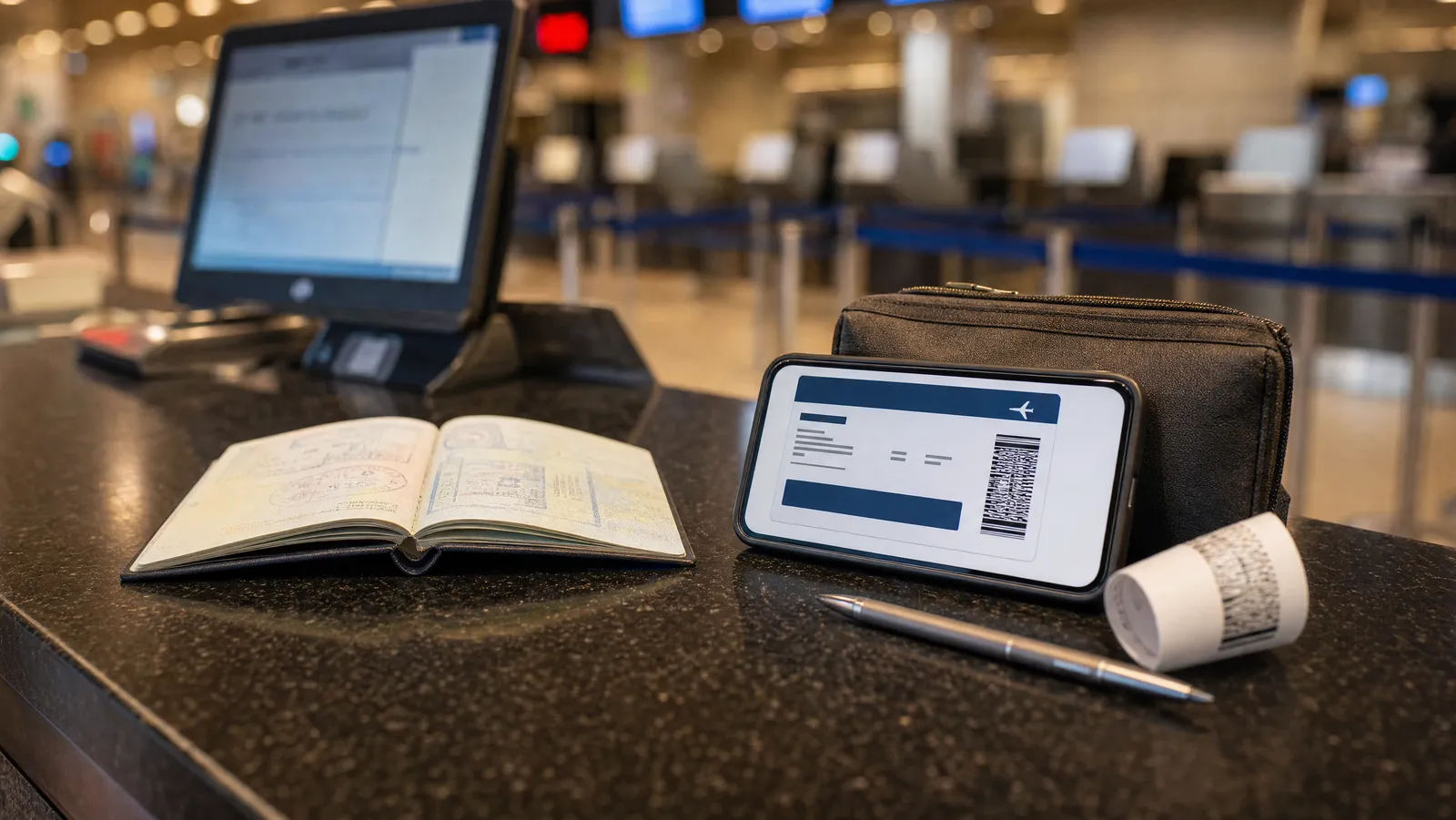
Proof of onward travel requirements are enforced by your airline at check-in, not by immigration at the border. The carrier pays the penalty and the cost of flying you back if your destination refuses you entry, so the desk agent asks before you board. A dated onward ticket saved on your phone settles it in about ten seconds.
That structural fact explains most of what goes wrong here. The agent is not assessing your trip; the agent is reading a screen that says your destination expects evidence of departure, and that screen has no field for "the immigration officer would probably have let me in".
Below: who actually asks, what satisfies them, and the three honest ways to hold a dated onward booking when your plans genuinely are open. For the rest of what gets tested at a departure airport in 2027, start with our guide to airline carry-on and boarding rules.
Why your airline cares more than the border does
The cost of getting this wrong lands on the carrier, and it is large.
A working paper presented by IATA to ICAO's Facilitation Panel in April 2026 (FALP/14-WP/29, dated 30 March 2026) puts the position bluntly: "Airlines are generally responsible for the full cost of returning inadmissible passengers to their point of origin or another admissible point, when these costs cannot be recovered from passengers." The same paper notes this "typically occurs even when the passenger does not hold a return ticket". Around 50 surveyed operators logged more than 111,800 such cases for 2024, at costs of up to USD 14,000 each in Europe.
Penalties sit on top of that. Council Directive 2001/51/EC requires EU member states to penalise carriers that bring in improperly documented passengers, and its Article 4(1) gives them three alternative thresholds to pick from: "either the maximum amount of the applicable financial penalties is not less than EUR 5000" for each person carried, or a minimum of EUR 3000 for each person carried, or a lump sum of at least EUR 500,000 for each infringement. In the UK, the Home Office's guide for carriers states that operators "may become liable for a charge of £2,000 for every passenger arriving in the UK without" a valid identity document, the required visa or e-visa, or a valid Electronic Travel Authorisation — the charge in section 40 of the Immigration and Asylum Act 1999.
Read the UK figure precisely: it is a documents charge, not an onward-ticket charge. We found no national carrier-liability charge that is triggered by a missing return flight as such. What drives the onward check is the removal bill, plus the expense of being wrong about admissibility.
Timatic, the screen the agent is reading
The agent is almost always reading IATA's travel-document database rather than exercising judgement, which changes how you handle the conversation.
IATA describes Timatic on its own product page as "a leading provider of real-time information on travel document requirements for international air travel", and says in its FAQ: "We make on average around 70 updates per day in Timatic." As of November 2026 the name has not changed: IATA publishes it as Timatic AutoCheck, Timatic Doc Scan, Timatic Web and Timatic Widget, with the IATA Travel Centre as the traveller-facing version.
An IATA Knowledge Hub article dated 23 June 2026 describes the check itself: the eligibility engine "takes the verified document data and checks it against the entry, transit and exit requirements for the whole journey", and when something fails "the document is flagged and the airline is alerted". The same article states plainly that "This is an airline process" and that the product "does not replace border control".
Two consequences. The agent has very little room to overrule the screen, so bring what it asks for rather than an explanation. And the rule it holds can be stricter than the destination's published policy and still win. The counter is where your bag and your paperwork get tested in the same two minutes, which is why carry-on size limits by airline and your onward booking belong in one pre-flight check.
Where the rule is written as "may be asked"
Conditional wording in a government source is the trap. Treat "may be asked" as "will be asked by the airline".
The clearest worked example is Thailand. The UK Foreign Office's Thailand entry-requirements page, read on 10 November 2026, lists among the things immigration may ask you to show "evidence of onward or return travel" and "proof that you have enough money for your stay (at least 10,000 Thai baht per person or 20,000 Thai baht per family)". It then adds the sentence that settles the argument: "British nationals have been refused entry for failing to provide this evidence."
The same page shows why the date matters as much as the ticket. From 15 September 2026, it states, "if you enter Thailand under the visa exemption scheme, you can stay for up to 30 days for tourism only". An onward flight dated 50 days out, held against a 30-day exemption, is not proof of compliance — it is evidence of intended overstay.
Which countries and routes actually ask
Each row below comes from a government page.
| Country or area | Typically asked on a one-way ticket? | What the published rule asks for | Source we checked |
|---|---|---|---|
| Thailand | Yes | "evidence of onward or return travel", plus funds of at least 10,000 baht per person or 20,000 per family | UK Foreign Office Thailand entry requirements |
| Indonesia | Yes — the published requirement sits on the visa on arrival | "you must have proof of your onward or return journey" | UK Foreign Office Indonesia entry requirements |
| Philippines | Yes | "proof of return or onward travel", which "Immigration officials and airlines may ask for" | UK Foreign Office Philippines entry requirements |
| New Zealand | Yes | "proof of a return or onward ticket" and "proof that you have enough money for your stay" at border control, plus an NZeTA for visa-free entry | UK Foreign Office New Zealand entry requirements |
| Panama | Sometimes, more likely arriving overland from Costa Rica | "a return or onward ticket", plus proof of "at least 1000 US dollars (or the same amount in other currencies) or a credit card" | UK Foreign Office Panama entry requirements |
| Schengen area | Sometimes | Means of subsistence for the stay and the return; Annex I lists "a return or round-trip ticket" as documentary evidence | Regulation (EU) 2016/399, Article 6 and Annex I |
Checked November 2026. Entry rules are set by the destination's own authorities and change without notice — read its immigration page, and your own foreign ministry's page for your nationality, before you book. The rows above are the UK government's reading of other countries' rules, written for British nationals.
We left rows out: the Foreign Office pages for Singapore and Costa Rica, read the same day, do not mention onward travel — which does not mean no airline will ask.
The Schengen case
Schengen is the one where the legal text is explicit and the enforcement is patchy.
Regulation (EU) 2016/399, the Schengen Borders Code, sets the short-stay entry conditions in Article 6(1)(c): a third-country national must "justify the purpose and conditions of the intended stay" and have "sufficient means of subsistence, both for the duration of the intended stay and for the return to their country of origin or transit to a third country into which they are certain to be admitted". Article 6(4) adds that the assessment "may be based on the cash, travellers' cheques and credit cards" you hold.
The ticket enters through the evidence list: Annex I to the same regulation, listing "The documentary evidence referred to in Article 6(3)", includes "a return or round-trip ticket" for travel for tourism or private reasons.
So the ticket is not a standalone Schengen requirement; it is one way to satisfy a means-of-return test an officer may apply. What refuses nomads more often is the day count, and that arithmetic lives in our explainer on the Schengen 90/180 rule — a booking dated beyond your remaining allowance is worse than none. Budget time at the border too, which we cover in EES border delays at airports.
What actually satisfies the check
The agent needs something dated, in your name, readable in seconds:
- A dated onward or return flight, with your name matching your passport and a date inside the stay you are permitted on that entry route.
- A surface ticket out — a dated bus, train or ferry booking crossing an international border. Acceptance varies by agent and route.
- A residence permit or long-stay visa for another country, which shows a lawful destination rather than a seat. If you hold a nomad visa, that document does more work than any flight booking; our digital nomad visa guide covers which programmes issue one.
- Onward travel from a different port or city than the one you arrived at, which is normal overland and usually accepted when the dates work.
A PDF or screenshot saved offline on the phone beats opening an airline app on airport wifi. Keeping dated documents in one offline folder is also what makes the visa application document checklist quick to assemble.
The three honest ways to hold an onward ticket
None of this is about misleading a border officer. The aim is a genuine, verifiable booking reflecting a real option you could take — which is what the entry conditions and the airline's screen ask for.
1. A refundable fare or a cancellation window. On flights touching the United States, the Department of Transportation's rule at 14 CFR 259.5(b)(4) requires each carrier's customer service plan to include "Allowing reservations to be held at the quoted fare without payment, or cancelled without penalty, for at least twenty-four hours after the reservation is made if the reservation is made one week or more prior to a flight's departure". The conditions matter: the carrier picks which option it offers, the booking must be at least seven days out, and the rule binds airlines rather than agents, so book direct. Outside the US, the equivalent is a free-cancellation or refundable fare — a commercial product, not a legal right.
2. A cheap genuine onward ticket. A low-cost carrier hop out of the region, bought outright, has no mechanics to get wrong. It is a real seat, and an unused one costs a small fixed amount rather than a trip.
3. Onward-ticket rental services. These exist and are widely used: you pay a fee and receive a booking reference for a flight you do not intend to take. What you are buying is typically a reservation held for a short window, not a ticket, and its reliability is entirely the service's — if the hold lapses or the reference does not validate at the desk, you have nothing. We do not recommend, rank or price any provider.
Entry decisions are discretionary and nothing here is immigration advice. Check the destination government's own page for your nationality, and where it is unclear, ask that country's embassy.
The pre-flight routine
This is a ten-minute job the night before, not an airport problem.
- Save the onward booking offline, as a screenshot or PDF on the phone.
- Match the date to your permitted stay, not to your plans. Check the stay length for your nationality on that entry route — visa-free, visa on arrival, land border or air — because they often differ.
- Read the destination's own page, not a summary. Entry-requirement pages change quietly, as Thailand's move to a 30-day visa exemption from 15 September 2026 shows.
- Expect the question at check-in. Have the booking open before you reach the desk, alongside whatever your departure airport wants in the tray — see our notes on getting your tech through security and on airport liquid rules by airport.
- If you are refused at the desk, buy an onward ticket there — almost always cheaper than a missed flight.
The bottom line
Proof of onward travel is an airline problem that becomes your problem at check-in. The carrier absorbs the cost of flying a refused passenger back — IATA's April 2026 paper to ICAO's Facilitation Panel says airlines are "generally responsible for the full cost" of that return — and penalties like the UK's £2,000 documents charge make guessing expensive. So the desk asks, the screen decides, and a dated booking ends the conversation.
Hold one honestly: a refundable fare inside a cancellation window, or a cheap real seat out of the region, dated inside the stay you are actually permitted. The number that matters is the permitted stay, not the price of the ticket.
For everything else that gets tested between the kerb and the gate in 2027 — cabin bag limits, battery rules already in force, and liquid limits that now vary by airport — see our 2027 air travel rules guide.
Frequently Asked Questions
Do I need a return ticket to fly on a one-way booking?
Often, in the form of an onward rather than a return ticket: the test is evidence that you will leave, not that you will go home. The UK Foreign Office's pages for Thailand, Indonesia, the Philippines and New Zealand all list onward or return travel among the things you may be asked to show, and the airline is the party that checks it.
Which countries require proof of onward travel?
There is no reliable central list, because the requirement is usually written as something immigration "may" ask for. From government pages read in November 2026, Thailand, Indonesia, the Philippines, New Zealand and Panama all publish an onward or return travel expectation, and the Schengen Borders Code lists a return ticket as evidence for its means-of-return test.
Can I use a refundable ticket as proof of onward travel?
Yes, and it is a genuine booking while it exists. On flights touching the United States, 14 CFR 259.5(b)(4) requires carriers to hold a reservation at the quoted fare without payment, or allow cancellation without penalty, for at least 24 hours when the booking is made a week or more before departure. The carrier picks which option, so confirm the terms first.
Are onward-ticket rental services safe to use?
They are widely used, but what you usually buy is a reservation held briefly rather than an issued ticket, and its reliability is entirely the provider's. If the hold expires early or the reference fails validation at check-in, you have no fallback. A cheap genuine ticket out of the region costs more up front and cannot fail that way.
Does a bus, train or ferry ticket count?
Sometimes. A dated surface crossing out of the country is real evidence of departure and is often accepted where overland travel is normal. It is weaker at a long-haul desk, where the screen mentions onward travel without specifying a mode.
Who actually checks, the airline or immigration?
Usually the airline, at check-in. IATA's June 2026 description of the process says the eligibility engine checks document data "against the entry, transit and exit requirements for the whole journey" and that it "does not replace border control". Immigration can still ask on arrival, which is why the booking should survive both checks.
About the Author