Power Bank Rules on Planes: What Changed in 2026 and What Changes in 2027
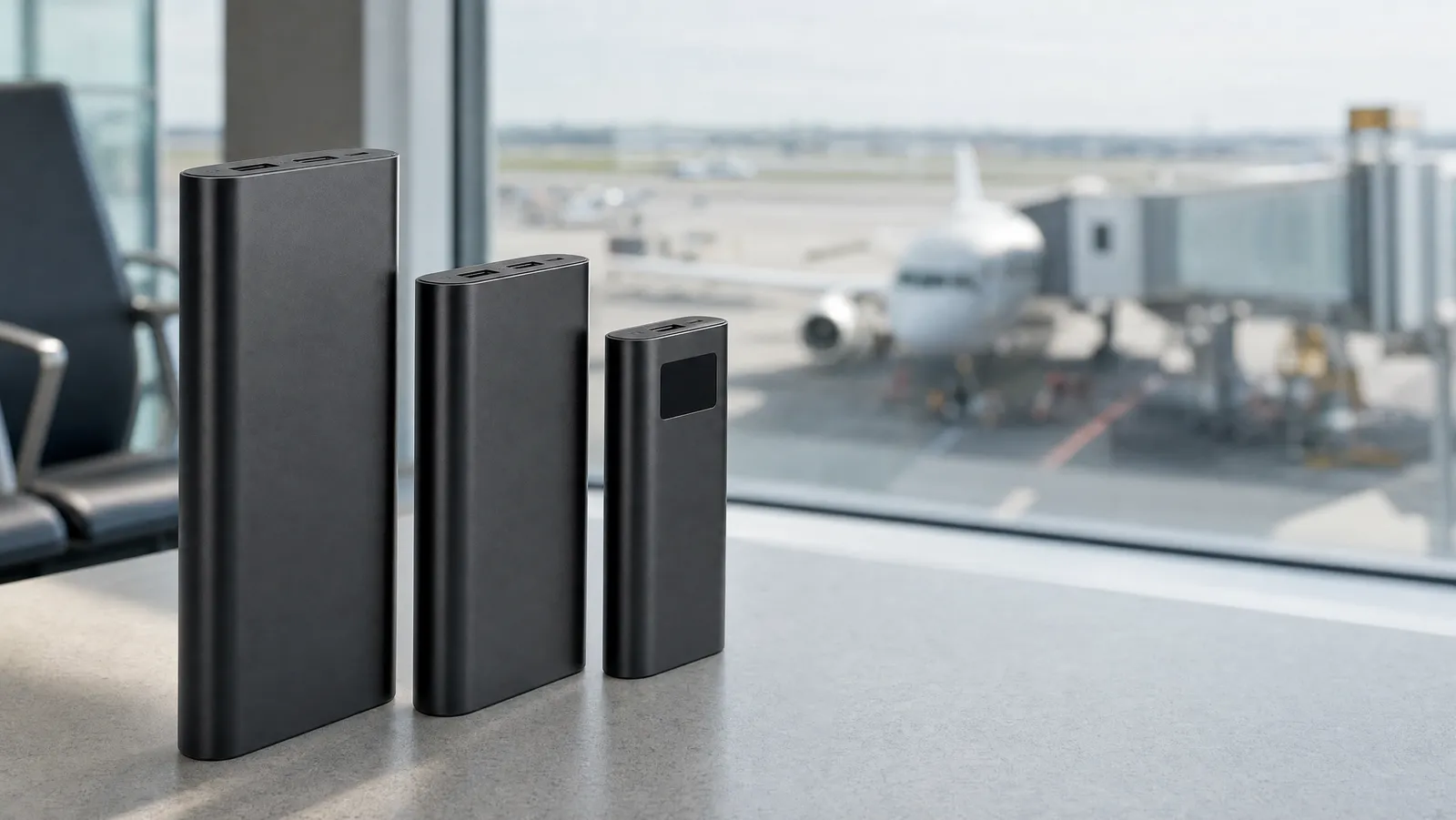

Almost every power bank a nomad owns is legal in carry-on baggage. The line is 100 watt-hours, which covers roughly everything up to about 27,000mAh, and the pack must never go in checked baggage. What changed in 2026 is the other half of the question: several airlines now restrict using a power bank in flight even though carrying it is fine.
Understand that split before your next boarding pass gets scanned. The carriage rule is global and settled; the usage rule is one international addendum plus carrier policies that go further, and it is still moving. For the wider picture on what else shifted in the cabin this year, start with our guide to airline carry-on rules; this page handles batteries.
Everything below is dated and attributed. Power bank airline rules changed twice in 2026 and are scheduled to change again on 1 January 2027, so a figure without a date on it is worth nothing at a checkpoint.
Why airlines measure watt-hours, not mAh
The number printed biggest on your power bank — 10,000mAh, 20,000mAh, 26,800mAh — is not the number any airline cares about. Milliamp-hours describe charge, not energy, and ignore voltage. Aviation rules are written in watt-hours (Wh), because Wh predicts how much heat a cell can dump into a cabin.
The conversion is simple arithmetic. The FAA's PackSafe guidance, last updated 11 August 2026, puts it as: "To calculate Wh, multiply the battery voltage by the Amp hours (Ah)." IATA's 2026 passenger guidance gives the same formula as Wh = Ah x V. So:
- Divide the mAh figure by 1,000 to get amp-hours.
- Multiply by the nominal cell voltage, which for lithium-ion is typically 3.6V or 3.7V.
Work one through. A 20,000mAh pack is 20Ah; at 3.7V nominal that is 74Wh, comfortably legal. A 27,650mAh pack on 3.6V cells works out to 99.54Wh, squeezing under the line with half a watt-hour to spare. Push to 30,000mAh at 3.7V and you get 111Wh, which is over.
One catch: do not do this maths at the gate and expect to win. IATA's guidance is explicit that all lithium-ion batteries must have the watt-hour rating marked on the outside of the case, and that "if passenger handling staff are unable to verify the Watt-hour rating by checking either the battery, or the user documentation, the operator may not permit the carriage of the lithium battery." An unmarked pack is a refusable pack. Our power bank buying guide for phones and laptops covers reading a spec sheet before you buy; our watt-by-watt guide to running Starlink Mini from a power bank applies the same arithmetic to a real load.
The watt-hour thresholds and what each one means
Here is where the three bands sit as of October 2026. The middle one moved this year, and it now means something different for a power bank than for a camera battery.
| Watt-hour rating | Power banks | Spare batteries and batteries in devices |
|---|---|---|
| Up to 100Wh | Carry-on only, no approval needed, max two per person | Carry-on only for spares, no approval needed |
| Over 100Wh up to 160Wh | Forbidden in IATA's 2026 passenger table | Operator approval required, max two spares per person |
| Over 160Wh | Not permitted in passenger baggage | Cargo only, under the IATA Dangerous Goods Regulations |
Table reflects IATA's "Passengers Travelling with Lithium Batteries" guidance dated 31 March 2026 and the FAA's PackSafe entry dated 11 August 2026. Carriers may be stricter — check your airline's own page before you fly.
Read that middle row twice. IATA's Table 1 marks power banks over 100Wh and up to 160Wh as forbidden, while the same row permits a 100-160Wh spare battery or a battery installed in a device with operator approval. The FAA states the spare-battery route plainly: "With airline approval, passengers may also carry up to two spare larger lithium ion batteries (exceeding 101-160 Wh)." A cinema-camera battery can be waved through on a form a comparable power bank cannot.
The ICAO addendum itself is looser than IATA's table on this point: IATA's operator guidance notes the addendum "provides for passengers to carry power banks of 100-160 Wh with the approval of the operator," which is why a carrier such as Qantas still permits two power banks of up to 160Wh each. IATA chose not to reflect that route in its 2026 passenger table, and says it "will not be carried into the 68th edition of the DGRs."
Above 160Wh you are out of passenger baggage entirely, which is why most of the gear in our portable power station roundup for remote work is van kit, not flight kit.
Power banks never go in checked baggage
The oldest rule on the page, and the least negotiable. The FAA's PackSafe guidance states that spare lithium-ion and lithium-metal batteries, "including power banks and cell phone battery charging cases, must be carried in carry-on baggage only." IATA puts it plainly: "Never place spare batteries or power banks in checked baggage."
The reason is crew access. IATA's operator guidance frames power banks as "presenting an increasing concern with the threat of thermal runaway and fire risk in aircraft," and a fire in the hold is a fire nobody can reach. Qantas states the consequence bluntly on its own dangerous goods page: power banks "are prohibited in your checked baggage, if found they will be confiscated or disposed of."
Gate-checking catches people out. If your roller gets pulled at the door, the FAA requires that "all spare lithium batteries and power banks must be removed from the bag and kept with the passenger in the aircraft cabin." The same provision covers flying with spare batteries for cameras and drones.
How many power banks you are allowed to carry
The quantity answer changed in 2026, and it depends on whose rule binds your flight.
- The international standard is two. ICAO's Addendum No. 1 to the 2025-2026 Technical Instructions, applicable from 27 March 2026, states that for power banks "no more than two power banks may be carried per person." IATA's operator guidance summarises the same change as limiting passengers and crew to two power banks for personal use.
- US federal rules set no power bank count. The FAA's PackSafe quantity entry reads "None for most batteries," then warns that "many airlines, both domestic and international, may have stricter quantity and Wh limits to include how many power banks/portable chargers each passenger is allowed to travel with, regardless of Wh capacity."
- Spare batteries are counted separately. IATA's 2026 table caps each person at 20 spare batteries of any type and 15 portable electronic devices. Qantas applies the same 20-battery ceiling.
- Some carriers allow fewer. Southwest cut its limit to one portable charger per passenger from 20 April 2026, per trade reporting on an internal memo from its vice president of safety and security.
Two is the number to plan around: a phone bank plus a laptop-class USB-C pack already puts you at the ceiling on most airlines.
What actually changed in 2026
Two things, days apart in the paperwork.
First, ICAO issued Addendum No. 1 to the Technical Instructions on 27 March 2026, applicable the same day. IATA's guidance for operators lists what it did: separated power banks out from spare batteries for the first time, limited passengers and crew to two power banks for personal use, and prohibited passengers recharging a power bank in flight. The addendum text says a power bank "must not be recharged while onboard the aircraft" and "should not be used to recharge a portable electronic device while onboard the aircraft" — the first is a requirement, the second a recommendation.
Second, IATA's passenger guidance of 31 March 2026 went slightly further than the addendum and told travellers that power banks "should not be stored in the overhead lockers" and "should not be used to provide power to other devices during taxi, take-off or landing." It also closes with the sentence that explains the whole patchwork: "Airlines may impose more stringent conditions on the carriage and use of power banks by passengers."
The stated reason is manufacturing quality, not passenger behaviour: IATA's operator document cites "low barriers to manufacturing and a general lack of confidence in global regulatory oversight of non-conforming manufacturers," and calls wireless power banks "an emerging concern."
Which airlines restrict using a power bank in flight
This is the part that bites on board rather than at the checkpoint. The carriers below have published, or been reliably reported to have adopted, rules beyond the ICAO baseline. This list is not exhaustive — we name only the ones we could verify.
| Carrier | What it restricts | Date |
|---|---|---|
| Qantas | Power banks "cannot be used or charged during the flight, including via in-seat USB ports"; two per person, each not over 160Wh; seat pocket or under the seat in front | Qantas dangerous goods page, checked October 2026 |
| Southwest Airlines | A charger in use "must be out of any baggage and remain in plain sight"; "Do not charge devices in the overhead bin" | Effective 28 May 2025 per the airline's statement |
| Southwest Airlines | One portable charger per passenger, 100Wh cap, no overhead bin, no charging from in-seat outlets | Reported effective 20 April 2026 |
| Lufthansa Group | No use or charging of power banks on board; two per passenger in carry-on | Reported effective 15 January 2026, group-wide |
| Virgin Australia | Power banks, jump starters and UPS units treated as loose batteries, carry-on only; recalled models banned outright | Virgin Australia dangerous goods page, checked October 2026 |
Policies in this table were checked in October 2026 and carrier rules change without notice. Read your airline's own dangerous goods page before you fly, especially on codeshares — the operating carrier's rule is the one that applies.
Our read: carriage limits are converging on the ICAO baseline, while in-flight use is where carriers differentiate — and the strictest version is becoming the default.
What is scheduled for 2027
Agreed, published, and not yet in force. The 68th edition of the IATA Dangerous Goods Regulations takes effect on 1 January 2027, and IATA has already published its passenger provisions. Three things change:
- 100Wh becomes a hard ceiling. The 68th edition's list of items forbidden in passenger baggage includes the flat entry "Power banks exceeding 100 Wh." No approval route. IATA's operator guidance explains that the ICAO addendum's 100-160Wh approval provision "will not be carried into the 68th edition of the DGRs," citing concerns over "regulatory oversight of power bank manufacturers."
- Two per passenger goes into the table. The published 68th-edition entry reads "No more than two (2) per passenger," lists power banks as carry-on only with no operator approval available, and repeats that they "must not be recharged in flight on board the aircraft."
- The spare-battery allowance drops to 18. IATA's 2026 table caps each person at 20 spare batteries; the published 68th-edition text says "Each person is limited to a maximum of 18 spare batteries," with the operator able to approve more.
The transitional documents expire with the year — IATA states its 2026 operator guidance "will not be effective beyond 31 December 2026." Beyond the 68th edition, nothing further is confirmed. IATA's March 2026 passenger guidance noted that "recent events have resulted in further proposed restrictions" on power banks and that "it will take some time for these proposals to be accepted into regulation" — the restrictions it was describing are the ones now written into the 68th edition. Treat anything past 1 January 2027 as a proposal, not a rule.
At the gate and in the air
Pack for the strictest version and you never have to check:
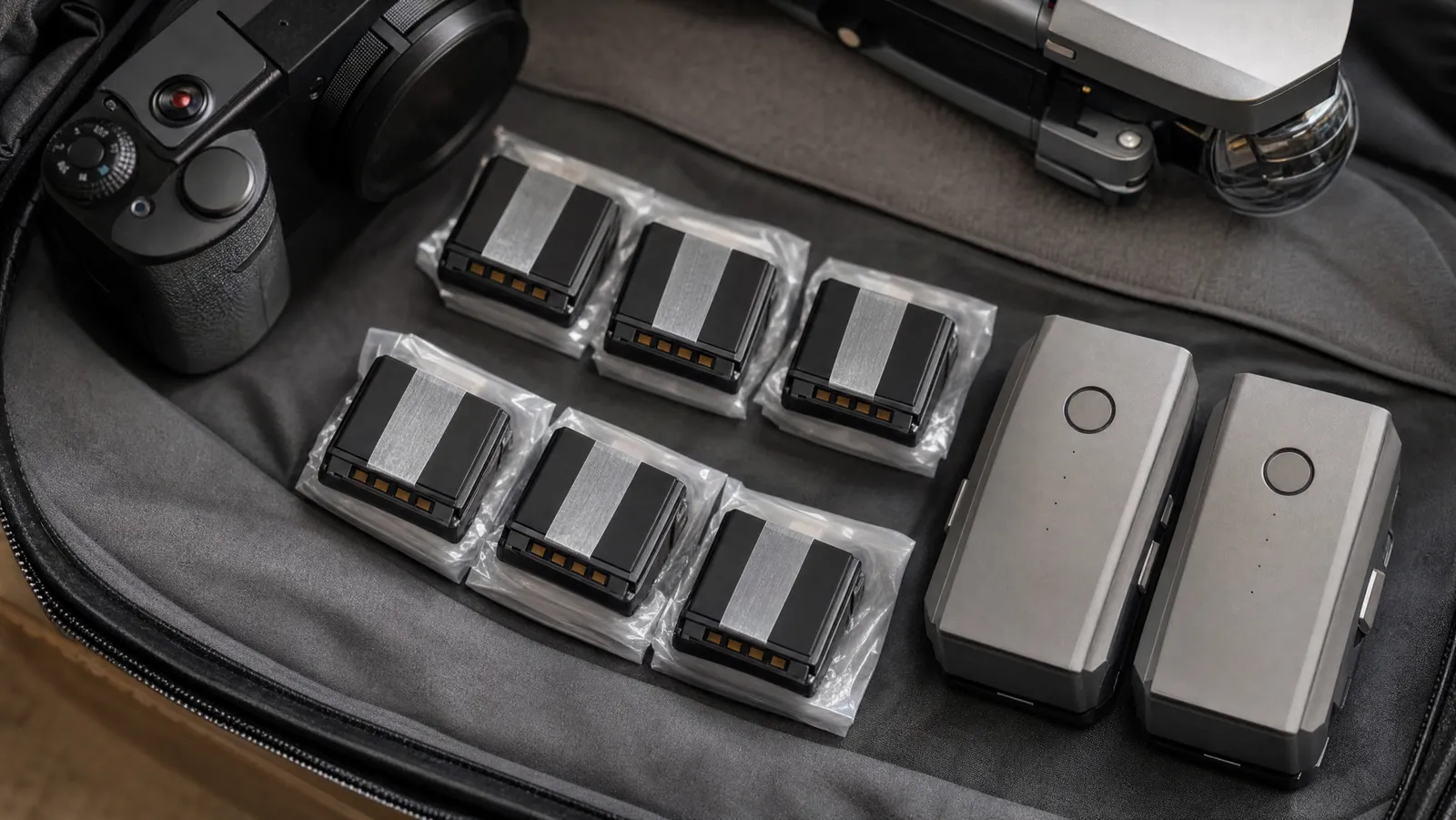
- Protect the terminals. The FAA's accepted methods: leave the battery in retail packaging, tape the terminals, use a battery case or sleeve, or put it "snugly in a plastic bag or protective pouch." That is the standard lithium battery safety bags are sold against, and the ICAO addendum requires power banks to be "individually protected so as to prevent short circuits when not in use."
- Arrive at a low state of charge. IATA says airlines "prefer spare batteries and power banks to be at less than 25%," and warns against recharging before boarding and then stowing the pack in the overhead locker.
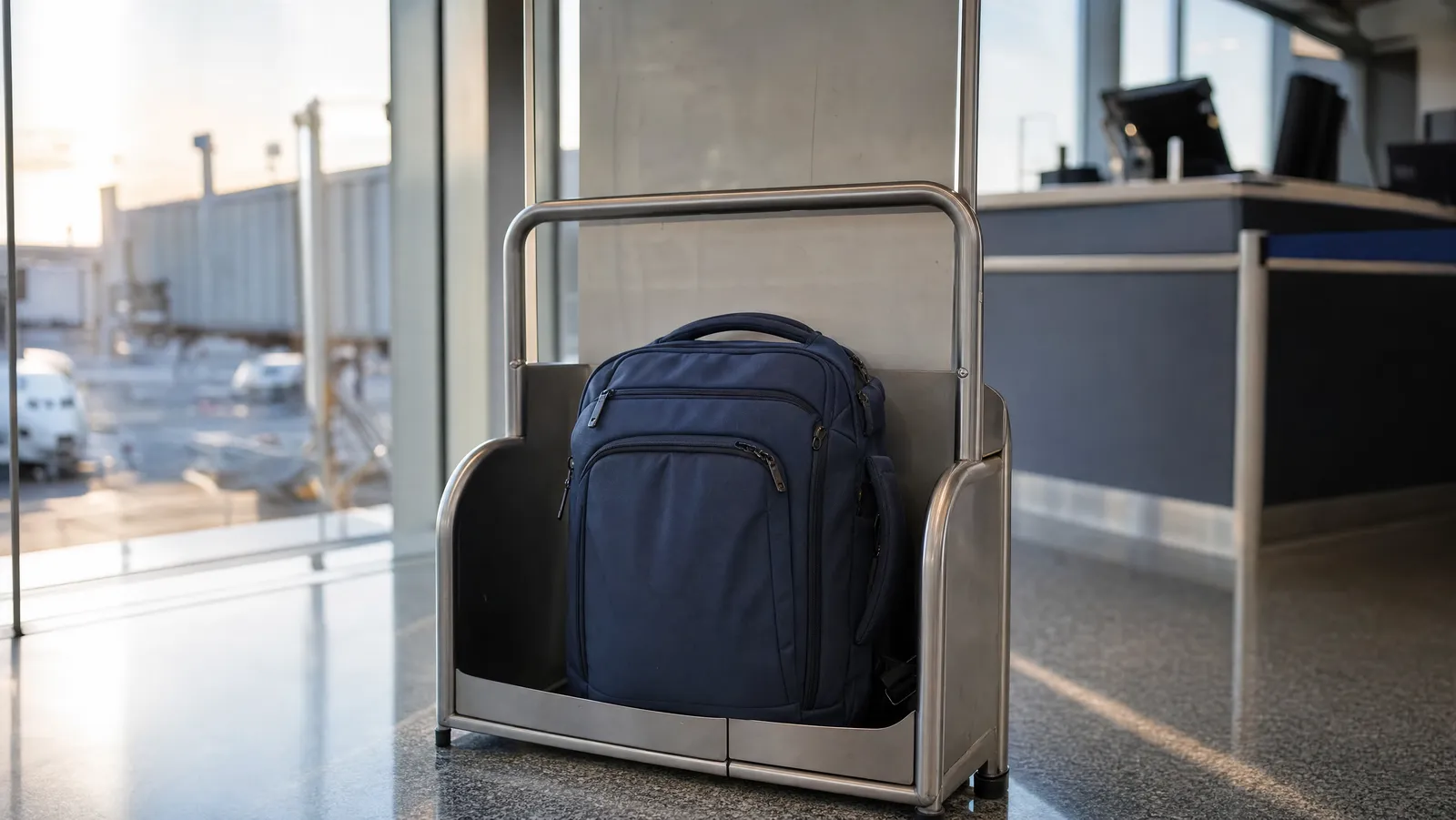
- Keep it where crew can see it. Seat pocket, under the seat in front, or on your person — the pattern across Qantas, Southwest and the Lufthansa Group. Not the overhead bin.
- Separate the packs. IATA asks passengers to "keep some space between spare batteries" and to switch wireless power banks off so they cannot start charging a phone inadvertently. A compartmented tech pouch or cable organiser handles this for you.
- Do not charge the bank from the seat USB. That is now an ICAO requirement rather than a carrier preference, and Qantas names in-seat USB ports explicitly.
- Speak up fast. IATA's instruction: "If a device is hot, smoking, or damaged, tell the crew (or airport staff) immediately."
Rebuilding your kit around these limits? Our connectivity packing list decides the batteries, cables and adapters together.
What to do if you get stopped
Four scenarios, most common first.
The Wh rating is not legible. The most common refusal and the hardest to argue: IATA's guidance lets the operator refuse carriage if staff cannot verify the rating from the battery or the user documentation. Keep a photo of the spec label on your phone.
You are over the quantity limit. Hand the extras over rather than negotiating. Checking them is not an option — the FAA, IATA and the carriers all prohibit power banks in the hold.
The pack is damaged, swollen or recalled. The FAA states that damaged or recalled batteries "must not be carried aboard an aircraft (e.g., carry-on or checked baggage) unless the damaged or recalled battery has been removed, or otherwise made safe." Virgin Australia points travellers at the Australian ACCC's recall list and says recalled power banks "are not permitted on Virgin Australia aircraft, including checked baggage at any time."
It gets confiscated. Neither the airline nor the screening authority will compensate you. For a laptop-class pack, that is a loss worth knowing your cover for — see our guide to insuring laptops and tech gear.
Arguing at the gate is a losing position in all four cases: the operator holds the discretion, and the operating carrier's rule is the binding one.
The short version
As of October 2026: carry up to two power banks, each at or under 100Wh, in carry-on only, terminals protected, stowed where a flight attendant can reach it. Do not recharge it from the aircraft, and assume your airline forbids using it in flight unless its own page says otherwise. From 1 January 2027 the 100-160Wh approval route is scheduled to disappear with the 68th edition of the IATA Dangerous Goods Regulations — so if you are buying now, buy under 100Wh and stop thinking about it.
When you need an actual recommendation rather than a rule, we have sized the field against these thresholds in our roundup of the best airline-approved power banks. For everything else in the bag — liquids, sharps, the sizers, the odd items that changed this year — see Nomad Outfit's complete guide to 2027 carry-on rules.
About the Author