Europe's New Hand Luggage Rules: What the EU Cabin Bag Reform Means

The short answer
The EU hand luggage rules for 2027 are law, and they guarantee less than the headlines promised. They come from Regulation (EU) 2026/2202, published in the EU's Official Journal on 2 October 2026, and the baggage entitlement is one free personal item: the regulation's own definitions article sets it at a maximum of 40 x 30 x 15 cm, or a bag that fits under the seat in front. There is no guaranteed free wheeled cabin bag.
Nothing changes at a gate before late next year either. The regulation's final article says it enters into force on the twentieth day after publication — 22 October 2026 — and that "It shall apply from 23 October 2027". The law firm Burges Salmon reads the same text as meaning "most of its substantive provisions will not apply until 23 October 2027". So the honest version of "free hand luggage in Europe" is a free under-seat item most carriers already allow, plus a price-display obligation. For what else moved in the cabin this year, start with our guide to airline carry-on rules for 2027; this page handles the EU reform on its own.
How a Brussels baggage rule becomes binding
The reporting has been contradictory because an EU regulation is agreed three or four times before it binds anyone, and each stage produces its own press release. The Commission proposes a text, the European Parliament adopts its position, the member states in the Council adopt theirs, the two negotiate the differences, and only the version published in the Official Journal has force — from the date that version names, not the date it was agreed. Where the two cannot reconcile in second reading, a Conciliation Committee is convened, which is the step the Parliament's own January 2026 press release describes for this file.
| Stage | Date | What it said about bags |
|---|---|---|
| Transport committee position | 24 June 2025, by 38 votes to 2 with 2 abstentions | Free personal item of "maximum dimensions of 40x30x15 cm" plus small hand luggage of "100 cm and 7 kg" |
| Parliament second-reading position | 21 January 2026, by 632 votes to 15 with 9 abstentions | Same pairing, bag specified as "100 cm (combined length, width and height) and seven kilograms" |
| Conciliation deal with the Council | 15 June 2026 | Provisional agreement; Euronews calls it the first major revision since 2004 |
| Parliament confirms the final text | 7 July 2026, by 646 votes to 12 with 3 abstentions | Euronews: a "free personal item measuring 40cm by 30cm by 15cm" |
| Council final clearance | 13 July 2026 | Release headed "Council gives final clearance for stronger air passenger rights" |
| Text signed | 16 September 2026 | The regulation carries the date "Done at Strasbourg, 16 September 2026" |
| Official Journal publication | 2 October 2026 | Regulation (EU) 2026/2202, amending Regulation (EC) No 261/2004 |
| Regulation applies | 23 October 2027 | Its own final article: "It shall apply from 23 October 2027" |
Stages and dates as checked 3 November 2026. The regulation's text is on EUR-Lex under the identifier 2026/2202.
The row that matters is the fourth. The 100 cm, 7 kg cabin bag was in Parliament's negotiating position and did not survive into the adopted text.
What the regulation actually guarantees
Four things, and only one of them is a free bag.
A free personal item. The new Article 11a inserted into Regulation (EC) No 261/2004 states that "operating air carriers shall permit passengers to carry a personal item into the cabin and at no extra cost". The definitions article fixes the size: a personal item is unchecked baggage complying with security and safety requirements, "either with maximum dimensions of 40 x 30 x 15 cm or on the condition that it fits under the seat in front of the seat in which the passenger is sitting". Euronews, reporting the 7 July 2026 vote, gives the same 40cm by 30cm by 15cm figure.
A trolley you may bring, not one you get free. Article 11a also requires carriers, "subject to the capacity of the aircraft cabin", to permit one piece of hand baggage into the cabin. The words "at no extra cost" appear only in the sentence about the personal item, and recital 43 says the reform does not impinge "on the possibility for air carriers and intermediaries to offer air fares which do not include a piece of hand baggage".
A price you can compare. Article 11a states that "whenever air fares are offered or published, air fares including allowance for a piece of hand baggage shall be displayed by default before the start of any booking process", while allowing "commercially differentiated offers to passengers who voluntarily choose to travel without hand baggage". Burges Salmon reads that as airlines having to "clearly disclose their hand baggage allowances" and "display fares including hand baggage by default"; Euronews notes the obligation extends to intermediaries and search portals.
A fallback, not an absolute. The regulation also lets a carrier send unchecked baggage to the hold at no further cost where safety, capacity or an aircraft change prevents cabin carriage.
What is not there: any requirement that a 10 kg trolley fly free. Coverage of the 7 July vote by Paddle Your Own Kanoo states airlines "will still be able to charge extra for hand baggage or trolley bags that are too big to fit underneath the seat in front".
The 100cm cabin bag rule, and why it was never a free trolley
The 100 cm figure still circulates, and it is measured in a way airlines do not use. Airlines publish three numbers — 55 x 40 x 20 cm — and measure each against a sizer. A combined limit adds them into one figure, so that same bag is 115 cm. Run real shapes through it:
- Ryanair's free under-seat bag at 40 x 30 x 20 cm sums to 90 cm, inside a 100 cm cap.
- A standard European cabin trolley at 55 x 40 x 20 cm sums to 115 cm, well outside it.
- easyJet's own cabin bags page sets its free small bag at 45 x 36 x 20 cm including handles and wheels, which sums to 101 cm — fractionally outside a cap sold as an upgrade on current practice.
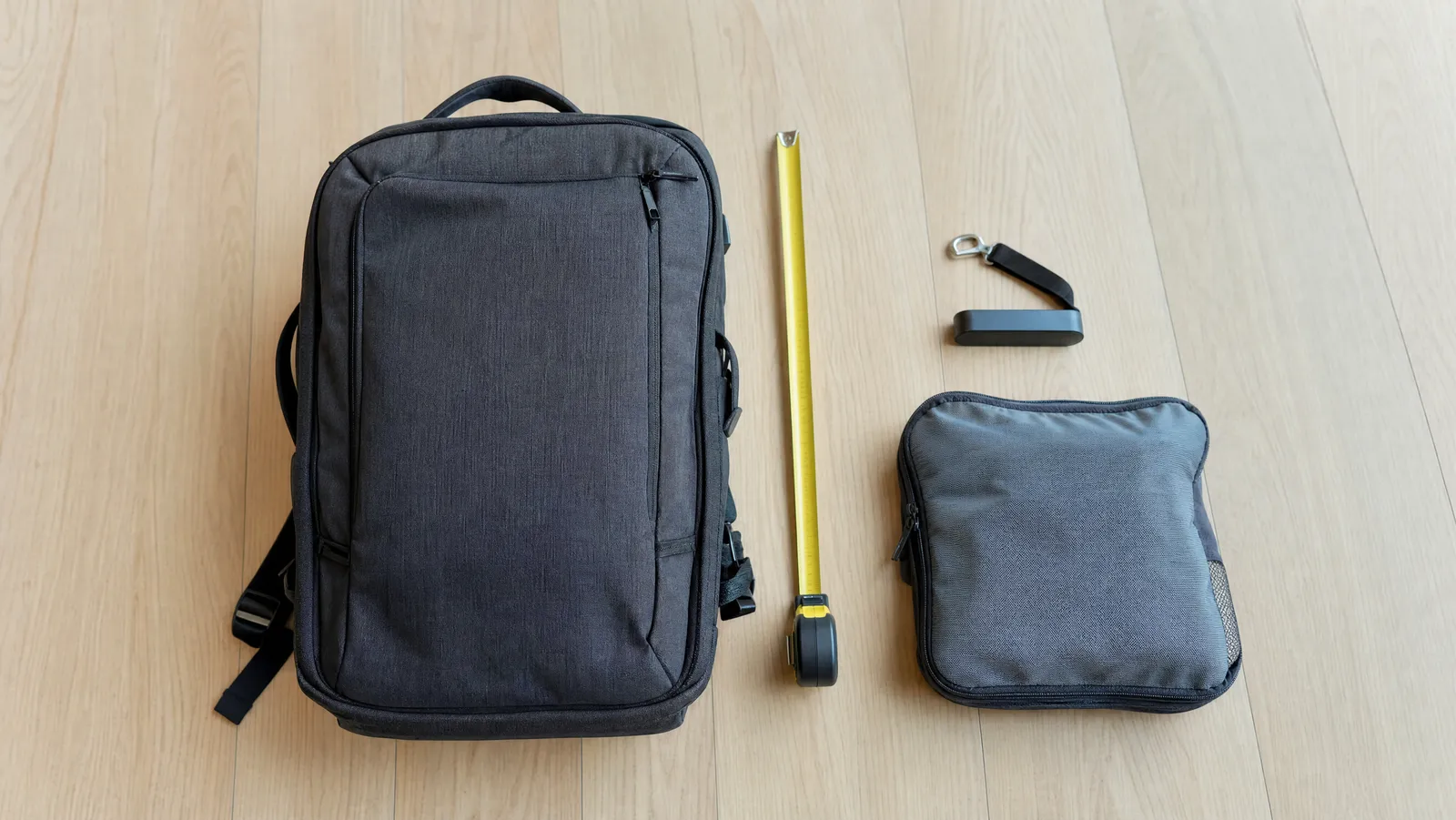
Even in the version MEPs voted for, a 100 cm allowance was a large backpack, not a roller. Our laptop daypack picks are the class of bag that clears combined limits comfortably, and packing cubes let you decompress a pack into an under-seat shape while a gate agent holds a sizer.
The legal backdrop that already exists
One strand of EU law already touches hand-baggage charges, and it predates the reform by a decade. In Case C-487/12, Vueling Airlines v Instituto Galego de Consumo, decided on 18 September 2014, the Court of Justice of the European Union struck down a Spanish rule requiring airlines to carry checked baggage without a surcharge, as incompatible with the pricing freedom in Regulation 1008/2008. The Court's own press release draws the distinction argued over ever since: storing checked baggage "is likely to lead to additional costs" for the airline, "which is not the case for carrying hand baggage". The same release goes further — the Court considered that hand baggage "must be considered, in principle, as a necessary item for the carriage of passengers", and that "the carriage of hand baggage cannot be made subject to a price supplement, provided that it meets reasonable requirements in terms of its weight and dimensions and complies with applicable security requirements".
Do not over-invest in it: the question referred to the Court was about checked baggage, so that passage is reasoning rather than the operative ruling, and commentators note the Court did not expressly decide whether a specific hand-baggage surcharge is lawful.
Spain then tested the argument with money. CNBC reported on 22 November 2024 that Spain's consumer rights ministry fined five budget airlines a combined 179 million euros over practices it called abusive, including cabin luggage fees, with Ryanair's share around 108 million euros. Ryanair's own filing with the US Securities and Exchange Commission is headed "Ryanair to appeal Spain's illegal baggage fine".
Those appeals are still unresolved as of November 2026. Reporting from June 2025 describes a Spanish court suspending the fines on Ryanair and Norwegian while their challenges proceed, against bank guarantees worth 111.8 million euros covering the sanctions plus interest, on the reasoning that the matter was too complex to resolve at that stage. We found no final ruling and no 2026 decision in the sources we could reach. Anyone telling you Spain has banned cabin-bag fees is describing a suspended penalty.
What European airlines charge right now
Until 23 October 2027 every number you are measured against is a commercial policy, and the low-cost carriers have been moving theirs in anticipation. Euronews reported on 3 July 2025 that Ryanair was increasing its free under-seat bag from 40 x 25 x 20 cm, a volume of 20 litres, to 40 x 30 x 20 cm, or 24 litres, with a spokesperson saying the change "will be implemented over the coming weeks, as our airport bag sizers are adjusted". The same report notes all Airlines for Europe members would have the guaranteed dimensions in place by the end of the 2025 summer season.
| What | Figure | Source and status |
|---|---|---|
| Free personal item from 23 October 2027 | 40 x 30 x 15 cm, or fits under the seat | Regulation (EU) 2026/2202, definitions article — not yet applicable |
| Dropped free small bag | 100 cm combined, 7 kg | Parliament position, 21 January 2026; not in the adopted text |
| Ryanair free under-seat bag today | 40 x 30 x 20 cm (90 cm combined) | Ryanair's own bag policy page, checked November 2026 |
| easyJet free small bag today | 45 x 36 x 20 cm including handles and wheels, up to 15 kg, under the seat | easyJet's own cabin bags page, checked November 2026 |
| Larger overhead cabin bag | Still a paid add-on on low-cost fares | Coverage of the 7 July 2026 vote |
Table checked 3 November 2026. Carrier allowances change without notice and vary by fare — check the airline's own baggage page for your route and fare class before you fly.
Note what the reform does not touch: it does not stop easyJet selling an overhead bag or Ryanair selling priority boarding. It stops both hiding that price until step four of a booking flow.
What to optimise for when you buy a bag in 2026
Size to the strictest carrier on your itinerary, not to the regulation. The binding number arrives in late 2027 and only sets a floor for one free item; carriers stay free to publish a larger allowance, as several already do, and free to charge above it. And a bag that is legal at 100 cm combined can still be refused at a three-number sizer for being 24 cm deep.
Our working rule: a personal item that genuinely fits a 40 x 30 x 15 cm envelope, and a main bag sized to the tightest published limit on your route. The carry-on backpacks we rate for 2026 are chosen against the tightest widely published figures, not the most generous, and our one-bag travel system covers living inside those numbers. For the carrier figures, see our reference table of carry-on size limits by airline.
Weight is the trap the EU text does not standardise: no weight figure appears in its baggage definitions, and recital 45 asks only that passengers "be informed at the time of booking of the maximum dimensions and weight of the baggage they can bring with them into the cabin" — a carrier number, not a Union one. easyJet publishes 15 kg for its free small bag, Ryanair 10 kg for its paid cabin bag. Some carriers weigh at the gate and some do not, which is why luggage scales earn their place in a kit.
The honest timeline
- 23 October 2027. The date the regulation's own final article says it applies from. Euronews' October 2026 explainer independently describes the changes as expected "from late 2027 at the earliest", with October 2027 "the earliest possible start date".
- Carrier implementation. Airlines and enforcement bodies have the twelve-month run-up to adjust fare displays and bag sizers. Euronews reports easyJet saying it is reviewing its own baggage rules ahead of the change.
- The UK carve-out. Euronews reports easyJet's position that the rules will apply to UK passengers only on return flights from EU countries, leaving outbound UK departures outside the guarantee on UK-based carriers including British Airways and Jet2.
One caution on sources. Euronews' October 2026 explainer still describes the package as including "one larger cabin bag weighing up to 7kg, with combined dimensions of up to 100cm", and still says the rules "need to complete the remaining EU legislative process" — both of which the published text overtakes. The adopted regulation settles it: neither 7 kg nor 100 cm appears in its baggage definitions, and "at no extra cost" attaches only to the personal item. Do not buy a bag on the strength of the 7 kg figure.
The bottom line
As of 3 November 2026 the EU cabin bag reform is adopted law rather than a proposal, but it does not apply until 23 October 2027, and it guarantees a free personal item of up to 40 x 30 x 15 cm plus an honest price at the start of a booking. The free 100 cm, 7 kg bag was a negotiating position that never made the final text, and Spain's fines are suspended pending undecided appeals. You keep paying for an overhead trolley on a low-cost fare into 2028 unless your carrier chooses otherwise.
For everything else that shifted in the cabin this year, including the battery changes already in force, see our 2027 carry-on rules guide. The other two moving parts of a 2027 cabin bag are the airport liquid rules, now fragmenting airport by airport, and the power bank rules, which tightened globally in March 2026. Flying into the Schengen area, budget time for EES border queues too.
Frequently Asked Questions
Is hand luggage free in Europe now?
Not in the way the headlines suggested, and not yet. Regulation (EU) 2026/2202 guarantees one free personal item, which its definitions article sets at a maximum of 40 x 30 x 15 cm or a bag that fits under the seat, and the regulation states that it applies from 23 October 2027. Larger overhead trolleys can still be charged for, before and after.
What happened to the 100cm cabin bag rule?
It was Parliament's ask, not the law. Parliament's position of 21 January 2026, adopted by 632 votes to 15 with 9 abstentions, sought a free personal item plus "one small piece of hand luggage with maximum dimensions of 100 cm (combined length, width and height) and seven kilograms". That second item did not survive conciliation; reporting on the 7 July 2026 vote describes only the personal item as guaranteed.
Does the reform mean Ryanair must carry my cabin bag for free?
No. Once the baggage provisions apply, Ryanair must let you bring a personal item free of charge and display a fare including a hand bag by default. Its own bag policy page gives the free small bag as 40 x 30 x 20 cm, larger than the regulation's figure, and Ryanair's newsroom dated the bigger bag sizers to 4 September 2025. The paid overhead bag stays paid.
Did Spain already ban cabin bag fees?
No. Spain's consumer rights ministry fined five budget carriers a combined 179 million euros in November 2024 over practices including cabin luggage fees, as CNBC reported, and Ryanair appealed immediately. A court suspended the fines on Ryanair and Norwegian in June 2025 against bank guarantees of 111.8 million euros, and we found no final ruling as of November 2026.
How do I measure a bag against a combined 100cm limit?
Add length, width and height into one number. A 55 x 40 x 20 cm European trolley is 115 cm combined, Ryanair's 40 x 30 x 20 cm free bag is 90 cm, and the regulation's personal item is 85 cm. A combined figure and a three-number sizer are different tests: clearing one does not clear the other.
Will the new rules apply to flights from the UK?
Partly, on at least one airline's reading. Euronews reports easyJet's position that the rules will apply to UK passengers only on return flights from EU countries, leaving outbound UK departures outside the guarantee on UK-based carriers including British Airways and Jet2. That is an airline's interpretation, not a regulator's, so check your carrier's policy closer to October 2027.
About the Author