EES Border Queues: Which Crossings Are Slow and How to Plan Around Them

The short answer
Entry exit system delays are real but concentrated, not universal. Three crossings are slow: your first enrolment at a large airport in peak season, the land and sea routes out of the UK, and any border where the national authority is still running half-finished kit. Everything else now moves at roughly the speed of the stamp it replaced.
The reason is structural. The Entry/Exit System has exactly one expensive step — capturing your fingerprints and facial image and building your file — and it happens once. The European Commission confirmed EES became fully operational on 10 April 2026 across the 29 countries that use it, after a phased rollout beginning 12 October 2025. Most frequent travellers have already paid that one-off cost. If you have not crossed a Schengen external border since October 2025, you have not — and that is the crossing to plan around. For the wider picture of what changed, start with our guide to the new EU border system.
One caveat before the numbers. There is no official live feed of EES wait times. Sites publishing per-airport minute counts are scraping their own estimates, not border-authority data. Everything below is either a documented figure with a named source or clearly labelled as our own judgement.
Why your first crossing is the slow one
Enrolment and verification are different transactions with wildly different costs.
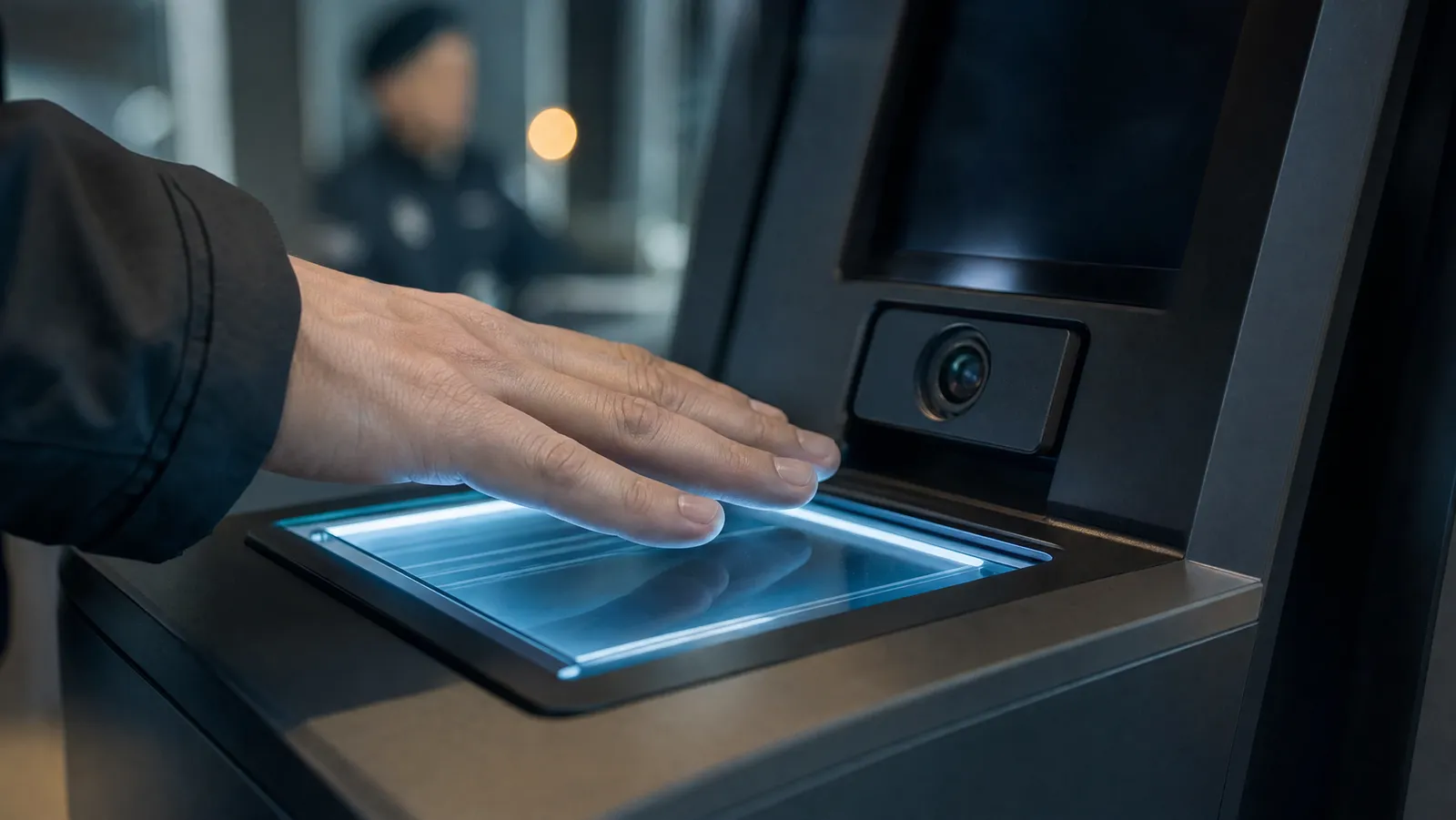
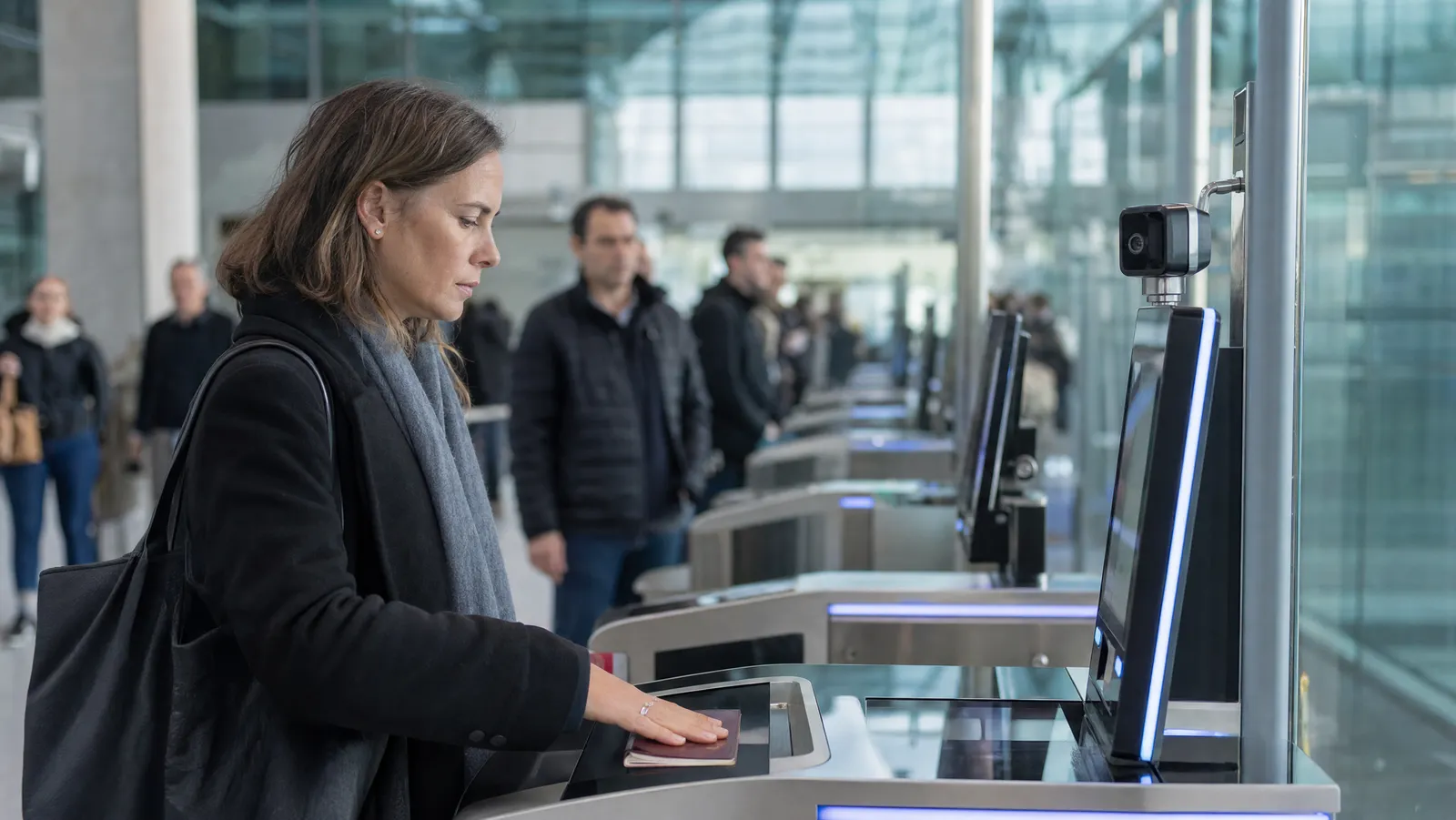
Enrolment means a border officer or self-service station reads your passport chip, takes a facial image, captures fingerprints, asks the standard entry questions and writes a new record. Verification means a camera matching your face against a file that already exists. The first is a conversation; the second is a lookup.
Berlin Brandenburg Airport describes its self-service systems as "automated kiosks located before border control" that let travellers "scan their passports, provide required travel information, and register biometric data such as fingerprints and a facial image" — and warns that "there may be longer waiting times when entering or leaving the Schengen Area." That warning is about enrolment throughput, not about the check itself.
The EU has not published an official per-traveller enrolment time, and we are not going to invent one. What is safe to say: enrolment runs in minutes, verification in seconds, and a terminal built for the second does not absorb a planeload of the first gracefully. Our walkthrough of how EES works covers what the officer is doing at the desk.
The consequence is counterintuitive: the worst crossing of your next three years is either behind you or is the next one.
What the summer 2026 entry exit system queues actually looked like
Most of the alarmist coverage of EES was written before the rollout and forecast delays that did not materialise at the scale predicted. Here is what was actually measured.
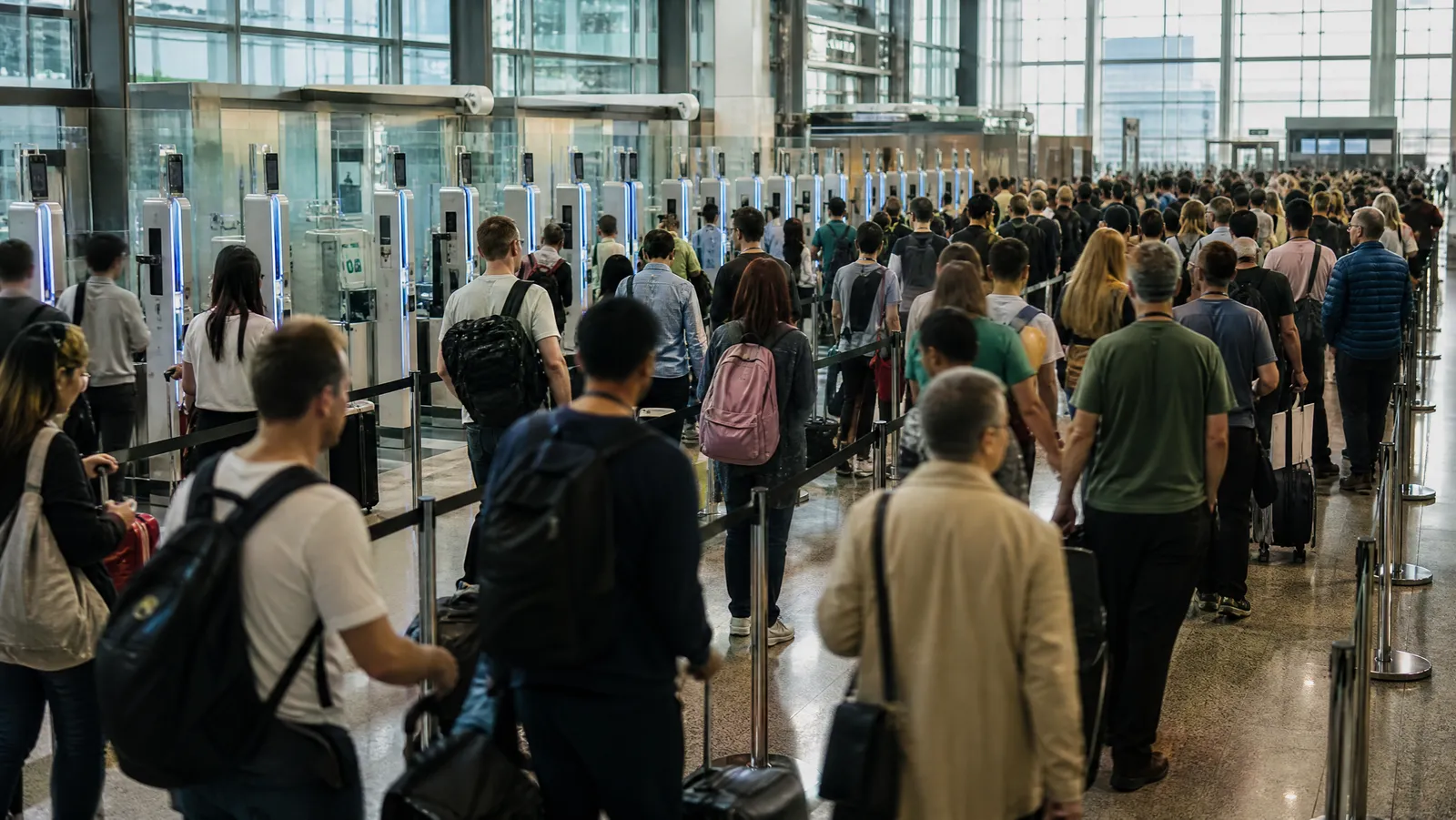
Euronews reported in August 2026 on an analysis by the Financial Times and the travel analytics group Qsensor, which found that at Frankfurt, the average wait reached 120 minutes in July, up from 60 minutes in the same month a year earlier. At Munich, the maximum rose to about 60 minutes against 31 a year before. At Amsterdam Schiphol, peak waits hit roughly 120 minutes against 80 — a rise of about half, not a collapse.
Those numbers cut both ways. A doubling is a genuine, plannable problem, and note that Frankfurt's 120 minutes is a monthly average, not a peak — bad days there ran longer. But a two-hour average at the worst-affected hub in that sample, in the worst month of the year, is not the six-hour meltdown IATA warned of in June 2026, and at Amsterdam the pre-EES baseline was already 80 minutes. Some of what travellers blamed on EES was ordinary August.
Land and sea told a rougher story, but no audited series exists for it. The smaller western French ferry ports handle far lower volumes, EES was not running at all of them through 2026, and what travellers reported there ranges from tens of minutes to an hour or two on bad days — anecdotes from specific sites on specific dates, not a general rate.
Air, land and sea are three different problems
Airports are the easy case. Passengers arrive pre-sorted by flight, there is space for banks of kiosks, and the border is a room you walk through. A bad airport queue is a throughput problem with a known shape.
Sea and tunnel crossings are harder, because the unit is a vehicle, not a person. A car carrying five people has to be processed as five enrolments without anyone getting out, in a lane that is holding up everyone behind it. There is no "step aside to the manual desk" when you are queued to board a ferry with a departure time.
Rail sits in between. Eurostar passengers are on foot, but they are on a fixed departure with a check-in cutoff, so a slow border does not delay them — it makes them miss the train.
That is why the UK-facing crossings dominate the EES complaint file out of all proportion to their passenger numbers. The format is hostile to biometric enrolment.
Dover, Folkestone and St Pancras: the juxtaposed-controls problem
If you are leaving the UK for the Schengen area by land or sea, your EES check happens before you leave Britain. UK government guidance is explicit: if you enter the Schengen area through the Port of Dover, Eurotunnel Le Shuttle at Folkestone or St Pancras International, "any information will be taken at the border, before you leave the UK". That is the juxtaposed-controls arrangement under the Le Touquet treaty, which puts French border officers on British soil.
That arrangement is why the rollout there has been so slow, and as of late September 2026 it is still unfinished. The Connexion France reported on 7 September 2026 that at Dover it remained "business as usual", with French officers creating EES files manually at the eastern docks for car passengers without capturing fingerprints or facial images, and that the pre-registration kiosks "are not yet operational". Eurotunnel told the same outlet there was "currently no change for customers in terms of the process at our sites" and that it was "awaiting confirmation from the French authorities on the timing of this next phase". At St Pancras, kiosks are installed and tested, but no activation date had been fixed.
The Connexion also reported that Port Boulogne Calais had been told the tolerance period was extended to the end of the year, though that had not been officially announced at the time. The honest position for these three crossings: you may be enrolled, or you may get a manual file with no biometrics, and nobody will tell you in advance which.
The UK Parliament held a Commons debate titled "EU Entry-Exit System: Transport Delays" on 16 July 2026, which tells you how live this is politically. Our read: assume full biometric processing could switch on at your crossing with little notice, and carry the buffer for that.
The connecting-flight trap nobody plans for
This is the failure mode that catches experienced travellers, because it is invisible when you book.
Your Schengen entry happens at your first Schengen airport, not your final destination. Fly London to Athens via Amsterdam and your border crossing is at Schiphol — you clear EES there, then walk to a Schengen gate and fly on with no further check. Fly New York to Lisbon via Paris and you enrol at Charles de Gaulle, not in Portugal.
Two things follow. First, the layover you chose on price now decides whether your first enrolment happens at a calm regional airport or at a hub that recorded two-hour peaks in July. A 90-minute connection at a hub, on a first crossing, in August, is not a schedule — it is a wager.
Second, the date and place of entry on your record are the transit airport's. Under EES the system calculates your remaining days automatically rather than leaving it to an officer reading stamps, so the arithmetic runs off a date you may not have registered as significant.
What we would do: when two itineraries cost about the same, take the one that enters Schengen at the smaller airport, at the off-peak hour, or best of all on a direct flight.
What actually speeds you up
Three things, in descending order of reliability.
1. Having already enrolled. Your EES record stays valid for three years, according to UK government guidance, so return trips inside that window reuse the biometrics on file. One caveat: the record is tied to the passport you enrolled with, so renewing your passport means enrolling again. Nothing else comes close.
2. Landside pre-enrolment kiosks, where they exist. Several hubs have installed stations before the border where you capture passport and biometric data ahead of reaching an officer, moving the slow step out of the bottleneck. There is no official EU-wide list of which airports have them — deployments are announced piecemeal — so check your terminal's own page, not a third-party roundup. Berlin Brandenburg notes that if registration fails at the kiosk you "proceed to a manual border control desk": the kiosks are a shortcut, not a gate.
3. The EU's "Travel to Europe" app. This is the only official pre-registration tool, it is free, and it lets eligible travellers submit passport data and a facial image in the 72 hours before crossing. The catch is that adoption is voluntary country by country. Reporting by The Local in July 2026 found it live only for Sweden, covering passport data, facial image and the entry questionnaire, and Portugal, covering the entry questionnaire — and only at a short list of airports. If you are routing through Lisbon, as many nomads are for the reasons in our Lisbon guide, check whether your airport is covered. Elsewhere it does nothing yet.
One thing that is not a speed-up but prevents the worst outcome: have working mobile data the moment you land, so you can read your airport's live updates instead of guessing. A plan from our Europe eSIM roundup costs a few euros.
And the obvious warning: nobody can sell you EES registration. There is no application and no fee.
How much buffer to allow, by crossing type
The following is our own planning guidance, not an official EU figure — built from the queue data above plus the structural differences between crossing types. Treat it as a floor, not a forecast.
| Crossing | If already enrolled | First enrolment |
|---|---|---|
| Major hub airport, peak summer | Normal arrival + 30 min | Normal arrival + 2 hours |
| Major hub airport, shoulder season | Normal arrival time | Normal arrival + 1 hour |
| Regional or secondary airport | Normal arrival time | Normal arrival + 45 min |
| Connecting flight through a hub | 2 hours minimum layover | 3 hours minimum layover |
| Dover or Eurotunnel by car, peak | Operator advice + 1 hour | Operator advice + 2 hours |
| Eurostar at St Pancras | Published check-in cutoff | Cutoff + 45 min |
Two rules matter more than any row in that table. Never let a first enrolment sit on a tight connection, and check the operator's own advice on the day — ferry and tunnel operators publish live terminal guidance far better than any general rule, ours included.
Summer versus shoulder season
The cheapest fix for entry exit system problems is not a kiosk or an app. It is the calendar.
Every documented spike in the 2026 data sits in July and August, against terminals already at capacity for ordinary summer reasons. The Commission's own handling was seasonal by design: a spokesperson explained at a 1 September press conference that "for the summer and including until the 6th of September, we have the possibility to temporarily suspend the registration of biometrics in case of exceptional circumstances" — a safety valve built for peak months.
That flexibility period has now expired, and what replaced it is untidy. Reporting in September 2026 indicated that nine countries — France, Belgium, the Netherlands, Germany, Greece, Malta, Portugal, Italy and Switzerland — have carried on limiting biometric capture at busy moments anyway, with the Commission declining to enforce strictly while, in its spokesperson's words, the "remaining challenges are fully addressed by the end of the year". Enforcement this autumn is therefore inconsistent by country.
For anyone with real schedule flexibility the conclusion is easy: do your first post-EES crossing outside July and August. From October through May the queue data simply does not show the same problem, and the rest of the trip is cheaper.
There is also a structural exit. If you hold a long-stay visa or residence permit from a Schengen country, you are generally outside EES altogether and are not enrolled or fingerprinted at all — one more argument for the national routes in our digital nomad visa guide, beyond staying past 90 days.
Frequently asked questions
Which airports have the worst EES airport delays?
On the most widely reported systematic measurement published so far — the Financial Times and Qsensor analysis reported by Euronews in August 2026 — Frankfurt and Amsterdam Schiphol showed the longest July 2026 waits of the three hubs measured, at about two hours each. Note the two are not the same statistic: Frankfurt's figure is a monthly average, Amsterdam's a maximum. Munich's maximum was around an hour. These are figures for the largest hubs in the worst month, not typical ones.
Will I be delayed every time I cross now?
No. Enrolment is the slow step and it happens once per three-year record. After that the biometric check is faster than the manual stamp it replaced.
Do EES delays affect my 90-day allowance?
Time in the queue does not, but the entry date the system records does — and it is recorded at your first Schengen airport, which on a connecting itinerary may not be where you expected. The underlying limit is unchanged at 90 days in any rolling 180, and our Schengen 90/180 explainer covers the arithmetic.
Do I need ETIAS to skip the queue?
No, and you could not apply if you wanted to. The EU's own ETIAS pages state that the system is not in operation and that no applications are being collected. It is a separate pre-travel authorisation with no confirmed launch date, and it would not change what happens at the desk. We track where that timeline actually stands in is ETIAS required yet.
What to do before your next crossing
- Work out whether this is your first crossing since October 2025. If yes, everything below matters. If no, most of it does not.
- Check where you actually enter Schengen — the transit airport, not the destination — and budget for that terminal.
- Protect the connection. Three hours at a hub on a first enrolment; do not book a 90-minute transfer in August.
- Check your airport, port or operator's own page the week you travel, not a general guide. Ours included.
- See whether the official "Travel to Europe" app covers your crossing. It is free and published by the European Union, and on the few supported borders it removes real minutes.
- If you are driving to Dover or Folkestone, assume the process may change without notice and carry the larger buffer.
- Move the trip out of July and August if you can.
The bottom line
The EES queue problem is smaller and more specific than the coverage suggested, and it is largely solvable by knowing which crossing you are making. One enrolment, at a hub you did not choose deliberately, in the worst month of the year, is how people lose two hours. The same traveller at a regional airport in October, already enrolled, walks through in seconds.
The UK land and sea routes remain the genuine outlier, and the honest answer there as of September 2026 is that nobody — including the operators — can tell you what the process will be on your date. Plan for the slower version.
For the full picture of how EES fits with ETIAS, who is exempt and what the system stores, read our complete guide to EES and ETIAS. Then stop thinking about it — after your first crossing there is very little left to think about.
About the Author