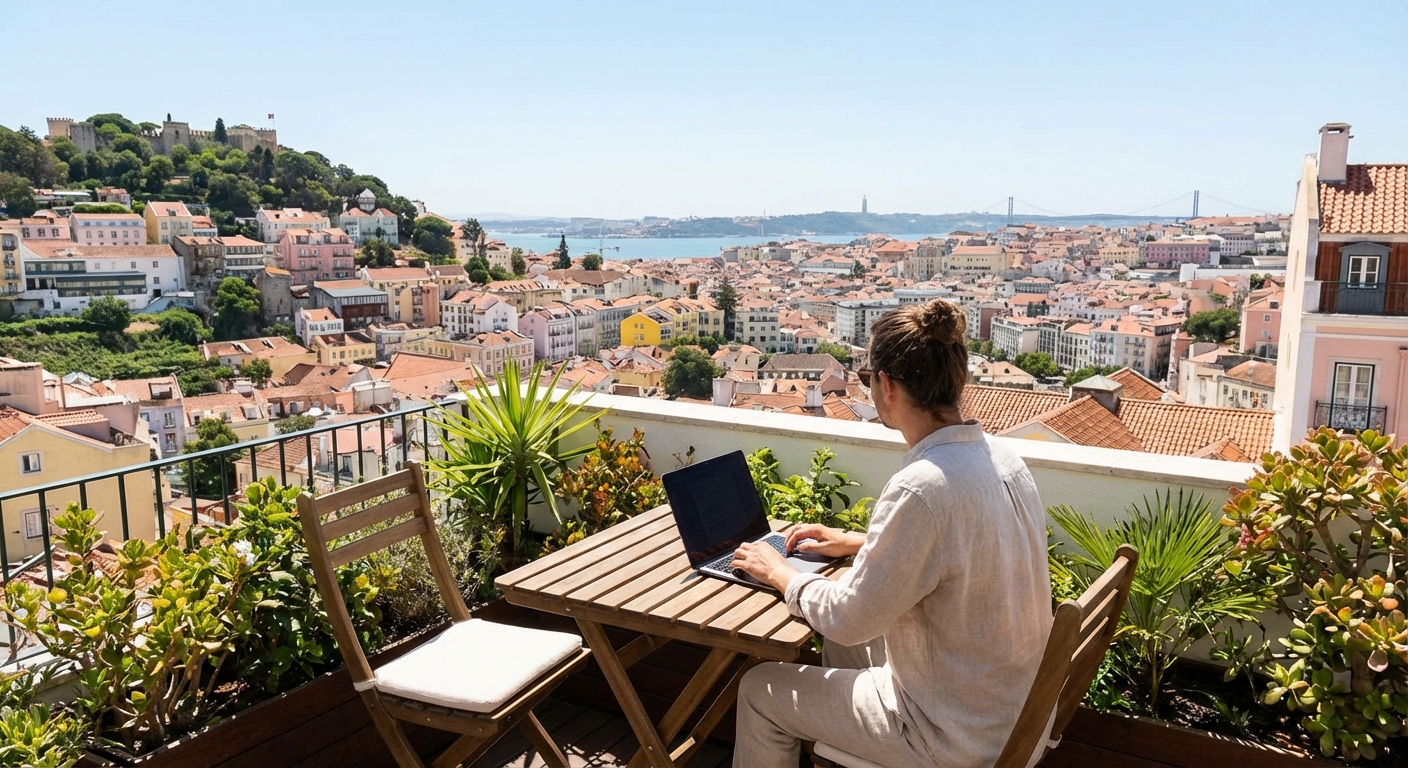
Lisbon has earned its position as Europe's digital nomad capital through a combination that's genuinely hard to replicate: 300 days of sunshine, a thriving startup ecosystem, world-class infrastructure, and that ineffable Portuguese quality of life that makes work feel less like work.
The city costs roughly 30% less than Paris and half what you'd pay in London—while delivering better weather than both. According to Portugal's Digital Economy and Society Index, 94% of Portuguese homes have access to very high-capacity internet, beating the EU average of 79%. And with Portugal's digital nomad visa (the D8) offering a legitimate path to long-term residency, Lisbon isn't just a temporary stop—it's a viable permanent base for remote workers building European lives.
This guide covers everything you need to work productively from Lisbon: realistic cost breakdowns, the coworking spaces worth your money, neighborhood recommendations for different budgets, visa pathways for extended stays, and the honest downsides that glossy travel content tends to skip.
Lisbon at a Glance
In this guide:
- Cost of Living Breakdown
- Best Neighborhoods for Digital Nomads
- Coworking Spaces and Cafes
- Internet and Connectivity
- Visa Options for Digital Nomads
- The Startup and Tech Scene
- Weather and Best Times to Visit
- Getting Around Lisbon
- FAQ
For how Lisbon compares to other options, see our best digital nomad destinations 2026 guide.
Cost of Living Breakdown
Lisbon sits in the mid-range for European digital nomad destinations. It's significantly cheaper than Western European capitals while offering comparable—often superior—infrastructure and quality of life. Budget-focused nomads can survive on $1,500/month; comfortable living runs $2,000-2,500; and premium lifestyle seekers should plan for $3,000+.
Accommodation
Housing is Lisbon's biggest expense and the area where costs have increased most dramatically as the city's popularity surged.
| Type | Budget | Mid-Range | Premium |
|---|---|---|---|
| Studio apartment | $800-1,000 | $1,100-1,400 | $1,500-2,000 |
| One-bedroom | $1,000-1,300 | $1,400-1,800 | $2,000-2,500 |
| Location | Outer neighborhoods | Central (Alfama, Graça) | Principe Real, Chiado |
| Lease type | Short-term/Airbnb | 6-12 month lease | Premium furnished |
The reality: Finding a decent apartment in Lisbon requires lead time and flexibility. The rental market is competitive, and the best deals go quickly. Facebook groups (Lisbon Housing, Apartments for Rent Lisbon) provide direct landlord access, but expect to spend your first few weeks actively searching if you want to beat Airbnb prices.
Budget strategy: Look beyond the tourist center. Neighborhoods like Arroios, Penha de França, and Areeiro offer significantly lower rents while staying connected via metro. A one-bedroom in these areas can run $900-1,200—still European prices but substantially less than Baixa or Alfama.
The expat premium: Furnished short-term rentals aimed at foreigners command 30-50% premiums. If you can commit to 6+ months and navigate Portuguese-language listings, your housing costs drop significantly.
For comprehensive strategies on finding, negotiating, and securing accommodation, see our Complete Digital Nomad Accommodation Guide.
Food and Dining
Portuguese food culture delivers exceptional value. Traditional restaurants serve complete meals for prices that would be appetizers in Paris.
Local restaurants: $8-15 for a full meal with drink. Daily specials (prato do dia) at neighborhood spots typically include soup, main course, and coffee for under $12. Seafood is fresh and affordable; grilled fish with potatoes and salad rarely exceeds $15 even in decent restaurants.
Grocery shopping: $200-350/month depending on habits. Pingo Doce and Continente are the main chains with reasonable prices. Farmers markets (feiras) offer better produce at lower prices.
Cafe culture: Coffee is sacred and cheap. A bica (Portuguese espresso) costs $0.80-1.20 at most cafes. Pastéis de nata (custard tarts) run $1-2. You can work from cafes all day for the price of a few coffees.
International food: Lisbon's growing diversity means quality options across cuisines, though prices climb to $15-25 for meals at trendier spots.
Monthly food budget: Most nomads land at $400-600 for a mix of home cooking, local restaurants, and occasional splurges.
Coworking and Workspace
Lisbon has over 50 coworking spaces, ranging from startup-focused accelerators to creative studios in converted palaces.
| Space | Day Pass | Monthly | Features |
|---|---|---|---|
| Heden | $11-16 | $165-220 | Creative vibe, Graça location |
| Second Home | $30 | $350-500 | Premium design, events |
| Selina | $15 | $200 | Social atmosphere, global network |
| Avila Spaces | $20 | $250-350 | Professional, meeting rooms |
| Cowork Central | $12 | $150 | Budget option, central location |
The sweet spot: Most serious nomads pay $150-250/month for coworking. This gets you reliable internet, comfortable seating, community, and the structure that helps maintain productivity in a city with many distractions.
Cafe working: Lisbon's cafe culture accommodates laptop workers, though wifi quality varies. The best strategy combines a coworking membership for focused work with cafe sessions for lighter tasks and meetings.
Other Monthly Costs
Transportation: $40-80. Lisbon's metro and tram system is efficient and affordable. A monthly pass (Navegante) costs about $45 and covers metro, buses, and trams throughout the city. Uber and Bolt operate for occasional trips.
Phone/internet: $15-30. Portuguese SIM cards with generous data are easy to obtain. MEO, Vodafone, and NOS all offer competitive plans.
Entertainment: $100-200. Live music, cultural events, day trips to Sintra or Cascais, wine and beer at neighborhood bars.
Health and fitness: $40-80. Gym memberships run $30-50/month. Yoga studios, outdoor running along the river, and free workout parks supplement paid options.
Monthly Budget Summary
| Category | Budget | Comfortable | Premium |
|---|---|---|---|
| Accommodation | $950 | $1,400 | $2,000 |
| Food | $350 | $500 | $700 |
| Coworking | $0 (cafe) | $200 | $350 |
| Transport | $45 | $60 | $100 |
| Entertainment | $80 | $150 | $300 |
| Phone/misc | $50 | $80 | $150 |
| Total | $1,475 | $2,390 | $3,600 |
For more European budget options, see our best digital nomad destinations in Europe guide.
Best Neighborhoods for Digital Nomads
Lisbon's neighborhoods each have distinct personalities. Where you stay shapes your daily experience more than in most cities.
Principe Real / Bairro Alto
The vibe: Trendy, sophisticated, central. Beautiful garden squares, upscale restaurants, boutique shops, and some of Lisbon's best nightlife. This is where well-paid creatives and tech workers live.
Best for: Those with comfortable budgets who want walkable access to the best of Lisbon. Social nomads who enjoy going out.
Costs: Premium. One-bedrooms run $1,800-2,500. Everything from coffee to cocktails costs slightly more than surrounding areas.
Downsides: Expensive. Tourist-heavy in some sections. Bairro Alto gets loud on weekend nights.
Our take: If you can afford it and prioritize location, Principe Real delivers premium Lisbon living. The adjacent neighborhoods of Chiado and Santos offer similar vibes at slightly lower prices.
Alfama / Graça
The vibe: Historic, atmospheric, steep. Winding streets, ancient buildings, traditional fado houses, viewpoints overlooking the river. The most "old Lisbon" feeling neighborhoods.
Best for: Culture seekers, photographers, those who want authentic atmosphere over modern convenience.
Costs: Mid-range. One-bedrooms $1,200-1,600. Some excellent value in older buildings, though you trade modern amenities.
Downsides: Very hilly—exhausting on foot daily. Some buildings are old with inconsistent internet. Fewer coworking options within walking distance.
Our take: Beautiful for a month or two. For longer stays, verify internet quality carefully and consider whether you want to climb those hills daily.
Arroios / Anjos
The vibe: Local, diverse, unpretentious. Working-class neighborhoods that have attracted younger Portuguese and immigrants. Less polished but more authentic than tourist areas.
Best for: Budget-conscious nomads seeking local experience. Those comfortable without English menus everywhere.
Costs: Budget to mid-range. One-bedrooms $900-1,300. Best value for central Lisbon.
Downsides: Less charming architecture. Fewer cafes and coworking options. Some areas feel rougher than tourist zones.
Our take: Excellent value for nomads who have their routines established and don't need tourist-friendly infrastructure.
Santos / Cais do Sodré
The vibe: Riverside, hip, transitional. Former industrial areas converted to creative spaces, restaurants, and nightlife. The famous Time Out Market is here.
Best for: Those who want proximity to water, nightlife, and a somewhat alternative vibe.
Costs: Mid-range to premium. Varies significantly by specific location and building age.
Downsides: Can be loud at night. Some areas are more developed than others.
Our take: Good middle ground between Principe Real prices and outlying neighborhood value.
Outer Neighborhoods (Benfica, Lumiar, Parque das Nações)
The vibe: Residential, local, suburban. Modern apartments, shopping centers, less character but more space.
Best for: Budget maximizers, families, those prioritizing apartment quality over neighborhood atmosphere.
Costs: Budget. One-bedrooms $800-1,200. Significantly more space for your money.
Downsides: Less walkable to central attractions. Fewer cafes and restaurants within walking distance. Requires metro commute for social activities.
Our take: Consider Parque das Nações specifically—it's modern, safe, well-connected by metro, and has its own restaurant/cafe scene along the river.
Coworking Spaces and Cafes
Lisbon's coworking scene has matured significantly, offering options across price points and work styles.
Coworking Spaces
Heden (Graça) Creative-focused space in the Graça neighborhood with an art studio and rooftop terrace. Bright design, community events, and a more artistic vibe than corporate alternatives. Half-day passes start at around $11, full day $16, monthly from $165.
Second Home (Multiple locations) The premium option. Beautiful design (featured in architecture publications), excellent events programming, and a network of spaces globally. Prices reflect the positioning—expect $350-500/month for membership.
Selina (Cais do Sodré) Part of the global Selina network combining coworking with co-living and hospitality. Social atmosphere, good for meeting travelers and other nomads. Day passes around $15, monthly from $200.
Avila Spaces (Avenue da República) More corporate/professional atmosphere with meeting rooms, business lounge, and reliable infrastructure. Good for client calls and professional image. Daily rates around $20, monthly $250-350.
Cowork Central Budget-friendly option in central Lisbon. Less polished than premium spaces but functional and well-located. Day passes $12, monthly from $150.
Impact Hub Lisbon Social enterprise focused with community of purpose-driven businesses. Good networking for impact-oriented work. Monthly memberships from $180.
Work-Friendly Cafes
Lisbon's cafe culture accommodates laptop workers, though expectations vary by establishment.
Copenhagen Coffee Lab (Multiple): Specialty coffee, reliable wifi, laptop-friendly. Popular with nomads.
Fabrica Coffee Roasters: Excellent coffee, comfortable seating, outlets available. Tourist-heavy but functional.
Hello, Kristof: Designed for remote work with good wifi and work-appropriate setup.
TOPO: Rooftop setting, beautiful views, decent wifi. More for light work than intensive sessions.
General cafe etiquette: Most cafes welcome laptop workers during off-peak hours. Buy something every hour or two. Avoid peak lunch hours for extended sessions. Many smaller traditional cafes don't have wifi—check before settling in.
For optimizing your mobile workspace, see our portable laptop stands guide.
Internet and Connectivity
Portugal ranks among Europe's best-connected countries, and Lisbon specifically delivers excellent infrastructure.
Speed and Reliability
Fixed broadband: Median speeds of 176 Mbps. Most modern apartments have fiber connections delivering 100+ Mbps. Older buildings vary more—always test before committing to long-term rentals.
Mobile networks: Median speeds of 166 Mbps. 4G/5G coverage is excellent throughout the city. Portuguese carriers (MEO, Vodafone, NOS) all offer reliable service.
Coworking spaces: Generally 100+ Mbps with business-grade reliability. Premium spaces like Second Home maintain redundant connections.
Getting Connected
Portuguese SIM: Easy to purchase at any phone shop or even supermarkets. Prepaid options with generous data (20-50GB) cost $15-25/month. MEO and Vodafone have the most coverage.
Home internet: If you're signing a longer lease, fiber internet costs approximately $30-50/month depending on speed tier. Installation can take 1-2 weeks.
EU roaming: If you have an EU SIM from another country, roaming applies throughout Portugal at no extra charge.
For complete connectivity strategies and eSIM options, see our WiFi and connectivity guide and best eSIM for Europe.
Visa Options for Digital Nomads
Portugal offers multiple pathways for digital nomads seeking legal residency beyond the 90-day Schengen limit.
Schengen Tourism (Up to 90 Days)
Most non-EU citizens can stay 90 days within any 180-day period across the entire Schengen Area—not per country. This works for short stays but limits long-term Lisbon living.
Important: The 90/180 rule applies cumulatively across ALL Schengen countries. If you spent 60 days in Spain, you only have 30 days remaining for Portugal (and all other Schengen destinations).
Portugal D8 Digital Nomad Visa
D8 Visa Overview
Portugal's Digital Nomad Visa (D8) is designed specifically for remote workers employed by companies outside Portugal. It provides a legitimate path to EU residency.
Requirements:
- Monthly income of at least €3,480 in 2025 (4x minimum wage of €870), increasing to €3,680 in 2026 (4x €920)
- Proof of remote employment or freelance contracts with non-Portuguese clients
- Health insurance valid in Portugal
- Clean criminal record
- Tax registration in home country
Duration: Initial two-year residency permit, renewable
Processing time: 2-4 months typically
Path to residency: After five years of legal residency, you can apply for permanent residency. Portuguese citizenship is possible after five years for most nationalities, with minimal Portuguese language requirements. Note: A proposed increase to 10 years for PR eligibility is under review.
Key benefit: The D8 provides genuine legal status including the right to rent, open bank accounts, and access Portuguese services—unlike tourist stays in a legal gray area.
Official source: AIMA Portugal
Portugal D7 Passive Income Visa
Originally designed for retirees with passive income, the D7 also works for remote workers who can demonstrate regular income.
Requirements:
- Proof of regular income (minimum approximately $800/month, but higher is better for approval)
- Can include employment income, investment returns, rental income
- Health insurance
- Clean criminal record
Duration: Two-year initial permit, renewable for three years, then permanent residency eligible
Differences from D8: D7 is more flexible about income sources but may require more documentation about income stability. Processing can be slightly faster.
Practical Visa Strategy
For most digital nomads:
- First visit: Enter on tourism (90 days max) to evaluate whether Lisbon works for you
- If you want to stay: Apply for D8 or D7 before your 90 days expire, or return home to apply at a Portuguese consulate
- Long-term: Maintain legal status, work toward permanent residency if desired
For complete visa comparisons, see our digital nomad visa comparison guide.
The Startup and Tech Scene
Lisbon has emerged as a legitimate European tech hub, which matters for digital nomads beyond just networking—it means better infrastructure, more understanding of remote work culture, and a community of skilled professionals.
Why Lisbon Became a Tech Hub
Several factors converged:
Web Summit: Europe's largest tech conference relocated to Lisbon in 2016 and has remained ever since. The annual event brings 70,000+ attendees and year-round attention to the city's tech ecosystem.
Government support: Portugal actively courted tech companies with incentives, visa programs, and investment in infrastructure.
Cost advantage: Compared to London, Paris, or Amsterdam, Lisbon offers similar talent at lower costs—attracting startups and remote teams.
Quality of life: The lifestyle factors that attract digital nomads also attract startup founders and tech workers seeking better work-life balance.
Networking Opportunities
Web Summit (November): The flagship event. Even if you don't attend the main conference, surrounding events, parties, and networking opportunities flood the city.
Startup Lisboa: Portugal's main startup accelerator and a hub for the local ecosystem. Events, programs, and connections to the Portuguese tech scene.
Tech meetups: Regular events covering specific technologies, industries, and interests. Meetup.com and Facebook groups list options across specialties.
Coworking events: Spaces like Second Home and Impact Hub host regular events that facilitate professional networking.
The Professional Advantage
The presence of a genuine tech ecosystem means:
- More people understand remote work and won't question your lifestyle
- Better infrastructure maintained for professional use
- Networking opportunities that go beyond digital nomad social events
- Potential client acquisition or partnership opportunities within the local scene
- Access to professional services (lawyers, accountants) familiar with international remote workers
Weather and Best Times to Visit
Lisbon's climate is a significant draw—perhaps the best weather of any major European city.
Seasonal Breakdown
Spring (March-May): Temperatures 15-22°C (59-72°F). Pleasant weather, blooming flowers, fewer tourists than summer. Excellent time for first visits.
Summer (June-August): Temperatures 25-30°C (77-86°F). Hot and dry. Tourist season peaks. Book accommodation in advance. Good for beach day trips.
Autumn (September-November): Temperatures 17-24°C (63-75°F). Warm and pleasant. Tourist crowds thin after October. Web Summit happens in November.
Winter (December-February): Temperatures 10-15°C (50-59°F). Mild by European standards but rainy. Shortest days but still far more sun than northern Europe.
Weather Advantages
300+ sunny days per year: Unlike northern European capitals, Lisbon delivers genuine sunshine most of the year. This affects productivity—SAD (seasonal affective disorder) is far less of an issue here.
Mild winters: You won't need heavy winter clothing. A light jacket handles most days. Coming from colder climates, Lisbon winters feel almost warm.
Dry summers: Unlike humid destinations, Lisbon's summer heat is manageable. The coastal influence moderates extremes.
Best Times for Digital Nomads
Optimal: September-November and March-May. Good weather, fewer tourists, reasonable accommodation prices.
Avoid if possible: August peak season for crowds and prices. December-January for rain.
Web Summit consideration: If you want to avoid the November conference chaos, plan around it. If you want to attend or network during the event, book months in advance.
Getting Around Lisbon
Lisbon is highly navigable without a car, though the hills create some physical challenges.
Public Transportation
Metro: Four lines covering most of central Lisbon. Clean, efficient, and affordable. A monthly Navegante pass costs about $45 and includes all metro, buses, and trams.
Trams: The iconic Tram 28 is a tourist attraction, but trams also serve as practical transportation. The modern trams on Line 15E connect Baixa to Belém efficiently.
Buses: Fill gaps where metro doesn't reach. Same monthly pass covers all routes.
Trains: Easy connections to Sintra, Cascais, and other day trip destinations from central stations.
Other Options
Walking: Lisbon is walkable but hilly. Comfortable shoes are essential. The hills provide views but also exhaustion—factor this into daily routines.
Uber/Bolt: Widely available and affordable. Useful for reaching restaurants, events, or neighborhoods not on your usual routes. Also essential for airport transfers.
Scooter/bike rentals: Electric scooters (Lime, Bird) are available though the hills make them challenging. Electric bikes are more practical for the terrain.
No car needed: Unlike some European cities, you can live comfortably in Lisbon without a vehicle. Parking is expensive and difficult anyway.
Airport Connections
Lisbon Airport (LIS) is remarkably close to the city—15-20 minutes by metro or taxi from the center. Uber/Bolt to central neighborhoods costs about $10-15. The metro red line connects the airport to the network.
FAQ
How does Lisbon compare to other European digital nomad destinations?
Lisbon offers the best combination of weather, infrastructure, and relative affordability among major European cities. Berlin is cheaper but colder and grayer. Barcelona has similar lifestyle appeal but higher costs. Bansko is much cheaper but lacks urban amenities. Lisbon sits in a sweet spot for nomads who want genuine European city living without London or Paris prices.
Is Lisbon good for families?
Yes. The city is safe, has excellent healthcare, offers good international schools, and provides child-friendly culture and activities. Many digital nomad families choose Lisbon specifically because it supports both adult work needs and family life. Costs are higher than Southeast Asia alternatives but infrastructure is more familiar.
How much Portuguese do I need to learn?
English proficiency in Lisbon is high by European standards, especially among younger people and in professional settings. You can function day-to-day without Portuguese. However, learning basics improves your experience and shows respect for your host country. For long-term residence, some Portuguese becomes practically necessary for bureaucratic processes.
What are the downsides of Lisbon?
Housing costs: The biggest challenge. Rents have increased dramatically, and finding good apartments requires effort. Tourist crowds: Certain areas (Alfama, Tram 28) get overrun in high season. Bureaucracy: Portuguese administrative processes can be slow and frustrating. Less sunshine than advertised in winter: While mild, December-January can be gray and rainy. Noise: Some neighborhoods are loud, especially near nightlife districts.
Can I open a Portuguese bank account as a digital nomad?
Yes, but it requires patience. Traditional banks want Portuguese residence documents. However, neobanks like N26 or Wise work throughout Europe. For longer stays with proper visas, opening a Portuguese account becomes easier and sometimes necessary for utility bills and local payments.
What should I pack for Lisbon?
Layers work best year-round. Light clothing for summer, a good jacket for winter and air-conditioned spaces, comfortable walking shoes for the hills. The climate is generally mild—you won't need heavy winter gear. See our capsule wardrobe guide and ultimate packing list for complete recommendations.
Your Next Steps
Lisbon rewards commitment. The rental market favors those who can sign longer leases. The community opens up to those who stick around. The bureaucracy becomes manageable once you understand the systems.
First visit strategy: Book accommodation for 2-3 weeks (Airbnb is fine initially). Use that time to explore neighborhoods, test coworking spaces, and search for longer-term housing. Join Facebook groups and start networking before arrival.
If you're staying: Budget time for apartment hunting and visa processes. Neither happens quickly. Build relationships at your coworking space—the community provides invaluable local knowledge.
Long-term planning: If Lisbon works for you, Portugal's digital nomad visa provides a clear path to legal residency and eventually citizenship. Few destinations offer such a well-defined trajectory for remote workers building a European life.
For how Lisbon compares to alternatives, see our best digital nomad destinations 2026 guide. For other European options, check our best digital nomad destinations in Europe guide.