Best Portable Solar Panels for Remote Work (2026)
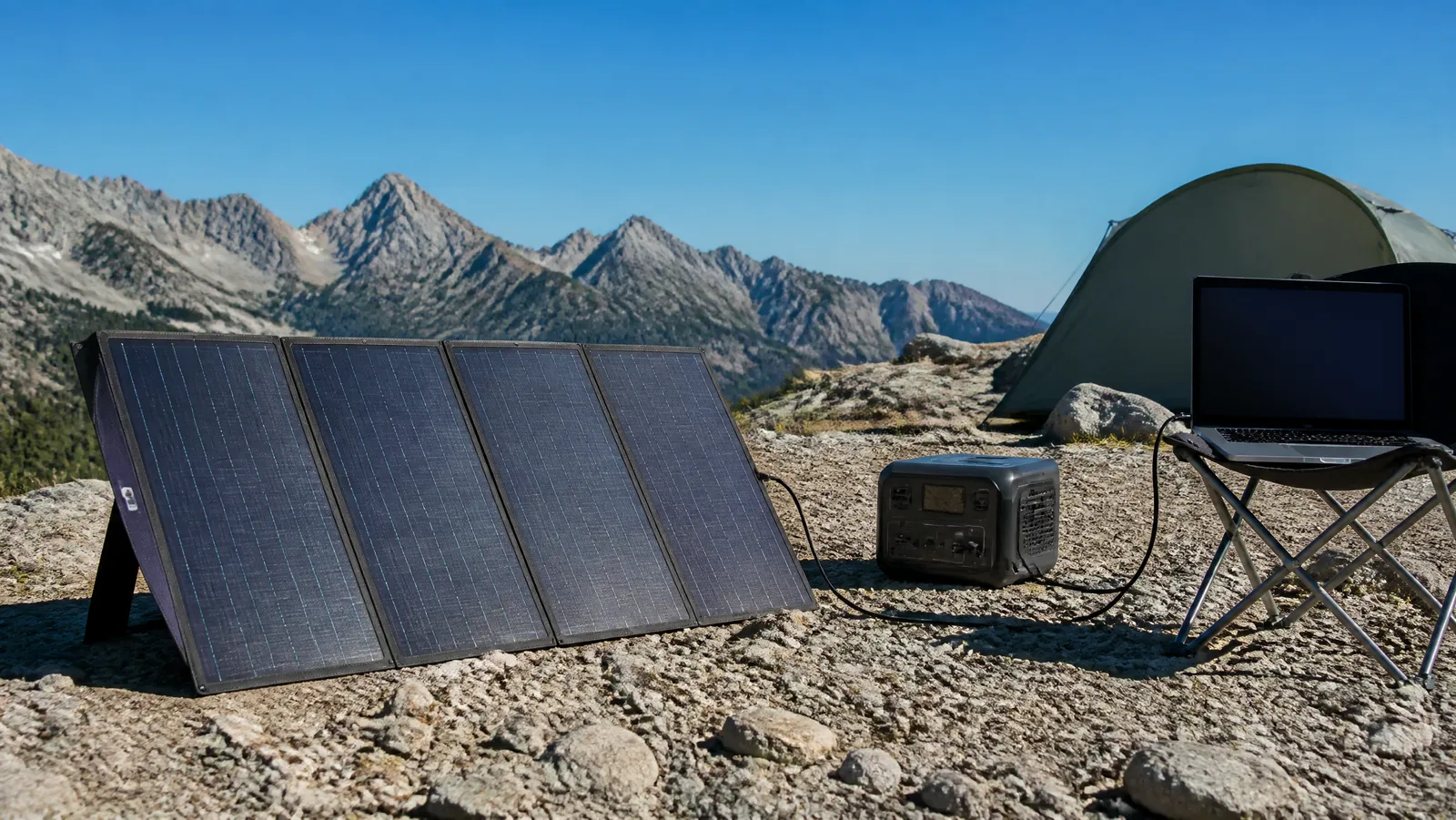

- Jackery SolarSaga 100W Air Solar Panel - Best Overall Portable Solar Panel for Remote Work
- Renogy REGO 100W Portable Solar Panel - Best Value Solar Panel for Power Stations
- FlexSolar 100W Portable Solar Panel - Best Budget Solar Panel for Remote Work
- Jackery SolarSaga 200W Portable Solar Panel - Best Solar Panel for Full Off-Grid Workweeks
- SOKIOVOLA N-Type 200W Portable Solar Panel - Best Budget 200W Solar Panel for Power Stations
- Jackery SolarSaga 40W Air Solar Panel - Best Ultralight Solar Panel for Backpack Nomads
The best portable solar panels for remote work in 2026 are the Jackery SolarSaga 100W Air for most nomads — 7 lbs, bifacial, and measured near its full rating in real sun — and the Jackery SolarSaga 200W for anyone who must bank a complete Starlink workday, every day. Budget buyers get remarkable value from the FlexSolar 100W at 81.99 dollars as of July 2026.
This article contains affiliate links — as an Amazon Associate, we earn from qualifying purchases at no extra cost to you.
A solar panel is the refill valve of an off-grid office: its entire job is putting watt-hours back into the battery that your laptop and internet dish drain all day. This guide covers one component of a complete off-grid power and internet setup — and it answers one question: which panel reliably refills a workday, at what weight, and at what price?
Our Six Picks at a Glance
- Top Pick: Jackery SolarSaga 100W Air — near-rated real output at just 7 lbs
- Best Value: Renogy REGO 100W — a 12-year output warranty for 124.99 dollars as of July 2026
- Budget Pick: FlexSolar 100W — 4.1 lbs, folds to laptop size, works with almost every power station
- Best for Full Workweeks: Jackery SolarSaga 200W — the highest conversion efficiency here at up to 26.7%
- Budget 200W: SOKIOVOLA N-Type 200W — 200 watts and a universal connector set for 189.99 dollars as of July 2026
- Ultralight Pick: Jackery SolarSaga 40W Air — 1.98 lbs for phones and power banks, not workdays
How Much Solar Charging Does a Remote Workday Need?
Start from consumption, not from panel wattage. According to power-draw data compiled by GridWright from Starlink's official specifications, a Starlink Mini averages 20-40W in use and about 15W at idle. Add a working laptop at 30-60W and you get the number this whole series is built on: a standard Starlink-powered workday runs 400-600Wh. That is what your panel has to put back.
The panel does not power your laptop directly — it refills one of the best portable power stations for remote work, which then feeds your laptop, dish, phone, and lights on its own schedule. The battery smooths over clouds; the panel replaces what the day consumed. If you want to know exactly where those watt-hours go, our Starlink Mini field review breaks down the dish's real-world draw hour by hour.
So how much does a "100W" panel actually put back? According to EcoFlow's 100W solar panel guide, you can expect roughly 300-600Wh per day in good weather — around 400-500Wh with 4 to 5 hours of direct sunlight, more in sun-rich regions, less under marine layer. Read that against the workday math and the buying logic writes itself:
- One 100W panel covers a light-to-standard workday in good sun — with almost no margin for weather.
- A 200W panel (or two 100W panels) covers a full Starlink workday with margin left for bad-sky days, phone charging, and lights.
- A 40W panel is a trickle charger for phones and power banks. It will not sustain a workday, and we only recommend it as a supplement.
Lab Watts vs. Real Watts: What Panels Actually Deliver
Every wattage rating on this page is a lab number, measured under standardized full-sun conditions that the real world rarely reproduces. Real-world production usually lands at 70-90% of rated power — GreenLancer's guide to panel output puts typical systems at 75-85% of rating, and even SOKIOVOLA's own documentation calls 70-90W normal for a 100W portable panel. Heat costs 0.3-0.5% of output for every degree Celsius above the 77°F test standard, per EcoFlow — easily 10-20% on hot summer ground — and shading even a single cell can slash a small panel's output by as much as 75%, per research cited by Aurora Solar. Independent tests bear this out — OutdoorGearLab measured the FlexSolar 100W generating about 70W in its charging tests, a normal, honest result for the category.
Location matters just as much. Per NREL data summarized by VoltCalcs, average peak sun hours in the US range from about 3.5 in northern states to 6.5+ in the Southwest — meaning the identical panel can harvest nearly twice the watt-hours in Arizona that it manages in Washington. Angle is the one variable you fully control: EcoFlow's angle guide recommends facing panels true south (in the Northern Hemisphere) and tilting them to roughly your latitude — 30-45 degrees across most of the US.
Our sizing rule for remote workers is therefore conservative: assume 60-80% of the rating when the panel is aimed well, and buy the next size up from what the napkin math says you need. A workday you cannot finish because the marine layer rolled in is a client call you missed.
The Best Portable Solar Panels for Remote Work in 2026
Jackery SolarSaga 100W Air — Top Pick
The 100W Air wins because it closes the gap between lab watts and real watts better than anything else at this weight. It is a bifacial panel — PERC cells at 23% conversion efficiency that capture light on both faces — and one independent review measured output in the 90-100W range under ideal full-sun conditions, unusually close to rating for this category. The same reviewer measured roughly 5-8W of extra harvest from backside reflection when the panel sits over reflective ground like concrete or a light tarp — a bifacial bonus that largely disappears over grass or dark soil, so pick your patch of ground deliberately.
The work-travel case is just as strong: 7 lbs (about 27% lighter than standard 100W panels, per Jackery), a W-fold that packs smaller than A2 paper, an integrated aluminum stand with roughly 60-second setup, and IP68 sealing with IEC TS 63163 certification covering drop, humidity, bend, and 4,000-fold testing. Dual USB ports (100W total) charge devices directly when the battery is elsewhere.
One hard warning before you buy: this panel is not compatible with the Jackery Explorer 300 or 300 v2 — the voltage mismatch triggers an F7 input error. If an Explorer 300 is your battery, pick the Renogy or FlexSolar below instead. At 248.99 dollars as of July 2026 (down from 299), the Air is the panel we would hand to most working nomads.
Renogy REGO 100W — Best Value
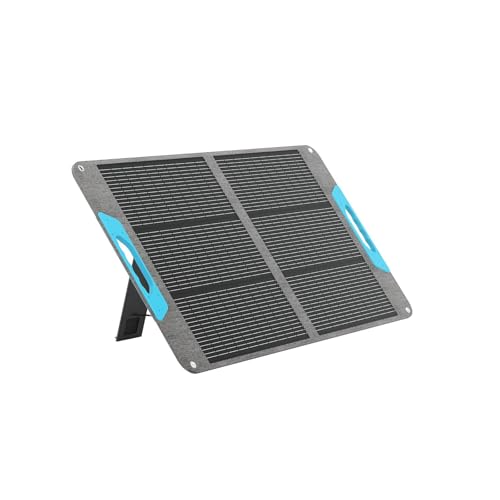
The REGO's case is the warranty and the ports. Renogy covers materials for 2 years and output for 12 — guaranteeing at least 80% of rated power — which is a longevity promise nothing else on this list matches at 124.99 dollars as of July 2026. Owners back the paper up: reviews of Renogy's portable panels repeatedly describe them as well-built and efficient, with users reporting panels that kept their batteries topped up even on cloudy off-grid days.
Practical details are strong for a van or vehicle base: Grade A cells under an ETFE surface rated up to 23.5% efficiency, four mounting holes plus buckles and Velcro straps for lashing to a roof rack or tree, a magnetic closure, and a solar connector output alongside USB-C and two USB-A ports for direct device charging. The one honest limitation is IP65 splash resistance — fine for drizzle and dust, not for prolonged soaking — so it comes inside when real weather arrives.
FlexSolar 100W — Budget Pick
At 81.99 dollars as of July 2026 and 4.1 lbs, the FlexSolar is the panel for nomads who carry their office on their back. It folds to 12.99 x 10.43 x 2.17 inches — genuinely laptop-sized — and OutdoorGearLab rated it the lightest panel in its test group, measuring about 70W of real charging output, which is exactly the 70% derate our sizing rule assumes. The included 2m 4-in-1 cable (XT60, Anderson, DC5521, DC8MM) connects to Jackery, EcoFlow, Bluetti, Anker, and most other stations without adapter shopping.
It also moonlights as a direct charger — QC3.0 USB-A at 18W and PD3.0 USB-C at 45W — which pairs naturally with a big USB-C power bank for fly-first nomads; our guide to choosing the biggest power bank for your phone and laptop covers that battery side. Trade-offs: no kickstand, so you prop it against a pack or hang it by the included carabiners, and reviewers note output depends heavily on how carefully you aim it.
Jackery SolarSaga 200W — Best for Full Workweeks
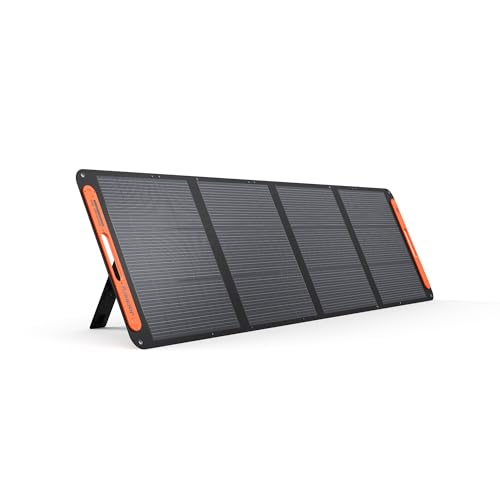
If your Starlink workday runs every day, this is the panel that makes the math comfortable. Its bifacial IBC cells reach up to 26.7% conversion efficiency per Jackery — the highest rating in this guide — and real-world numbers back it up: a 90-day hands-on review measured 175-195W in typical conditions and 200W+ in ideal sun, while one owner logged 320W from a pair of panels under clear midday sun — right around the 80% derate our sizing rule assumes. That puts a realistic day at 600Wh+ in decent conditions: a full workday banked, with margin. Reviewers describe top-tier build quality and setup in about 10 seconds via the ergonomic handle.
Know its two constraints. First, station pairing: it is built for the Jackery Explorer 1000 Plus, 2000 Pro, 2000 Plus, and 3000 Pro — if you run another brand, the SOKIOVOLA below is the flexible choice. Second, weight: one long-term review weighed it at 18.3 lbs, and like any large propped panel it needs anchoring when the wind picks up. This is a van-and-basecamp panel, not a backpack panel. The included 9.8 ft cable is not weatherproof, so route it accordingly. IP68 sealing on the panel itself, a -4°F to 149°F operating range, and a 5-year warranty round out a serious tool at 379 dollars as of July 2026.
SOKIOVOLA N-Type 200W — Budget 200W
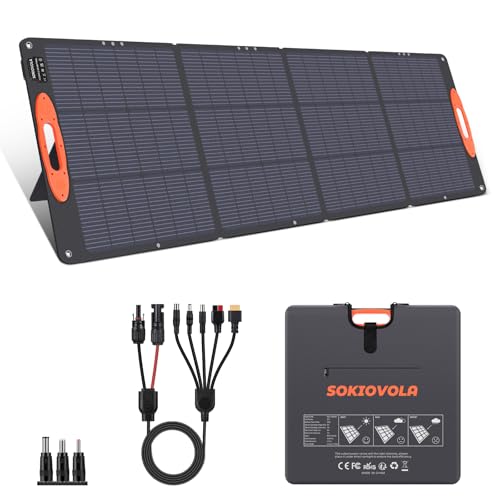
Half the price of the SolarSaga 200W — 189.99 dollars as of July 2026 — and the most universal connector story on this list: an MC-4 to 5-in-1 set (XT60, DC5521, DC7909/8mm, DC8020, Anderson) that plugs into most stations from Jackery, EcoFlow, Bluetti, Goal Zero, and Anker, plus a 10.49 ft extension cable for chasing sun away from your parked shade. The N-type monocrystalline cells are rated up to 25% efficiency by the maker — and to SOKIOVOLA's credit, its own documentation is upfront that real-world delivery of 70-90% of rating is normal for any portable panel.
The compromises are what you would expect at the price: a 12-month warranty against Jackery's 5 years, and 16.31 lbs that the maker itself flags as heavy for backpacking. Two setup notes: check your power station's maximum solar input before pairing any 200W panel, and treat the IP68 rating as storm insurance rather than an invitation — with any folding panel, connectors and cable junctions are best kept out of sustained rain. For van lifers on a budget who want workweek-scale harvest without a brand lock-in, it is the value play.
Jackery SolarSaga 40W Air — Ultralight Pick
Let us be precise about what 40W buys: this is a trickle-charging panel for phones, headlamps, and power banks — by our workday math it cannot sustain a Starlink Mini day on its own, and Jackery does not pretend otherwise. What it does brilliantly is exist everywhere: 1.98 lbs, folded to book size, hung off a pack or tent by its carabiners and four-corner mounting holes, quietly refilling a power bank while you hike to the next work spot. Early reviewers call it thin, light, and genuinely stylish — one described it as a stealth camper's dream on a rooftop or backpack.
The engineering is not budget-grade despite the size: bifacial PERC cells at 23% efficiency, dual USB ports spreading 40W across up to three devices, IP68 sealing, a -4°F to 149°F operating range, and IEC TS 63163 Class I certification including the same 4,000-fold test as its bigger sibling. At 109 dollars as of July 2026, buy it as the supplement that keeps small electronics off your main battery — never as your primary harvest.
When a Foldable Solar Panel Is the Wrong Tool
Solar is not always the answer, and pretending otherwise sells panels, not workdays.
- You drive most days. A vehicle's alternator via a DC-DC charger typically refills a battery faster during a normal driving day than a folding panel manages in camp, which is why our van life internet setup guide treats alternator charging as the primary input and solar as the parked-for-days backup. Roof space is finite; plan both together.
- You fly between bases. Panels fly fine, but the power stations they feed mostly do not — and a folded 200W panel is 16-18 lbs of checked weight. Fly-first nomads are better served by a sub-100Wh power bank topped up from cafés, with a light panel like the FlexSolar or 40W Air as emergency insurance.
- Your weather is genuinely bad. In a region averaging 3 peak sun hours, even a 200W panel yields a marginal workday. Budget for a bigger battery and grid top-ups instead of more glass.
How to Get More Watt-Hours Out of Any Panel
- Chase the angle. Face true south (Northern Hemisphere) and tilt to roughly your latitude — 30-45 degrees across most of the US, per EcoFlow's angle guide — and re-aim two or three times a day. Aiming is free wattage.
- Protect the midday window. The hours around solar noon deliver the bulk of your harvest; set up before your first call, not after lunch.
- Keep cells cool. Heat costs 0.3-0.5% of output per degree Celsius above the 77°F test standard, per EcoFlow — prop panels for airflow underneath rather than laying them flat on hot ground.
- Exploit bifacial backsides. Set bifacial panels (both SolarSagas here) over light, reflective ground; independent testing measured 5-8W of bonus harvest from backside reflection.
- Eliminate partial shade. A guy line's shadow across one cell string hurts far more than it should — up to 75% output loss in bad cases, per research cited by Aurora Solar.
Which Portable Solar Panel Should You Buy?
- Most remote workers with a compatible station: Jackery SolarSaga 100W Air — the best real-output-per-pound on the list.
- You own an Explorer 300, or want the longest warranty: Renogy REGO 100W — 12 years of guaranteed output.
- Backpack office, tightest budget: FlexSolar 100W — 4.1 lbs and universal cables for under 85 dollars as of July 2026.
- Daily Starlink workdays from a big Jackery station: SolarSaga 200W — workweek margin in one fold.
- Daily workdays, any station brand, half the price: SOKIOVOLA N-Type 200W.
- Phones and power banks only: SolarSaga 40W Air — the supplement, never the system.
Final Thoughts
Size the panel to the workday, not the other way around: 400-600Wh of consumption, 60-80% of rated output when aimed well, and one size bigger than the napkin math suggests. A 100W panel covers a careful workday in good sun; 200W buys you weather insurance and margin; 40W keeps your phone alive. Match the panel to your battery's input limits and connector type before you buy, and the whole system disappears into routine — sun goes in, work comes out.
The panel is one link in a chain that also includes your battery, your dish, and your backup plans. For the full system — power budgets, internet redundancy, and the gear that ties it together — start with Nomad Outfit's off-grid guide.
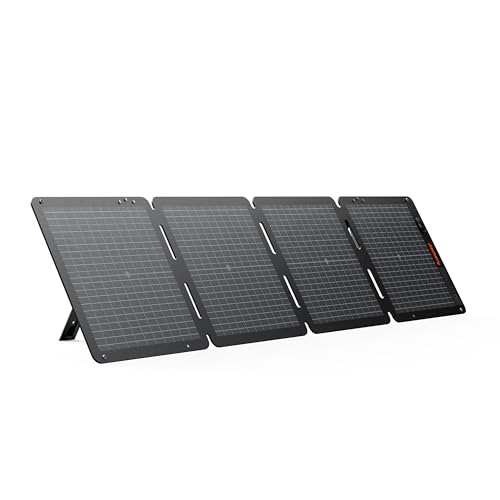
Jackery SolarSaga 100W Air Solar Panel - Best Overall Portable Solar Panel for Remote Work
Jackery SolarSaga 100W Air Solar Panel
Best Overall Portable Solar Panel for Remote Work
A bifacial 100W panel with PERC cells at 23% conversion efficiency that captures light on both sides.
A bifacial 100W panel with PERC cells at 23% conversion efficiency that captures light on both sides. At 7 lbs it is about 27% lighter than standard 100W panels per Jackery, and the W-fold design folds smaller than A2 paper, with a carrying bag included. It is IP68 water and dust rated, operates from -4°F to 149°F, and is IEC TS 63163 certified through drop, humidity, bend, and 4,000-fold tests. Dual USB ports (100W total) charge devices directly, and the integrated aluminum stand sets up in about 60 seconds.
What We Like
❝Independent testing praises how close this panel gets to its rating, with output measured near the full 100W in ideal sun, and reviewers consistently highlight the light, fast-folding design and the measurable bifacial bonus from backside reflection over bright ground.❞
Renogy REGO 100W Portable Solar Panel - Best Value Solar Panel for Power Stations
Renogy REGO 100W Portable Solar Panel
Best Value Solar Panel for Power Stations
A 100W foldable panel with Grade A cells under an ETFE surface, rated at up to 23.
A 100W foldable panel with Grade A cells under an ETFE surface, rated at up to 23.5% conversion efficiency. Alongside a solar connector output for power stations, it carries USB-C and two USB-A ports for direct device charging. IP65 splash and dust resistance handles weather short of prolonged soaking or heavy rain, while four mounting holes, a magnetic closure, and buckles with Velcro straps make vehicle or tree setups easy. Renogy backs it with a 2-year materials warranty plus a 12-year output warranty guaranteeing at least 80% of rated power.
What We Like
❝Owners repeatedly describe Renogy's portable panels as well-built, lightweight, and efficient, with several reporting they kept batteries topped up through multi-day off-grid trips even under cloudy skies.❞
FlexSolar 100W Portable Solar Panel - Best Budget Solar Panel for Remote Work

At 4.1 lbs (1.85 kg) and folding to 12.99 x 10.43 x 2.17 in — roughly laptop-sized — this is the lightest 100W panel in our lineup. It reaches up to 24% conversion efficiency, with a built-in IC chip protecting against over-voltage, over-current, and short circuits. The included 2m 4-in-1 cable (XT60, Anderson, DC5521, DC8MM) works with Jackery, EcoFlow, Bluetti, Anker, and most other power stations, while QC3.0 USB-A (18W) and PD3.0 USB-C (45W) ports charge devices directly. IP67 waterproofing with ETFE lamination, a carry bag, and carabiners complete the kit.
What We Like
❝Reviewers consistently like how small and light it packs while still feeding a power station properly, calling it an ideal panel for a hike-in mobile office and praising its strong harvest when aimed well.❞
Jackery SolarSaga 200W Portable Solar Panel - Best Solar Panel for Full Off-Grid Workweeks
Jackery SolarSaga 200W Portable Solar Panel
Best Solar Panel for Full Off Grid Workweeks
A 200W bifacial panel built on IBC cell technology with conversion efficiency up to 26.
A 200W bifacial panel built on IBC cell technology with conversion efficiency up to 26.7% per Jackery — the highest rating in this guide. It pairs with the Jackery Explorer 1000 Plus, 2000 Pro, 2000 Plus, and 3000 Pro power stations, and includes USB-C, USB-A, and DC8020 ports plus a 9.8 ft multi-function charging cable (the cable itself is not weatherproof). IP68 water and dust rated with a -4°F to 149°F operating range, it sets up in about 10 seconds with an ergonomic handle and carries a 5-year warranty.
What We Like
❝Hands-on reviewers call out superb build quality and easy setup, with long-term testing recording output close to its rating under full sun and fast charging into large Jackery stations.❞
SOKIOVOLA N-Type 200W Portable Solar Panel - Best Budget 200W Solar Panel for Power Stations
SOKIOVOLA N-Type 200W Portable Solar Panel
Best Budget 200W Solar Panel for Power Stations
A 200W N-type monocrystalline panel with conversion efficiency up to 25%, an ETFE coating, and IP68 waterproofing.
A 200W N-type monocrystalline panel with conversion efficiency up to 25%, an ETFE coating, and IP68 waterproofing. Its MC-4 to 5-in-1 connector set (XT60, DC5521, DC7909/8mm, DC8020, Anderson) covers most power stations including Jackery, EcoFlow, Bluetti, Goal Zero, and Anker, and a 10.49 ft solar extension cable and carry bag are included. At 16.31 lbs, folding to 21 x 23 in with a magnetic handle, the maker itself notes it may be heavy for backpacking. It carries a 12-month warranty and 30-day refund guarantee — check your station's maximum solar input limit before pairing.
What We Like
❝Buyers rate SOKIOVOLA panels highly overall, highlighting the sturdy ETFE build quality and the travel-friendly fold with its magnetic handle that makes a 200W panel manageable for vehicle-based setups.❞
Jackery SolarSaga 40W Air Solar Panel - Best Ultralight Solar Panel for Backpack Nomads

A 1.98 lb bifacial 40W panel — about 30% lighter than mainstream panels per Jackery — that folds down to book size. PERC cells reach 23% conversion efficiency, and dual USB ports deliver 40W across up to three devices. It is IP68 waterproof and dustproof, operates from -4°F to 149°F, and is IEC TS 63163 Class I certified including a 4,000-fold test, with carabiners and four-corner mounting holes for hanging on backpacks or tents. This is a trickle-charging tier panel: it tops up phones and power banks, but is not sized to sustain a Starlink Mini workday on its own.
What We Like
❝Early reviewers describe the Air as thin, light, and genuinely backpack-friendly — one called it a stealth camper's dream — noting it looks as good strapped to a rooftop or pack as it performs.❞
Review of Our Favorite 3
Best Overall Portable Solar Panel for Remote Work
A bifacial 100W panel with PERC cells at 23% conversion efficiency that captures light on both sides.
Best Value Solar Panel for Power Stations
A 100W foldable panel with Grade A cells under an ETFE surface, rated at up to 23.
About the Author