Best Airline-Approved Power Banks for 2027

The best airline-approved power bank for 2027 is the Anker Prime 27,650mAh, because Anker rates it at 99.54Wh: roughly half a watt-hour under the 100Wh ceiling that lets you board without asking anyone's permission. Every pack below clears that line. The limit, not the headline mAh number, is the spec that matters.
Some links on this page are affiliate links: if you buy through them we earn a commission at no extra cost to you.
Two things make this a harder purchase than it was a year ago. The International Civil Aviation Organization issued Addendum No. 1 to the 2025-2026 Edition of its Technical Instructions (Doc 9284) with an applicability date of 27 March 2026, capping passengers at two power banks and prohibiting recharging them on board. And the 100Wh line is about to stop being negotiable: IATA's guidance document for operators states that the 68th edition of the Dangerous Goods Regulations "will come into force on 1 January 2027", and that the provision letting passengers carry 100 to 160Wh power banks with operator approval "will not be carried into the 68th edition of the DGRs". The wider picture is in our guide to the 2027 carry-on and battery rules.
So shop as though 100Wh is a wall. Here is how to read that number, and the six packs we would fly with.
How to read the 100Wh limit before you buy
Airlines do not care about mAh. They care about watt-hours, and IATA's passenger guidance spells out the conversion: the watt-hour rating "is calculated by multiplying the rated capacity in ampere-hours by the nominal voltage (Wh = Ah x V)". For a power bank that means dividing the mAh figure by 1,000 and multiplying by the nominal cell voltage, which is 3.6V or 3.7V on essentially everything you can buy.
Run that in reverse and the no-approval ceiling lands at roughly 27,000mAh. At 3.7V nominal, 100Wh works out to about 27,027mAh; at 3.6V nominal it is about 27,778mAh. Above that band a pack stops being automatically acceptable anywhere.
The printed number is what gets read at the checkpoint. IATA's passenger guidance states that "all lithium-ion batteries are required to have the Watt-hour rating marked on the outside of the battery case", and warns that if staff "are unable to verify the Watt-hour rating by checking either the battery, or the user documentation, the operator may not permit the carriage of the lithium battery". British Airways' restricted and prohibited items page says the same thing from the other direction: it cannot accept a battery on board where the watt-hour rating is not shown and cannot be worked out, and it gives the conversion as the milliamp-hour figure divided by 1,000 and then multiplied by the battery's voltage.
Practical conclusion: buy a pack with the watt-hour figure printed on the case. If you are choosing mainly on capacity and charging speed rather than on compliance, our power bank buying guide for phones and laptops covers the rest of the decision.
What changed for 2027, and why the ceiling now bites
Three layers of rule stack up here, and they do not say quite the same thing.
- ICAO. The addendum applicable from 27 March 2026 requires power banks carried for personal use to be in carry-on baggage, prohibits recharging them on board, recommends that they not be used to recharge a device on board, limits each person to no more than two, and requires them to be individually protected against short circuits when not in use. The addendum text also caps lithium-ion batteries covered by the new paragraph at a watt-hour rating of 100Wh.
- IATA. IATA's operator guidance, dated 31 March 2026, goes further on capacity than the addendum does. Its passenger table lists power banks rated above 100Wh and up to 160Wh as Forbidden outright, and the document states that the 100 to 160Wh approval route "will not be carried into the 68th edition of the DGRs" taking force on 1 January 2027. The same table caps passengers at two power banks of 100Wh or less, carry-on only, with no operator approval needed.
- US regulators. The TSA's own page still uses the familiar wording: spare lithium-ion batteries, including power banks and cell phone battery charging cases, must be carried in carry-on baggage only, and lithium-ion batteries are limited to a rating of 100 watt hours per battery. FAA PackSafe guidance still describes the 101 to 160Wh route for spare batteries with airline approval, limited to two per person, and tells travellers to check with their carrier for its own restrictions.
Hedge this honestly, because the enforcement picture is uneven. IATA's own document notes that the change interacts with state sovereignty and that "for some States, it is immediate; some require a short administrative period, and some will require public notification and legislative amendment". As of October 2026 you can still find carriers that will approve a 100 to 160Wh pack. Buying one is a bet against the clearly stated direction of travel.
Why you should buy the most watt-hours you legally can
Under the ICAO addendum you cannot recharge a power bank in flight, so the charge you board with is the charge you have. IATA's passenger guidance also advises that airlines "prefer spare batteries and power banks to be at less than 25%" and that power banks "should not be stored in the overhead lockers" or recharged just before boarding and then stowed overhead.
That combination argues for one honest conclusion: if you work on long flights, the useful metric is watt-hours per dollar and watt-hours per gram under the 100Wh line, not headline mAh. A 99.54Wh pack and a 72.36Wh pack are both legal; only one of them finishes a transpacific working day. Keep the bank in your seat pocket or the bag under the seat in front of you, which means you want a carry-on with a reachable external pocket rather than something you have to unpack. Our carry-on travel backpack roundup flags which bags make that easy.
The best flight-safe power banks for air travel
Six picks, in the order we would recommend them. Capacity, output and watt-hour figures come from our October 2026 product data, and we have flagged which watt-hour numbers the maker publishes and which are our own arithmetic.
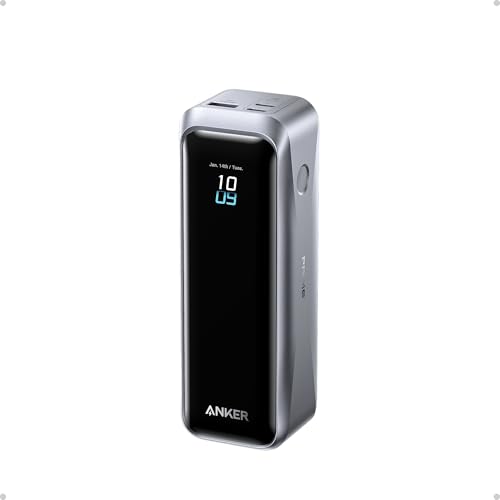
Anker Prime 27,650mAh: the most legal capacity in one brick
For nomads whose working day is the flight. Anker rates this pack at 99.54Wh, which is a maker-stated figure printed as part of the spec rather than our estimate, and that 0.46Wh of headroom is as close to the ceiling as you can responsibly buy. It delivers 250W total, with 140W available to a laptop while a tablet and phone charge alongside, and Anker's own testing claims a 16-inch MacBook Pro to 50 percent in 28 minutes. It is 179.99 dollars as of October 2026.
The reason not to buy it: you are paying the most per watt-hour of anything here, the charging base is a separate purchase, and 250W of output is wasted on anyone carrying a phone and a tablet. If 140W single-port charging is not something you will use, pick cheaper.
AsperX 27,600mAh: the best watt-hours per dollar
For nomads who want near-ceiling capacity without the Anker tax. AsperX states 99.36Wh, and describes that as the maximum capacity permitted by airlines. Output is 140W on a single port, or up to 165W split across two at 100W plus 65W, and the TFT display reports remaining battery, input and output wattage, and device temperature, which is genuinely useful when you are trying to board under 25 percent. At 89.99 dollars as of October 2026 it is half the price of our top pick for 99.8 percent of the watt-hours.
The reason not to buy it: AsperX has nothing like Anker's service record, and at this capacity you are relying on the maker's own watt-hour marking being accurate. The 24-month warranty only matters if the company is still answering email in 2028.
Anker 25,000mAh 165W: best for laptop users who hate cables
For the one-bag worker charging four things at a hotel desk. Three USB-C ports do 100W each and 165W in total, and two cables are built in: a retractable one to 2.3 ft rated for 20,000 retractions, and a 0.98 ft version that doubles as a carrying strap. Anker does not publish a watt-hour figure for this model in our data; it states only that the pack complies with the 100Wh airline restriction and is carry-on friendly. Our own calculation: 25,000mAh works out to roughly 92.5Wh at the usual 3.7V nominal, so call it about 7Wh of margin on the conservative assumption.
The reason not to buy it: built-in cables are a failure point you cannot replace, and the pack carries an 18-month warranty rather than the 24 months on the Prime models. If you prefer modularity, the separate-cable picks plus a decent tech pouch and cable organiser is the more repairable setup.
Anker Prime 20,100mAh: best compact high-output pick
For nomads charging a power-hungry laptop out of a small pack. Anker states 20,100mAh and 72.36Wh, a maker-published figure that leaves about 27.6Wh of headroom under the limit, and still manages 220W total across two USB-C ports and one USB-A. Single-port output peaks at 140W with a 5A cable, and it refills to 50 percent in 25 minutes over a 100W input. The headroom has a second use: it is the pack least likely to trigger an argument at a checkpoint.
The reason not to buy it: at 129.99 dollars as of October 2026 you are paying more than the AsperX for 27Wh less capacity. That is output money, not capacity money, and most people need capacity.
Anker 20,000mAh 87W: the default nomad pack
For most people reading this. It sends 87W across three devices and up to 65W to a single one, which Anker says takes a 14-inch MacBook Pro to 50 percent in under 40 minutes, and the built-in USB-C cable is rated for over 10,000 bends. Anker states the 20,000mAh capacity is approved for airline travel, but publishes no watt-hour figure for it in our data; our own calculation puts 20,000mAh at roughly 74Wh at 3.7V nominal. It is also the only pick here with a published size and weight in our data, at 6.2 x 2.9 x 1.0 in and 15.5 oz, and it is 69.99 dollars as of October 2026.
The reason not to buy it: 65W will not fast-charge a 16-inch laptop, and roughly 74Wh is a quarter less than the near-ceiling packs. If you run heavy gear from a battery, read our watt-by-watt guide to running Starlink Mini off a power bank before you assume a 20,000mAh pack is enough.
Anker 10,000mAh 30W: the legal second pack
For the second of the two power banks you are allowed to carry. At 4.32 x 2.58 x 0.98 in it is a phone-sized insurance policy: 30W charging, an iPhone 16 Pro Max to 50 percent in 27 minutes per Anker, about two full charges of an iPhone 15, and a 5.4-inch built-in USB-C cable tested to over 10,000 bends. Our own calculation puts 10,000mAh at roughly 37Wh at 3.7V nominal, so it is nowhere near any limit. At 25.99 dollars as of October 2026 it is the cheapest way to stop hunting for an outlet in a transit lounge.
The reason not to buy it: it does nothing useful for a laptop, and if you only ever carry one pack, this is not the one. Pair it with a bigger bank rather than treating it as your main battery. It slots neatly into our connectivity packing list.
Comparison: watt-hours per dollar under the 100Wh line
Capacity and output are from our October 2026 product data. The watt-hour column distinguishes maker-published figures from our own arithmetic at 3.7V nominal, and the last column is derived from October 2026 prices.
| Pack | Capacity | Watt-hours | Source of Wh figure | Max output | Wh per dollar (Oct 2026) |
|---|---|---|---|---|---|
| Anker Prime 27,650mAh | 27,650mAh | 99.54Wh | Maker-stated | 250W total, 140W single port | 0.55 |
| AsperX 27,600mAh | 27,600mAh | 99.36Wh | Maker-stated | 165W total, 140W single port | 1.10 |
| Anker 25,000mAh | 25,000mAh | about 92.5Wh | Our estimate at 3.7V | 165W total, 100W per port | 0.88 |
| Anker Prime 20,100mAh | 20,100mAh | 72.36Wh | Maker-stated | 220W total, 140W single port | 0.56 |
| Anker 20,000mAh | 20,000mAh | about 74Wh | Our estimate at 3.7V | 87W total, 65W single port | 1.06 |
| Anker 10,000mAh | 10,000mAh | about 37Wh | Our estimate at 3.7V | 30W | 1.42 |
Read the table as two decisions. If you need maximum legal endurance, the AsperX beats our top pick on watt-hours per dollar by roughly double and gives up 0.18Wh. If you need output rather than endurance, the Prime models cost roughly twice as much per watt-hour, and that is what you are buying.
What disqualifies a power bank at the gate
- Anything over 100Wh without approval. IATA's passenger table, in the operator guidance it dated 31 March 2026, already lists power banks above 100Wh as forbidden, and the 100 to 160Wh approval route is not being carried into the DGR edition that IATA says takes force on 1 January 2027.
- No printed watt-hour rating. IATA states the rating must be marked on the outside of the case, and that staff who cannot verify it may refuse carriage. A pack that advertises only mAh is a pack you may have to argue about.
- AC-outlet power stations. These are a different class and are mostly far above the limit. If you need mains sockets rather than USB, read our portable power station guide for remote work and plan to leave it at home or ship it.
- Damaged or swollen cells. IATA's passenger advice tells travellers to alert crew or airport staff immediately if a device is hot, smoking or damaged. A bank with a bulging case is not a boarding risk worth taking.
- No-name packs with implausible capacity claims. A 50,000mAh pack sold as airline-safe is arithmetically about 185Wh at 3.7V nominal. IATA's own guidance cites concerns about regulatory oversight of power bank manufacturers as a reason for tightening the rules.
One more thing to note: lithium battery safety bags are increasingly sold as a fix for all of this. They are not a substitute for a compliant watt-hour rating, and no rule we found treats them as one.
How many power banks can you bring
Two, for now, for most carriers. IATA's passenger table caps each person at a maximum of two power banks of 100Wh or less, in carry-on baggage, with no operator approval required, and the ICAO addendum sets the same two-unit limit. Quantity rules interact with separate limits on spare batteries and devices, and carriers count them differently, so the detail lives in our companion piece on power bank rules on planes.
Carrier policies that go further than ICAO
Several airlines are stricter than the international baseline, and the stricter rules are mostly about using the bank, not carrying it. Policies as published on each carrier's own pages and checked by us in October 2026, and this list is not exhaustive:
| Carrier | What its own policy page says |
|---|---|
| Emirates | One power bank under 100Wh; no use of any power bank on board; must be kept in the seat pocket or a bag under the seat in front of you |
| Lufthansa | Maximum 100Wh per bank and two banks per passenger; charging and using power banks on board prohibited, except for approved medical devices |
| Qantas | Use and charging prohibited in flight, including from in-seat power or USB ports; above 100Wh and up to 160Wh requires prior approval |
| easyJet | Power banks prohibited from use on board and must not be used to charge other devices; 160Wh ceiling |
| Delta | No more than two power banks per person, each not exceeding 100Wh |
| Singapore Airlines | Up to 100Wh without approval; 100 to 160Wh requires prior approval from the airline |
| Ryanair | Two power banks per passenger, counted within its overall limit of 20 spare batteries |
| British Airways | Cannot accept a battery whose watt-hour rating is not shown and cannot be worked out; gives the conversion as mAh divided by 1,000, then multiplied by the battery's voltage |
Carrier policies change without notice, and this table reflects what these airlines published as of October 2026. Check your own airline's dangerous goods or baggage page before you fly, especially on codeshares, where the operating carrier's rules apply.
What we would pack
If you want the most endurance the rules allow, buy near the line and buy a pack that prints its watt-hour rating: the Anker Prime 27,650mAh at a maker-stated 99.54Wh if budget is not the constraint, the AsperX 27,600mAh at a maker-stated 99.36Wh if it is. If you mostly charge a phone and a thin laptop, the 20,000mAh Anker at roughly 74Wh by our own calculation is the sane default, with the 10,000mAh pack as your legal second unit.
Then do the one thing that actually stops problems at the gate: board with the bank at a low state of charge, keep it in the seat pocket rather than overhead, and do not plug it into the aircraft. Before your next flight, check what the new airline battery rules allow against the bank already in your bag, and if the case does not show a watt-hour figure, replace it before it gets taken off you.
Anker Prime 27,650mAh - Best Overall Airline-Approved Power Bank

Anker Prime Power Bank (27,650mAh, 250W)
Anker Prime 27 650mAh Best Overall Airline Approved Power Bank
Anker states this pack is 99.
Anker states this pack is 99.54Wh, which puts it just under the TSA 100Wh carry-on threshold, and it delivers 250W total output: 140W to a laptop while a tablet and a phone charge alongside. Anker's internal testing puts a 16-inch MacBook Pro at 50 percent in 28 minutes, and it quotes 1.28 full charges of an M2 13-inch MacBook Air. It refills in 37 minutes at 170W total input using dual chargers, and an app reports charge status and helps locate the bank. A 0.6 m USB-C to USB-C cable and a travel pouch are in the box; the charging base is not included. Warranty is 24 months.
What We Like
❝We'd pack this one when the goal is the most legal capacity in a single brick, with enough output left over to run a laptop and two other devices off one pack. It is the heaviest and most expensive pick here, and for long-haul working days we think that is the right trade.❞
Anker 25,000mAh 165W - Best for Laptop Users

Anker Laptop Power Bank (25,000mAh, 165W)
Anker 25 000mAh 165W Best for Laptop Users
Three USB-C ports deliver up to 100W each and 165W in total, and two of the cables are built into the pack: one retractable to 2.
Three USB-C ports deliver up to 100W each and 165W in total, and two of the cables are built into the pack: one retractable to 2.3 ft and rated for 20,000 retractions, one 0.98 ft version that doubles as a carrying strap. Anker does not publish a watt-hour figure for it in our data, but states that it complies with the 100Wh airline restriction and is carry-on friendly. It charges four devices at once across the two built-in USB-C cables, one USB-A port and one USB-C port. Ships with a protective pouch and an 18-month warranty.
What We Like
❝We'd pack this one if you charge a laptop plus two or three other things and would rather not carry a cable roll, because the cables you need most are already attached. Those built-in cables are also the part most likely to fail first.❞
AsperX 27,600mAh 140W - Best High-Capacity Value

AsperX Laptop Power Bank (27,600mAh, 140W)
AsperX 27 600mAh 140W Best High Capacity Value
AsperX states this pack is 99.
AsperX states this pack is 99.36Wh and describes that as the maximum capacity permitted by airlines. It pushes 140W on a single port and up to 165W across two ports in a 100W plus 65W split, and AsperX says it takes an M4 MacBook Pro to 50 percent in 25 minutes. A TFT display shows remaining battery, input and output wattage, and device temperature. An integrated USB-C cable is joined by a 3.28 ft 240W USB-C cable in the box, with a 24-month warranty.
What We Like
❝We'd pack this one for the watt-hours per dollar: almost the same maker-stated capacity as our top pick for a lot less money, with a screen that tells you exactly where you stand. The brand has far less track record than Anker, and that is the trade you are making.❞
Anker Prime 20,100mAh - Best Compact High-Output Pick
Anker Prime Power Bank (20,100mAh, 220W)
Anker Prime 20 100mAh Best Compact High Output Pick
Anker states this pack is 20,100mAh and 72.
Anker states this pack is 20,100mAh and 72.36Wh, which leaves it well inside the 100Wh limit, and it still delivers 220W total output across two USB-C ports and one USB-A port. Single-port output peaks at 140W with a 5A cable, which Anker says takes a 16-inch M4 Pro MacBook Pro to 50 percent in 28 minutes. It recharges to 50 percent in 25 minutes over a 100W USB-C input. A 3.3 ft 240W USB-C cable and a travel pouch are included, with a 24-month warranty.
What We Like
❝We'd pack this one when output matters more than raw capacity, because 220W out of a pack the maker rates at 72.36Wh leaves a lot of headroom under the limit. You are paying a premium for wattage most nomads will rarely draw.❞
Anker 20,000mAh 87W - Best Value

Anker Power Bank (20,000mAh, 87W, built-in USB-C cable)
Anker 20 000mAh 87W Best Value
This pack spreads 87W across three devices and sends up to 65W to a single one, which Anker says takes a 14-inch MacBook Pro to 50 percent in under 40 minutes.
This pack spreads 87W across three devices and sends up to 65W to a single one, which Anker says takes a 14-inch MacBook Pro to 50 percent in under 40 minutes. Anker states the 20,000mAh capacity is approved for airline travel but does not publish a watt-hour figure for it in our data. The built-in USB-C cable is rated for over 10,000 bends, and a 65W charger refills the pack in about 1.5 hours. It measures 6.2 x 2.9 x 1.0 in and weighs 15.5 oz, with an 18-month warranty.
What We Like
❝We'd pack this one as the default nomad brick: it is the only pick here that comes with published dimensions and weight in our data, and 65W covers most thin-and-light laptops. It will not fast-charge a 16-inch machine.❞
Anker 10,000mAh 30W - Best Ultralight Second Pack

At 4.32 x 2.58 x 0.98 in, this is small enough to be the second pack you are allowed to carry rather than a bag penalty. It does 30W fast charging, which Anker says takes an iPhone 16 Pro Max to 50 percent in 27 minutes, and quotes about two full charges of an iPhone 15. The 5.4-inch built-in USB-C cable is tested to over 10,000 bends, and charging is bi-directional at 30W with up to 20W input. Warranty is 18 months.
What We Like
❝We'd pack this one as the second of the two power banks you are allowed, because it buys phone insurance for almost no weight. It will not do anything useful for a laptop.❞
Review of Our Favorite 3
Anker Prime 27 650mAh Best Overall Airline Approved Power Bank
Anker states this pack is 99.
Anker 25 000mAh 165W Best for Laptop Users
Three USB-C ports deliver up to 100W each and 165W in total, and two of the cables are built into the pack: one retractable to 2.
AsperX 27 600mAh 140W Best High Capacity Value
AsperX states this pack is 99.
About the Author