Airport Liquid Rules in 2027: Why They Now Depend on Where You Fly From
The short answer
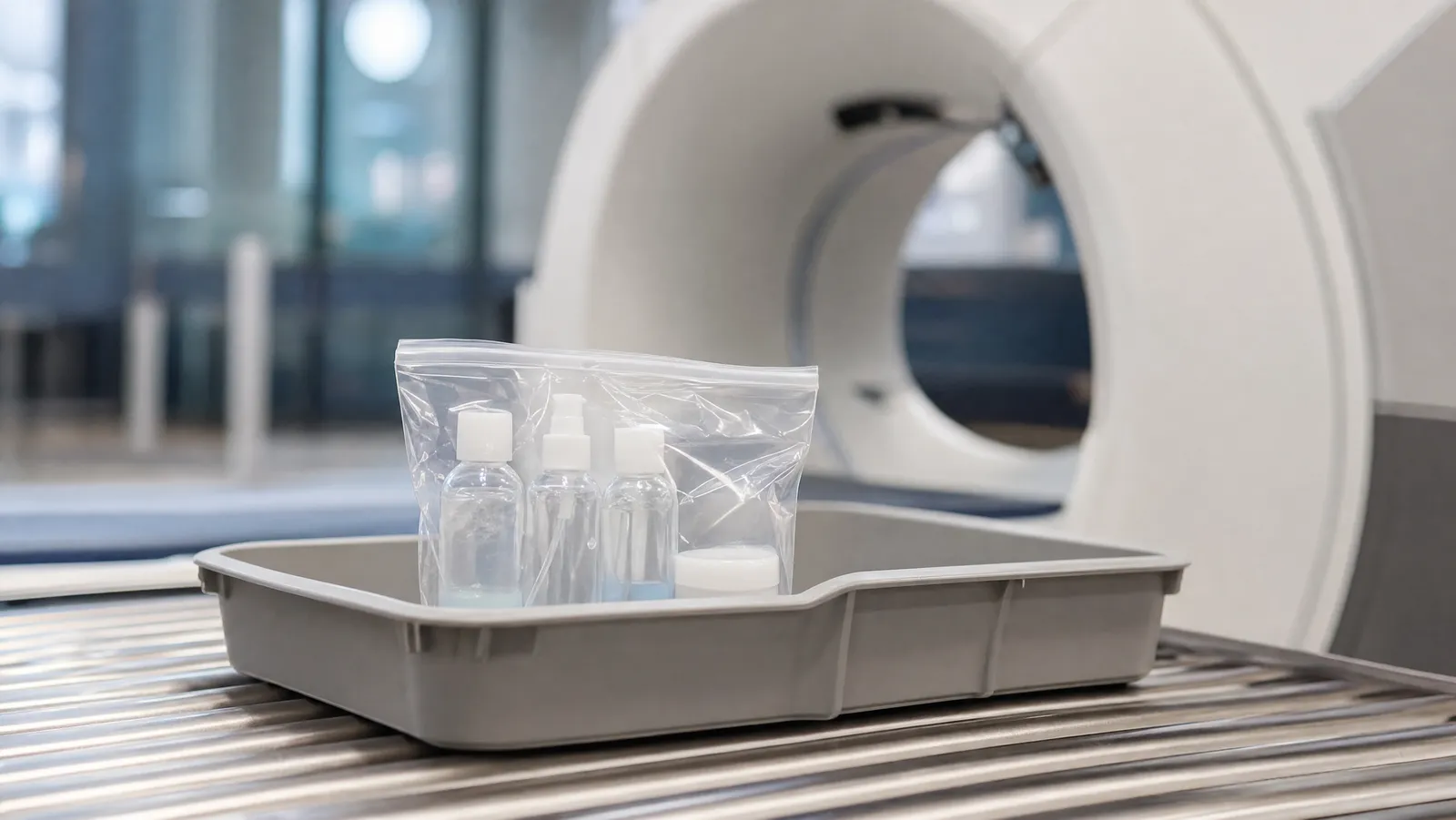
There is no single number any more. Airport liquid rules in 2027 depend on where you board: most checkpoints still cap hand-luggage containers at 100ml, a minority fitted with certified CT scanners allow up to two litres per container, and the limit that binds you is the one at your departure airport — not your airline's policy, not your destination's rules, not your nationality.
The UK government puts it plainly on its own hand luggage page: "The rules for carrying liquids in your hand luggage depend on the airport," and it tells travellers to check the departure airport, any connections and the return leg. For everything else that moved in the cabin this year — batteries, bag sizes, screening lanes — start with our guide to airline carry-on rules.
Why the 100ml limit existed in the first place
The cap is an artefact of August 2006. MI5's own case summary records that three men who plotted in 2006 to blow up aircraft in flight between the UK, America and Canada using liquid explosives were jailed for life; prosecutors alleged at trial that the explosives were to be disguised as 500ml bottles of Oasis or Lucozade, with food dye added to match the drinks' colour. The UK Department for Transport describes the response in its own words: the liquids rules "were introduced in 2006 following a terrorist threat" and "have been designed to stop those with hostile intent carrying liquid explosives onto planes."
The limit was never about liquids being dangerous. It was about old X-ray machines not being able to see inside a bottle: flat X-ray images cannot resolve a bottle's contents, so capping the container capped the damage instead. Computed tomography reconstructs a three-dimensional volume and can characterise a sealed container's contents, so the volume cap stops doing useful work.
The rule belongs to the airport, not to you
This inverts how every other cabin rule works. Your baggage allowance follows your ticket; your battery allowance follows your carrier; your liquid allowance follows the building you are standing in, because screening is run by the airport operator under its national authority's approval.
A one-litre bottle of contact lens solution that clears Dublin on the way out can be taken off you at Amsterdam on the way back, and neither checkpoint is being inconsistent. Heathrow says as much on its own hand baggage page: the two-litre allowance applies at Heathrow, and many airports outside Heathrow still have a 100ml limit. Destination can matter too: Heathrow notes that containers over 100ml cannot be taken on flights to Australia, and Aeroporti di Roma applies the old 100ml procedure at Fiumicino to flights bound for the USA or Israel. The limit can differ between two queues in one building.
How Europe ended up with a patchwork
The timeline matters, because the web is full of 2024 snapshots presented as current.
- December 2022. The UK Department for Transport announced that the 100ml limit "will be extended to 2 litres," and said airports had "until June 2024 to upgrade their screening equipment and processes."
- July 2024. The European Commission announced on 31 July 2024 a temporary, precautionary restriction on C3 explosives-detection systems for cabin baggage, which returned the 100ml cap from 1 September 2024 at EU airports that had lifted it. Euronews, reporting on 23 August 2024, said a Commission technical report found the scanners' software "cannot guarantee their reliability for containers with a content of more than 330 millilitres."
- July 2025. The Commission reversed course. TravelMole reported on 1 August 2025 that on 29 July the Commission announced airports "will be allowed again to reintroduce high-tech scanners," and quoted Commission transport spokesperson Anna-Kaisa Itkonen putting the approval at "700 scanners across 21 member states."
The detail most coverage drops is the decisive one. Per that same report, each scanner manufacturer must still submit its equipment for individual certification, and until all brands are approved the Commission is leaving it to each airport authority to decide whether to lift the 100ml restriction.
That is still the position as of 3 November 2026: we found no announcement from the Commission, the UK Department for Transport or the TSA lifting the limit across the board. What exists instead is a per-airport, sometimes per-terminal map that moves as equipment clears certification — and Which? reported on 23 January 2026 that the UK roll-out was "running several years behind schedule."
Airport liquid rules by jurisdiction, checked November 2026
| Airport or jurisdiction | Limit per container | Clear bag required? | Source we checked |
|---|---|---|---|
| Heathrow, Terminals 2, 3, 4 and 5 | Up to 2 litres | No | Heathrow's own page |
| Dublin Airport | Up to 2 litres, no limit on item count | No | Dublin Airport's own security page |
| Rome Fiumicino, Terminals 1 and 3 | Up to 2 litres, except flights to the USA or Israel | No, on C3 lanes | Aeroporti di Roma's own page |
| Manchester Airport | 100ml | No | Manchester's own page, updated April 2026 |
| Amsterdam Schiphol | 100ml | Yes, one resealable bag of about 1 litre | Schiphol's own liquids page |
| United States, all checkpoints | 3.4 oz / 100ml | Yes, one quart-sized bag | The TSA's liquids rule page |
| UK, general position | Depends on the airport | Depends on the airport | GOV.UK hand luggage restrictions |
Checked November 2026. Airport and terminal policies change without notice — read your departure airport's own security page before you fly, and the one for your return leg. We built this from airports' own pages, not aggregator lists, which contradict each other on Gatwick, Bristol and Manchester.
The United States has not moved
On US routes, 3-1-1 is still the only rule. The TSA's liquids rule page, read on 3 November 2026, states that carry-on liquids "are limited to travel-sized containers that are 3.4 ounces (100 milliliters) or less per item," carried in a quart-sized bag, with exemptions for medications and infant and child nourishments. Anything that alarms during screening, it warns, gets additional screening.
CT is being deployed there too, but it buys convenience rather than capacity. A TSA press release dated 13 July 2026 about a new installation at Juneau states that "passengers using these machines are permitted to leave their laptops and other electronic devices in their carry-on bags" and that "passengers screened in security lanes with CT units do not need to remove their travel-sized 3-1-1 liquids." Read that precisely: the CT lane removes the unpacking, not the limit.
A change has been hinted at for over a year without arriving: The Hill reported in July 2025 that Homeland Security Secretary Kristi Noem told the Hill Nation Summit "the liquids, I'm questioning" and "that may be the next big announcement is what size your liquids need to be." Nothing has been published since.
Do you still need a clear liquids bag?
Increasingly not — but the bag and the limit are separate rules, relaxed at different times and in different places.
- Limit lifted, bag gone. Heathrow says containers of up to two litres "can stay inside your cabin bag"; Dublin Airport states that "liquids and gels no longer need to be packed inside clear plastic bags."
- Bag gone, limit kept. Manchester Airport's page says "liquids under 100ml no longer need to be in a plastic bag and can be left in your hand luggage," while containers over 100ml "cannot go through Security even if the container is only part full."
- Both kept. Schiphol asks for all liquids, gels, creams and aerosols in one transparent resealable bag of about a litre, one per person, each container 100ml or less. The TSA's quart-sized bag requirement is unchanged.
Where a UK airport still asks for a bag, GOV.UK describes it as one transparent resealable bag of no more than a litre per person.
Medication, baby food and medical liquids
These exemptions survived every version of the rule in every jurisdiction we checked. They are the one part of this subject that is not a patchwork.
GOV.UK states that liquids up to two litres are allowed through security at all UK airports where they are for essential medical purposes, a special dietary requirement, or are baby food or baby milk. Heathrow adds that liquid medicines can go in your cabin bag, that above two litres you should bring a prescription or doctor's letter, and that breast milk must be liquid rather than frozen and not in metal or insulated containers. Schiphol's exemption covers medicines with a doctor's certificate and baby food for travellers with a child under two, and the TSA's two exemptions from 3-1-1 are medications and infant and child nourishments.
The procedure everywhere is to declare, not hide: keep exempt items separate and say so before your bag enters the machine.
Duty-free, STEBs and the transfer trap
Buying a litre of gin after security does not make it a cabin liquid. It makes it a sealed item with paperwork, and the paperwork is what fails at a connection.
GOV.UK's rule is that duty-free liquids bought at an airport or on a plane can pass security if they were sealed in a security bag at purchase with the receipt sealed inside and visible, and it adds the line that catches people: "You must not open the security bag until you reach your final destination." The mechanism has an official name: ICAO's guidance on security controls for liquids calls it a Security Tamper Evident Bag, or STEB. Heathrow's own page is looser — it says you can usually take liquids bought after security onto your flight, including drinks, fragrances and cosmetics over 100ml, and reserves the STEB wording for powders on US-bound flights.
The US version is stricter on timing. The TSA permits duty-free liquids over 3.4 oz only if they were bought internationally on a trip connecting to the US, are in a retailer-sealed transparent tamper-evident bag, and carry an original receipt from a purchase "made within 48 hours."
The trap has three jaws: a bag opened to show someone the bottle, a receipt no longer inside the seal, or a connection rescreened more than 48 hours after purchase. Transit passengers have one more problem: transfers from some non-Schengen origins may fall outside one-stop security arrangements, so check the rules with your airline before you buy.
What else now stays in the bag
The scanners that lifted the liquid cap also changed what you unpack, and the two get confused. Heathrow's instruction is "leave laptops, tablets and other large electronic devices in your bag." Manchester, which still enforces 100ml, also lets electrical items stay in hand luggage — proof the two rules are independent. Whether you end up taking laptops out at security in 2027 depends on the lane, which we will cover separately.
One smaller trap: Heathrow asks that reusable metal or insulated bottles be emptied before security and refilled after, and Schiphol says the same about drink bottles. Batteries are a separate regime with their own thresholds — see our notes on flying with spare batteries and on power bank carriage and in-flight use.
How to pack for the patchwork
One rule survives all of the above: pack to the 100ml standard and treat a two-litre allowance as a bonus at one end of the trip.
- Decant everything, and check the container itself is 100ml or less — Manchester Airport's page specifies that a part-full larger bottle fails, and Schiphol caps each container at 100ml. That is the logic behind our toiletry bag guide.
- Keep liquids in one pouch near the top of the bag. At a 100ml checkpoint you hand it over in one movement; at a CT lane you never open the bag. That is also how we approach organising a nomad backpack, and packing cubes keep the pouch reachable.
- Check both ends of the trip on the airports' own pages, and assume the return may be stricter.
- Buy the big bottles at your destination. A litre of shampoo weighs 1kg, a large slice of a cabin weight allowance under carry-on size limits by airline.
- Budget time at the checkpoint you do not know. New scanners do not guarantee short queues, and on EU routes border formalities can cost more time than screening — see EES border queues at airports.
The bottom line
As of 3 November 2026 there is no universal airport liquid limit. The 100ml cap is still the default — it applies at every US checkpoint per the TSA's own page, and at hubs including Amsterdam Schiphol and Manchester per theirs — while Heathrow, Dublin and Rome Fiumicino publish a two-litre allowance on certified CT lanes.
None of that is stable. The Commission has handed the decision to individual airport authorities pending per-manufacturer certification, so the map will keep changing without an announcement that reaches travellers. Pack to 100ml and read your departure airport's own page before each flight.
For the rest of the cabin — battery limits already in force, the EU hand-luggage reform that is approved but not yet applied, and what airlines actually measure at a gate — see our complete 2027 carry-on rules guide.
Frequently Asked Questions
Can I take a 500ml bottle through airport security in 2027?
Only at an airport that has published a larger allowance. Heathrow permits containers of up to two litres at Terminals 2, 3, 4 and 5, and so does Dublin Airport. At Manchester, Schiphol and every US checkpoint it is refused: Manchester's page states that containers larger than 100ml fail even when only part full.
Which airports have scrapped the 100ml rule?
There is no reliable central list. We verified three from their own pages in November 2026: Heathrow, Dublin and Rome Fiumicino. Which? reported in January 2026 that Heathrow, Edinburgh, Birmingham, Gatwick, Bristol and both Belfast airports had lifted it. Check the airport's own page; aggregator lists go stale within weeks.
Do I still need a clear plastic bag for liquids?
It depends on the airport, and it is a separate question from the size limit. Heathrow, Dublin and Manchester no longer require one. Schiphol still asks for one transparent resealable bag of about a litre per person, and the TSA still requires a quart-sized bag. GOV.UK says you do not have to use a bag at all airports.
Does the US 3-1-1 rule still apply?
Yes. The TSA's liquids rule page, read on 3 November 2026, still limits carry-on liquids to containers of 3.4 ounces or 100ml or less in a quart-sized bag. Homeland Security Secretary Kristi Noem said in July 2025 that liquid sizes might be the next announcement, but nothing has followed. CT lanes let you leave 3-1-1 liquids in the bag; they do not raise the limit.
What happens to duty-free liquids on a connecting flight?
They travel on the strength of the sealed bag, not the liquid rules. GOV.UK requires the security bag to be sealed at purchase with the receipt visible inside, and says you must not open it until your final destination. For liquids over 3.4 oz entering the US, the TSA also wants a receipt from a purchase made within 48 hours.
About the Author